Bridging Systems and Intelligence: Ontologies, Semantic Layers, Data Products, and UDP 2.0 in BFSI
An enterprise can expose every API and database view across its core systems and still lack a coherent, unified model of its own business. In Banking, Financial Services, and Insurance (BFSI), institutions typically operate across fragmented silos: a CRM tracking client relationship, a Core Banking ledger maintaining accounts, an ERP managing financial entries, and a Policy Administration System (PAS) handling claims processing.
When C-suite executives evaluate artificial intelligence to unlock sustainable operating leverage, a fundamental question often brings the room to a standstill: How do we transition from fragmented pilots to an AI-Native operating model without risking core stability? Before autonomous AI agents or large language models (LLMs) can safely reason across these boundaries, the architecture must establish explicit business meaning, cross-system identity resolution, and authoritative source tracking without forcing an expensive, high-risk core replacement migration.
1. Concrete BFSI Scenario: The Execution Breakdown
Consider a Relationship Manager (RM) in commercial banking asking an AI Agent:
"Identify all high-risk corporate accounts in APAC, aggregate their total credit exposure, and trigger a priority credit committee review for those exceeding $10M."
While an LLM understands standard English and raw SQL syntax, it has zero innate understanding of what "high-risk", "credit exposure", or "priority review" means within this specific bank's risk framework:
Is a corporate account "high-risk" based on liquidity ratios, credit rating downgrades, or open risk compliance tickets?
Does "total credit exposure" sum drawn facilities only, or does it include undrawn commitments and derivatives mark-to-market?
How does the system map the corporate parent entity across Salesforce, Core Banking, and Trade Finance systems?
Without deterministic grounding, the agent will hallucinate joins, miscalculate exposure, or invoke unauthorized state mutations.
2. Defining the Core Concepts via Operational Separation
To solve this, the architecture splits responsibility between the Ontology, the Knowledge Graph, and the Semantic Layer:
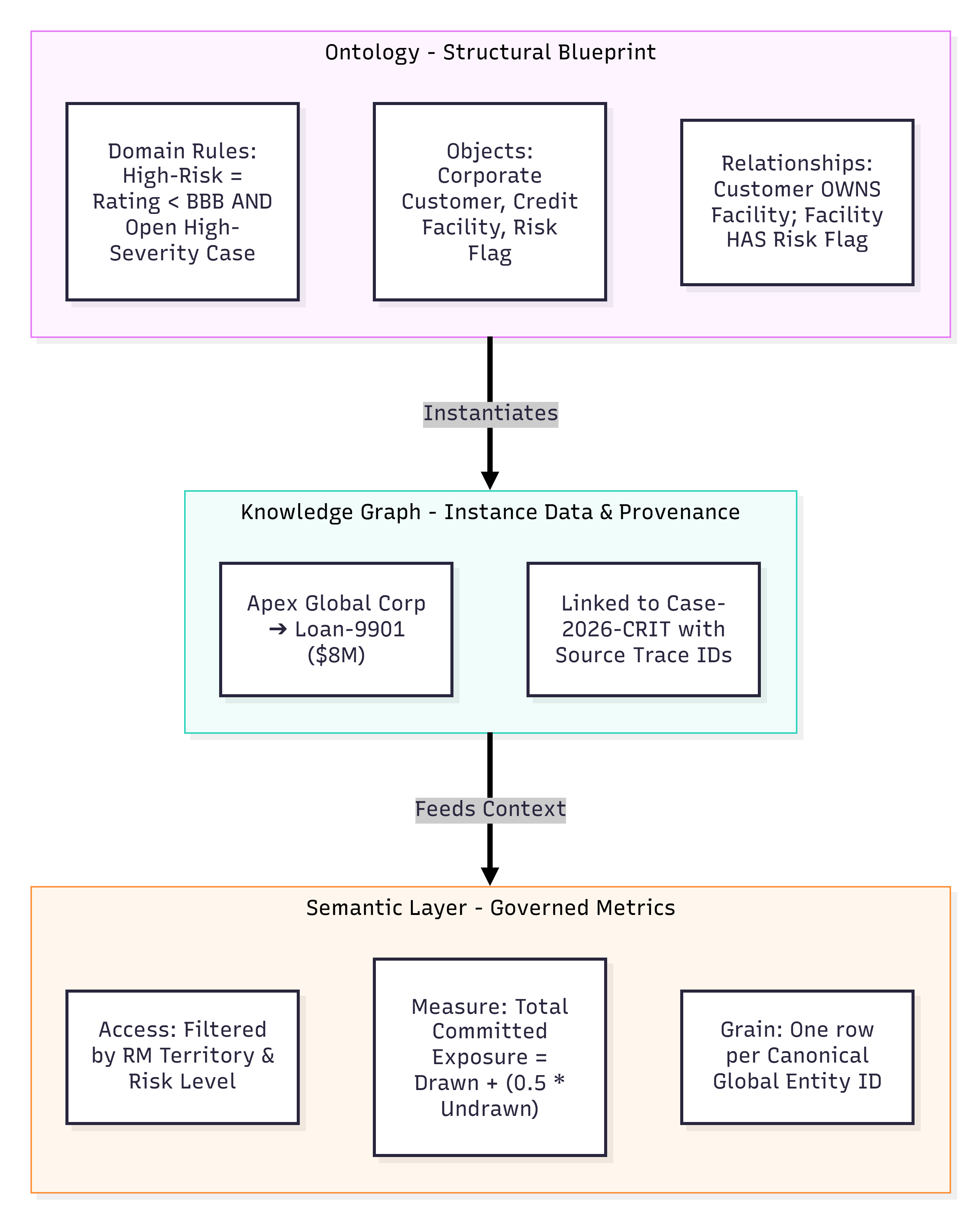
The Ontology (Governs Domain Meaning & Rules)
The ontology is the machine-readable structural blueprint of the business. Think of it as the class definition in object-oriented programming.
Objects: Corporate Entity, Credit Facility, Risk Incident, Underwriting Delegate.
Relationships: A Corporate Entity holds Credit Facilities; an Incident impacts a Facility.
Business Rules: An account is classified as "high-risk" when its internal credit score drops below investment grade and an open high-severity risk incident has been active for over 7 days.
The Knowledge Graph (Stores Real Instance Data)
If the ontology is the class definition, the Knowledge Graph (KG) is the instantiated object in memory containing actual records.
Instance Mapping: Apex Holdings (Global ID: ENT-8891) ---> 3 Subsidiary Accounts ---> 4 Active Facilities.
Traceable Links: Keeps explicit reference pointers to the underlying core banking ledger and risk system records, ensuring every link is audit-traceable back to its source of evidence.
Agent Traversal: The AI agent follows graph edges to gather exact context without querying raw tables.
The Semantic Layer (Governs Calculation & Measurement)
The semantic layer provides governed, repeatable calculations. It does not select which accounts to escalate, nor does it send notifications or execute state changes.
Measures: Total Exposure = Drawn Balance + (Undrawn Commitment * Credit Conversion Factor)
Dimensions: Risk Band, Geography, Fiscal Quarter.
Grain & Access: Aggregates at the canonical Global Entity ID while enforcing row-level security so RMs only see entities within their assigned coverage list.
3. Integrating Ontologies and Semantic Layers within Data Models, MDM, Data Products, and UDP 2.0
To build a modern Unified Data Platform (UDP 2.0) or decentralized Data Mesh, organizations must align ontologies and semantic layers alongside foundational data architectures rather than treating them as isolated components:
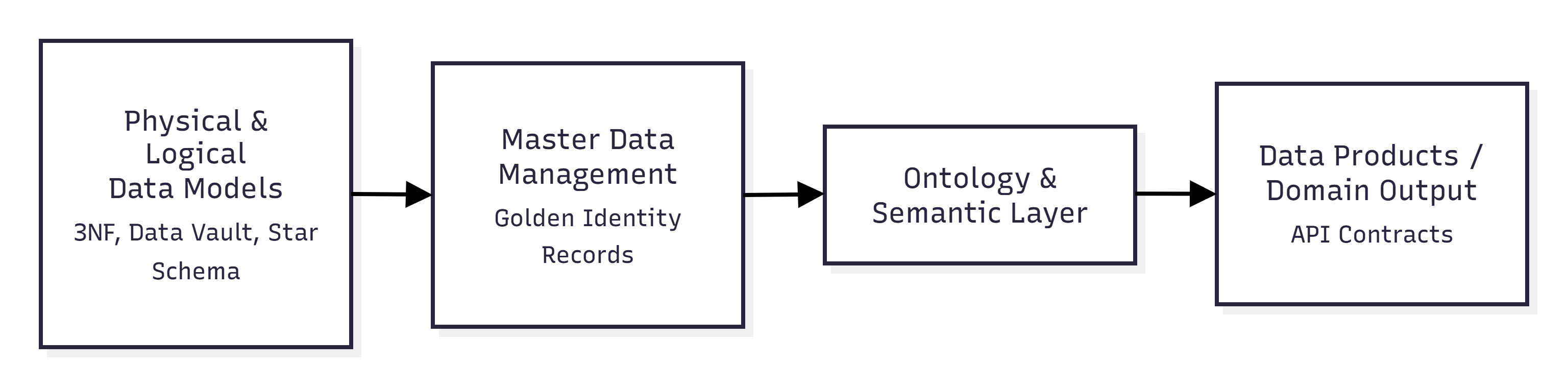
Physical and Logical Data Models (3NF, Data Vault, Star Schema): Establish the underlying structural table schemas, foreign keys, and storage layouts optimized for transaction processing (OLTP) or analytical querying (OLAP). They supply the raw relational foundation.
Master Data Management (MDM): Resolves duplicate entities across disparate systems to produce a single, deduplicated Golden Record for core master entities (such as mastering a Party/Customer or Financial Product). MDM feeds reliable entity IDs upward.
Data Domains and Data Products: Form the organizational and technical boundaries under a Data Mesh paradigm, where domain teams own, package, and expose clean dataset APIs with strict service-level agreements (e.g., Credit Risk Data Product, Claims Analytics Data Product).
Unified Data Platform 2.0 (UDP 2.0): Represents the modern cloud data architecture (Lakehouse combined with Data Mesh) that unifies real-time streaming (Pub/Sub, Kafka), analytical engines (BigQuery, Databricks, Snowflake), and operational APIs into a cohesive, federated ecosystem.
Architectural Layer Interoperability
Architectural Layer | Core Responsibility | Primary Output | Relationship to AI Agents |
Physical Data Model | Storage layout and relational constraints | Relational tables, views, indexes | Provides database schema for raw SQL execution. |
MDM | Entity deduplication and golden record creation | Unique Golden Customer/Entity ID | Guarantees agents point to verified, canonical records. |
Data Product | Domain-owned, API-packaged data asset | Governed endpoints / Delta shares | Serves clean, SLA-backed inputs to agent tools. |
Ontology and Graph | Relationship topology and domain logic | Knowledge Graph (RDF/OWL/Nodes) | Supplies agents with reasoning paths across domains. |
Semantic Layer | Standardized metric calculations | Versioned YAML metric models | Ensures agents use verified math (e.g., Net Exposure). |
4. Azure and Google Cloud Technology Stack Mapping
Building these layers requires combining cloud-native metadata engines, graph databases, and semantic tooling across Microsoft Azure and Google Cloud (GCP):
Layer | Microsoft Azure Stack | Google Cloud (GCP) Stack | Open Source / Neutral Tools |
UDP 2.0 and Storage | Azure OneLake / Microsoft Fabric | BigQuery Lakehouse / Dataplex | Apache Iceberg, Delta Lake |
Data Products and Mesh | Microsoft Fabric Data Products | GCP Dataplex Data Products | Amundsen, DataHub |
Master Data Management | Profisee (Microsoft Strategic Global Data Partner, Fabric-native MDM) / CluedIn | Tamr / Reltio on GCP | No mature OSS MDM equivalent exists; most institutions rely on commercial tools |
Ontology and Knowledge Graph | Azure Cosmos DB (Gremlin API) / Fabric Graph (preview) | Spanner Graph (GA, native GQL) / Neo4j on GCP | Protégé, Apache Jena, Neo4j |
Semantic Layer and Metrics | Power BI Semantic Models / Fabric Metrics | Looker (LookML) / Cube on BigQuery | dbt Semantic Layer, Cube.js |
AI Agent Interface | Azure AI Foundry Agent Service / Azure API Management AI Gateway | Vertex AI Agent Engine (rebranding toward Gemini Enterprise "Agent Search") | Model Context Protocol (MCP) |
5. Who Defines It and What Tools to Use?
Governance requires collaboration across Domain SMEs (Risk/Underwriters), Enterprise Data Architects, and Data Engineers:
For Ontologies and Knowledge Graphs:
Protégé: Open-source ontology editor for domain experts to define classes, properties, and OWL/RDF rules.
Apache Jena / RDF4J: Frameworks for managing semantic web triples and SPARQL endpoints.
Neo4j / NetworkX: Graph engines for modeling cross-system identity and entity relationships.
For Semantic Layers and Metrics:
dbt Semantic Layer / Cube.js: Frameworks for defining version-controlled metrics, dimensions, and caching models over data warehouses.
Atlan / DataHub: Active metadata platforms bridging ontologies, data products, and metric definitions.
6. Open-Source Availability and Ecosystem Tools for BFSI
For financial institutions looking to avoid vendor lock-in, a robust open-source and standards-compliant technology stack exists across all layers:
Ontology & RDF Standards: W3C standards including OWL (Web Ontology Language) and RDF/RDFS managed via open-source toolkits like Apache Jena.
Knowledge Graphs & Graph Storage: Neo4j Community Edition and NetworkX for executing graph traversals and resolving identity links locally or in private clouds.
Semantic Metrics & Abstraction: dbt Core combined with open semantic specifications for version-controlling business calculations and dimensions as code.
Metadata & Lineage Catalogs: DataHub and Amundsen for open-source enterprise data discovery, lineage tracking, and ontology-to-asset mapping.
7. The Four Architectural Obligations
When designing an ontology and semantic layer for BFSI, the architecture must honor four absolute pillars:
Preserve Meaning: Explicitly define entities, attributes, and ownership. A CRM Account, a Core Banking Customer ID, and an Insurance Policyholder remain distinct business concepts linked via controlled relationships.
Preserve Evidence: Retain source provenance, effective dates, and data freshness alongside any retrieved fact. A cross-system answer must remain traceable back to authoritative source systems.
Choose How Data is Accessed: Query source systems in place (federated queries) where latency permits, or leverage governed materialized views and event-fed projections where workloads demand high performance.
Preserve Transaction Boundaries: Querying an ontology or semantic layer does not grant permission to mutate state. Writes must always execute behind authorized business interfaces with proper validation, approval workflows, and audit trails.
8. Operational Distinctions from AI Models
Dimension | AI Model (LLM / Neural Net) | Semantic Layer and Ontology |
Nature | Probabilistic, pattern-matching, associative. | Deterministic, symbolic, governed. |
Source of Truth | Encodes statistical weights from training data. | Points directly to authoritative systems of record. |
Mutability | Prone to hallucinations without structured context. | Enforces rigid mathematical and logical constraints. |
Role in Architecture | Perception and Generation: Interprets intent and generates text. | Constraint and Grounding: Provides guardrails, business logic, and grounding. |
9. Exposing Ontologies and Semantics to AI Models
In secure architectures, AI models do not query databases directly. Instead, the ontology, knowledge graph, and semantic layer are exposed via:
Model Context Protocol (MCP) Servers: Exposing governed ontology graphs and semantic metrics as standardized tool definitions (
get_customer_exposure,validate_loan_eligibility).Structured System Prompts / Context Injection: Translating ontology subgraphs and metric definitions into compact JSON schemas injected into the agent's working memory during task execution.
10. End-to-End Implementation Code Example
Below is a production-grade Python implementation demonstrating how to combine Ontology Rules, Knowledge Graph Traversal, and Semantic Metric Calculations for an AI Agent via a Model Context Protocol (MCP) tool design.
from typing import ClassVar, Dict, List
from pydantic import BaseModel, Field
import json

# =====================================================================
# 1. ONTOLOGY DEFINITIONS (Classes, Relationships & Rules)
# =====================================================================

class CreditFacility(BaseModel):
    facility_id: str
    drawn_amount: float
    undrawn_limit: float
    credit_conversion_factor: float = 0.5  # Illustrative default; real CCF ranges 10%-100% by facility type under Basel

class RiskIncident(BaseModel):
    incident_id: str
    severity: int = Field(..., ge=1, le=5)  # 1 = Critical
    days_open: int

class CorporateCustomer(BaseModel):
    global_entity_id: str
    company_name: str
    region: str
    internal_rating: str  # e.g., "BB+", "BBB", "AAA"
    facilities: List[CreditFacility] = []
    incidents: List[RiskIncident] = []

    # Full agency rating scale (best to worst) for ordinal comparison
    RATING_SCALE: ClassVar[List[str]] = [
        "AAA", "AA+", "AA", "AA-", "A+", "A", "A-",
        "BBB+", "BBB", "BBB-",  # Investment-grade cutoff
        "BB+", "BB", "BB-", "B+", "B", "B-",
        "CCC+", "CCC", "CCC-", "CC", "C", "D",
    ]
    INVESTMENT_GRADE_CUTOFF: ClassVar[int] = RATING_SCALE.index("BBB-")

    # ONTOLOGY RULE: Evaluates if entity meets "High-Risk" status
    def is_high_risk(self) -> bool:
        try:
            rating_index = self.RATING_SCALE.index(self.internal_rating)
        except ValueError:
            rating_index = len(self.RATING_SCALE) - 1  # Unknown rating = worst case
        has_rating_downgrade = rating_index > self.INVESTMENT_GRADE_CUTOFF
        has_critical_incident = any(
            inc.severity == 1 and inc.days_open > 7 for inc in self.incidents
        )
        return has_rating_downgrade and has_critical_incident

# =====================================================================
# 2. SEMANTIC LAYER ENGINE (Governed Metrics & Aggregations)
# =====================================================================

class BFSISemanticEngine:
    def __init__(self, customers: Dict[str, CorporateCustomer]):
        self.graph_store: Dict[str, CorporateCustomer] = customers

    def calculate_total_exposure(self, customer: CorporateCustomer) -> float:
        """
        SEMANTIC METRIC RULE:
        Total Exposure = Drawn Amount + (Undrawn Limit * Conversion Factor)
        """
        return sum(
            f.drawn_amount + (f.undrawn_limit * f.credit_conversion_factor)
            for f in customer.facilities
        )

    def process_high_risk_escalation_query(self, entity_id: str) -> dict:
        """
        Traverses Knowledge Graph, applies Ontology logic, and executes Semantic math
        for a single named entity.
        """
        customer = self.graph_store.get(entity_id)
        if not customer:
            return {"error": "Entity not found in Knowledge Graph."}

        # 1. Check Ontology Rule
        high_risk_flag = customer.is_high_risk()

        # 2. Calculate Semantic Metric
        exposure = self.calculate_total_exposure(customer)

        # 3. Formulate Deterministic Output for AI Agent
        return {
            "entity_id": customer.global_entity_id,
            "company_name": customer.company_name,
            "ontology_evaluation": {
                "is_high_risk": high_risk_flag,
                "rating": customer.internal_rating,
                "active_critical_incidents": len(
                    [i for i in customer.incidents if i.severity == 1]
                ),
            },
            "semantic_metrics": {
                "total_exposure_usd": exposure,
                "exposure_threshold_exceeded": exposure > 10_000_000.0,
            },
            "action_recommendation": (
                "TRIGGER_COMMITTEE_REVIEW"
                if high_risk_flag and exposure > 10_000_000.0
                else "NO_ACTION_REQUIRED"
            ),
        }

    def find_apac_committee_candidates(self) -> dict:
        """
        Resolves the original RM query from Section 1:
        'Identify all high-risk corporate accounts in APAC, aggregate their
        total credit exposure, and trigger a priority credit committee
        review for those exceeding $10M.'
        """
        candidates = []
        for customer in self.graph_store.values():
            if customer.region != "APAC" or not customer.is_high_risk():
                continue
            exposure = self.calculate_total_exposure(customer)
            if exposure > 10_000_000.0:
                candidates.append({
                    "entity_id": customer.global_entity_id,
                    "company_name": customer.company_name,
                    "total_exposure_usd": exposure,
                })

        return {
            "matched_accounts": candidates,
            "aggregate_exposure_usd": sum(c["total_exposure_usd"] for c in candidates),
            "action": "TRIGGER_COMMITTEE_REVIEW" if candidates else "NO_ACTION_REQUIRED",
        }

# =====================================================================
# 3. AI AGENT TOOL EXECUTION SIMULATION
# =====================================================================

if __name__ == "__main__":
    # Populate mock Knowledge Graph
    mock_kg = {
        "ENT-8891": CorporateCustomer(
            global_entity_id="ENT-8891",
            company_name="Apex Holdings Global",
            region="APAC",
            internal_rating="BB+",
            facilities=[
                CreditFacility(
                    facility_id="FAC-01", drawn_amount=8_000_000.0, undrawn_limit=6_000_000.0
                )
            ],
            incidents=[
                RiskIncident(incident_id="INC-901", severity=1, days_open=12)
            ],
        )
    }

    engine = BFSISemanticEngine(mock_kg)

    print("--- AI Agent Inquiring Semantic Context Layer (single entity) ---")
    response = engine.process_high_risk_escalation_query("ENT-8891")
    print(json.dumps(response, indent=2))

    print("\n--- AI Agent Resolving Original RM Query (APAC, >$10M, High-Risk) ---")
    committee_response = engine.find_apac_committee_candidates()
    print(json.dumps(committee_response, indent=2))
11. Conclusion: Grounding Intelligence Without Core Disruption
Return to the question that opened this piece: How do we move from fragmented AI pilots to an AI-Native operating model without risking core stability? The answer is not a multi-year core replacement program. It is the disciplined separation of concerns demonstrated throughout this architecture — the Ontology defining what things mean, the Knowledge Graph tracing how they connect across systems of record, and the Semantic Layer governing how they are measured — all exposed to AI agents through standardized interfaces like MCP, without ever granting write access to the underlying core.
The RM's original query — identify all high-risk corporate accounts in APAC, aggregate exposure, and trigger committee review above $10M — is no longer a prompt an LLM has to guess at. It is a deterministic traversal: resolve the entity through MDM's golden record, evaluate risk through the ontology's codified business rule, compute exposure through the semantic layer's versioned formula, and return a governed, auditable answer the agent can act on with confidence. Nothing here required touching the core banking ledger, the CRM, or the policy administration system directly — only building a disciplined interpretation layer above them.
This is ultimately what separates an AI-Native institution from one running isolated pilots: not the sophistication of the model, but the rigor of the context it reasons over. The four architectural obligations — preserving meaning, preserving evidence, choosing deliberate access patterns, and preserving transaction boundaries — are not abstract governance principles. They are the operational guardrails that let a CRO sign off on autonomous agents touching credit decisions, and let a CTO scale AI adoption without reopening the core migration debate every time a new use case appears.
For BFSI leaders, the path forward is incremental: start with one high-value domain (credit risk, as shown here, is a natural first candidate), define its ontology and metrics as code, expose it through a governed MCP interface, and let the agent prove itself on bounded, auditable tasks before expanding scope. The architecture scales; the risk does not have to.
Comments
Join the discussionNice write-up, Namit. Bookmarked.
Implementing AI systems in BFSI is definitely hard and critical. It also feels like one of the more open areas right now, with a lot of room for new startups to explore and build.