Human-AI Complementarity in Healthcare: Building Deterministic Control Planes for Generative AI
Executive Summary
The rapid emergence of Large Language Models (LLMs) and Generative AI presents a transformative opportunity for healthcare systems. However, deployed without strict operational governance, LLMs introduce unacceptable clinical risks—ranging from hallucinated dosages and unverified treatment plans to data leakage and loss of practitioner domain expertise.
To move healthcare from isolated, non-scalable AI pilots ("pilotitis") to safe, production-grade systems, we must decouple probabilistic AI reasoning from clinical execution. This article presents a tripartite control plane architecture:
Design 1: A Human-in-the-Loop (HITL) Clinical Decision Control Plane bridging probabilistic perception (System 1) with deterministic validation (System 2).
Design 2: A Multi-Agent Healthcare Ecosystem deploying the Model Context Protocol (MCP) and Unified Knowledge Graphs across Acute and Community Care transitions.
Design 3: An Enterprise GovOps Operating Model embedding regulatory compliance (MOH/HSA), differential privacy, and real-time clinical drift monitoring into CI/CD pipelines.
Core Philosophical Themes
1. System 1 (AI Perception) vs. System 2 (Human Authority & Deterministic Logic)
Healthcare requires dual-process operational separation:
System 1 (Probabilistic Perception): Handles high-throughput pattern recognition, unstructured EHR note extraction, diagnostic transcription, and triage drafting.
System 2 (Deterministic Authority): Reserves empathetic care, complex diagnostic synthesis, ethical review, accountability, and hard rule enforcement for code-defined policy gates and clinical human staff.
2. Avoiding the "Borg Effect"
When clinical staff blindly trust AI-generated recommendations, group wisdom drops, unique clinical intuition erodes, and subtle edge cases are missed. To preserve human expertise, AI systems must never emit unverified final verdicts. Instead, they must present multi-perspective options accompanied by strict source provenance and citations, forcing the human practitioner to evaluate, synthesize, and make the ultimate decision.
3. Curing "Pilotitis" Through Platform Architecture
Hospitals frequently deploy isolated AI chatbots or localized triage scripts that fail to scale across regional health clusters. Curing "pilotitis" requires enterprise-grade MLOps, unified data fabrics connecting Electronic Health Records (EHR) to knowledge engines, and standardized AI service catalogs across acute, community, primary, and population care tiers.
Technical Architectures & Control Planes
Design 1: The Human-in-the-Loop (HITL) Clinical Decision Control Plane
This architectural flow ensures complete human-in-the-loop control. Tiers 1 through 3 handle probabilistic data extraction (System 1) and validate it against deterministic FHIR clinical rules (System 2). Tier 4 puts the decision entirely in the clinician's hands via the Review UI. Any clinician overrides trigger a continuous feedback loop back to the Medical LLM, while approved actions flow safely into Tier 5 for downstream execution and immutable auditing." Clinicians will not trust AI if it acts as a "black box" or takes unvetted actions. This architecture establishes a System 1 (Probabilistic Perception) vs. System 2 (Deterministic Validation) loop where AI drafts recommendations, but execution requires human authorization and Policy-as-Code.
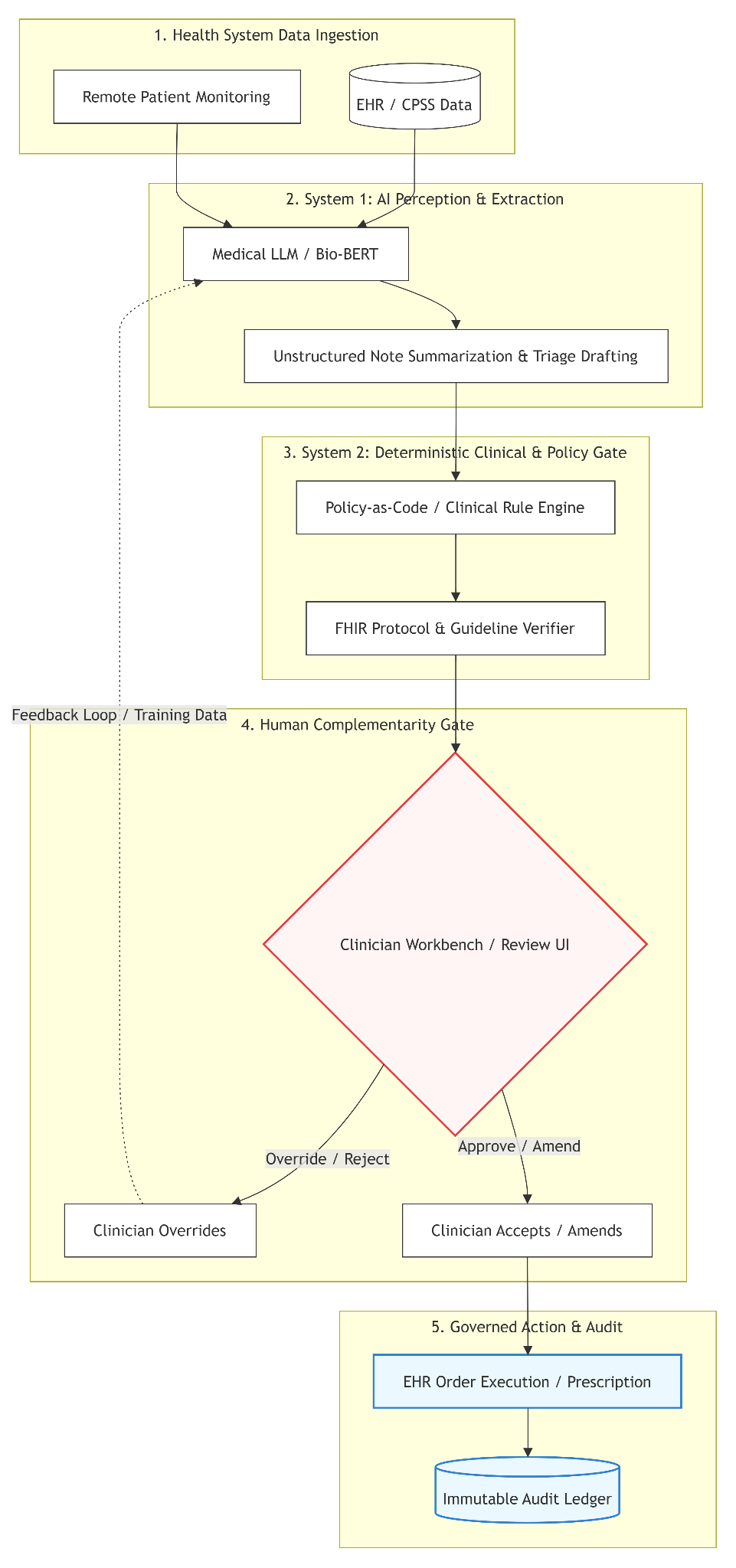
Health System Data Ingestion Remote Patient Monitoring: Ingests real-time patient vital signs, wearable telemetry, and continuous care signals. EHR / CPSS Data: Streams structured historical patient records, clinical documentation, and electronic health record datasets.
System 1: AI Perception & Extraction Medical LLM / Bio-BERT: Processes incoming multimodal streams to perform entity extraction, intent detection, and clinical concept mapping. Unstructured Note Summarization & Triage Drafting: Synthesizes raw clinical notes into candidate triage decisions, patient summaries, and preliminary care plans.
System 2: Deterministic Clinical & Policy Gate Policy-as-Code / Clinical Rule Engine: Evaluates candidate AI summaries against hard enterprise governance rules, safety parameters, and institutional protocols. FHIR Protocol & Guideline Verifier: Validates parameters against standard HL7 FHIR clinical guidelines to ensure 100% deterministic, zero-hallucination compliance.
Human Complementarity Gate Clinician Workbench / Review UI: Central decision interface presenting candidate care plans, source data provenance, and explicit guideline validations to medical staff. Clinician Accepts / Amends: Active approval path where doctors endorse or modify candidate treatment recommendations. Clinician Overrides: Rejection path where clinicians explicitly reject or override AI guidance. Feedback Loop / Training Data: Dashed feedback pipeline routing clinician override decisions back to System 1 (Medical LLM / Bio-BERT) for ongoing model refinement and alignment.
Governed Action & Audit EHR Order Execution / Prescription: Downstream execution layer triggering validated medication prescriptions, clinical orders, or patient updates. Immutable Audit Ledger: Non-repudiable audit database logging the full provenance chain—data inputs, AI outputs, policy evaluations, and final clinician signatures.
Design 2: Multi-Agent Healthcare Ecosystem (Acute Care to Community Health)
When a patient transitions from acute care at KTPH to community rehabilitation at Yishun Community Hospital, their data is often trapped in fragmented silos. By deploying a Multi-Agent Architecture using Model Context Protocol (MCP) over a Unified Knowledge Graph, domain-specific agents—one for acute care and one for community care—can communicate directly (Agent-to-Agent / A2A). They handle data transformation and auto-reconciliation in the background, presenting the Human Care Coordinator with a single, validated transition plan. Singapore’s health ecosystem spans KTPH (Acute Care) ---> YCH (Community Hospital) ---> Primary Care/GPs ---> Home/Population Health. This architecture uses Model Context Protocol (MCP) and specialized agents to maintain continuity of care without leaking sensitive data or hallucinating patient history.
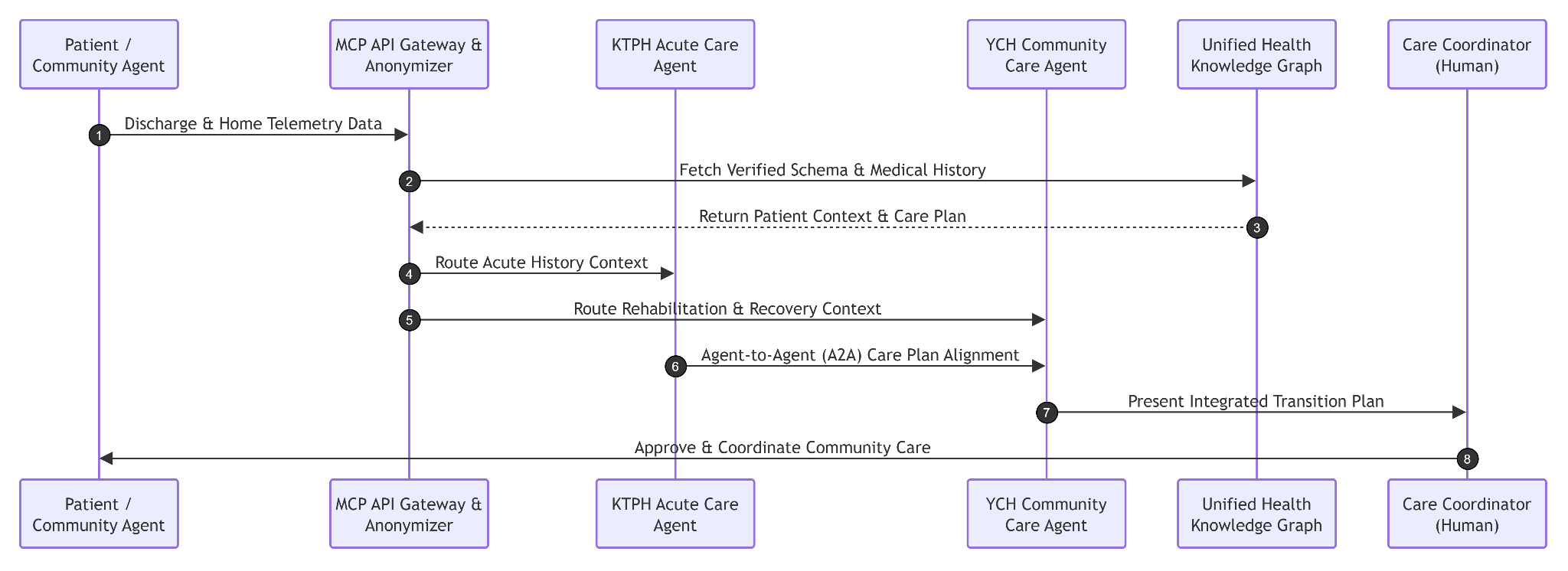
Multi-Agent Healthcare Ecosystem: Stage Breakdown
Patient & Telemetry Ingestion: The patient or community health agent submits home telemetry, continuous care signals, and post-discharge data to the system.
MCP API Gateway & Anonymization: The Model Context Protocol (MCP) Gateway intercepts incoming data streams, stripping Personal Health Information (PHI) and enforcing data privacy policies before routing.
Graph Schema & History Fetch: The Gateway queries the central Unified Health Knowledge Graph to retrieve deterministic schema definitions, medical histories, and active care guidelines.
Context Return: The Knowledge Graph returns verified, single-source-of-truth patient context and structural rules back to the Gateway.
Acute History Routing: The Gateway packages and routes acute clinical history context to the specialized KTPH Acute Care Agent.
Community History Routing: The Gateway routes rehabilitation targets, social determinants of health, and community recovery parameters to the YCH Community Care Agent.
Agent-to-Agent (A2A) Care Plan Alignment: The Acute Care Agent and Community Care Agent engage in direct agent-to-agent negotiation to reconcile medication lists, align therapy protocols, and resolve care handoff conflicts.
Integrated Handoff Blueprint: The Community Care Agent presents a synthesized, zero-hallucination transition blueprint to the Human Care Coordinator.
Clinician Approval & Action: The Care Coordinator reviews the unified plan, makes final clinical adjustments, and authorizes seamless community care delivery to the patient.
Design 3: Enterprise Healthcare MLOps & GovOps Operating Model
The biggest bottleneck in scaling hospital AI isn't the algorithms—it's platform governance. To move beyond isolated pilots, we build an enterprise GovOps control plane that bakes data privacy, compliance checking, and real-time clinical drift monitoring directly into the CI/CD pipeline. To solve "pilotitis" (where AI projects never scale past the testing phase in public healthcare), you need a platform governance framework that aligns IT, Cyber Security (ICS), Legal, and Clinical Governance.
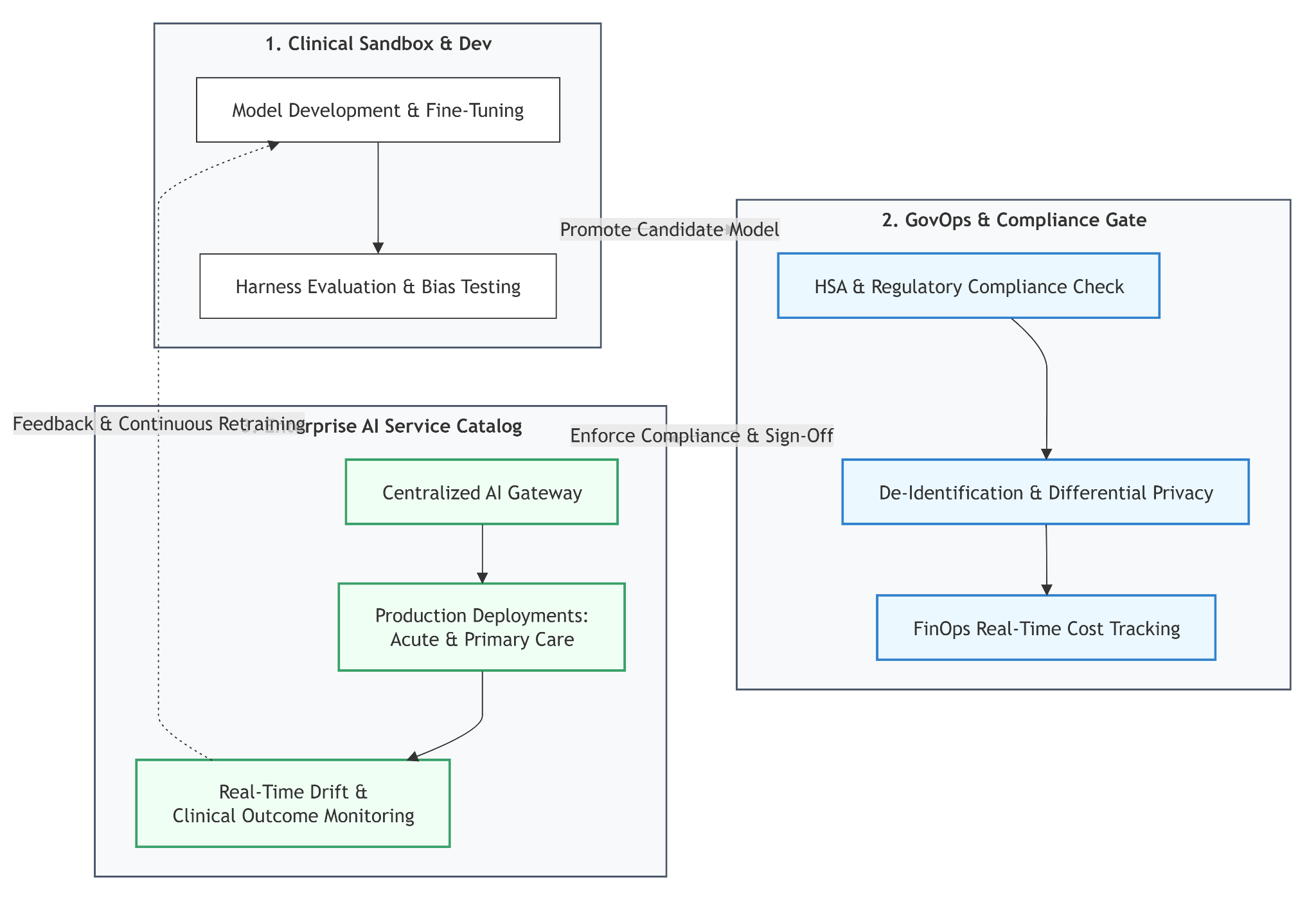
Clinical Sandbox & Dev
Model Development & Fine-Tuning: Ingests medical datasets to train, fine-tune, or prompt-engineer domain-specific healthcare models.
Harness Evaluation & Bias Testing: Evaluates candidate models against clinical benchmark suites to test for hallucinations, clinical bias, and safety risks.
GovOps & Compliance Gate
HSA & Regulatory Compliance Check: Automates check against Ministry of Health (MOH) and Health Sciences Authority (HSA) medical software regulatory standards.
De-Identification & Differential Privacy: Enforces data privacy filters, stripping Personal Health Information (PHI) before production release.
FinOps Real-Time Cost Tracking: Tracks LLM token costs, query latency, and compute budgets across acute and community care deployments.
Enterprise AI Service Catalog
Centralized AI Gateway: Single endpoint governing API authentication, RBAC, model access, and rate limiting across the health cluster.
Production Deployments (Acute & Primary Care): Serves validated AI models to KTPH acute care systems, YCH community care platforms, and polyclinic portals.
Real-Time Drift & Clinical Outcome Monitoring: Monitors model performance in production to detect data drift, accuracy decay, or adverse clinical signals.
Feedback & Continuous Retraining: Dashed loop sending clinical performance telemetry back to the Clinical Sandbox for ongoing fine-tuning.
Conclusion & Code Availability
Clinical AI must be designed as an amplifier of human capability, protected by unbypassable deterministic safety gates. The complete working implementation—including the FastAPI backend, Streamlit workbench UI, Policy-as-Code engine, and Docker deployment configurations—is open-source and available on GitHub:
Repository: sehgalnamit/hitl-clinical-control-plane: Health
Comments
Join the discussionNo comments yet. Be the first to comment.