
Demystifying GenAI Engineering: What to Train, How to Build, and Real Healthcare Architectures
When embarking on a Generative AI journey, many organizations quickly find themselves asking fundamental questions: Should we train our own AI model? Do we need a network of autonomous agents? How can an AI reliably understand vast domain documentation—like a 2,000-page medical reference book—without hallucinating or breaking the bank?
This guide breaks down the core concepts of Generative AI engineering, separating myth from reality through clear frameworks, practical healthcare use cases, and structural diagrams.
1. What Can Be Trained vs. What Cannot
The term "training" is often oversimplified. In modern software engineering, AI adaptability exists on a spectrum based on model access.
Pre-Training from Scratch (Almost Never Needed)
Building a base model from zero parameters requires thousands of high-performance GPUs, massive public datasets, and tens of millions of dollars. No standard business should pre-train a foundation model.
Fine-Tuning Open-Weight Models (Targeted Customization)
Open-Weight Models (e.g., Gemma 2, Llama 3, MedGemma): You own the model weights. You can perform Parameter-Efficient Fine-Tuning (PEFT / LoRA) on your own GPU infrastructure. This adapts the model's internal parameters to master specialized medical terminology, custom JSON output formats, or clinical coding standards (ICD-10, SNOMED).
Proprietary Models (e.g., Gemini 2.5 Pro, Gemini 2.5 Flash, Claude 3.5, GPT-4o): You cannot access the raw weights or run local PyTorch training loops. However, managed cloud platforms (like Google Cloud Vertex AI) offer limited fine-tuning via APIs to adjust specific output styles or behaviors on hosted adapters.

2. End-to-End Data Flow: Bypassing the LLM with Semantic Caching & AI Search
To address real-world problems—such as querying a 2,000-page physical medical reference book—the best engineering pattern is to avoid calling the LLM whenever possible.
Instead of routing every user question directly to a costly generative model, production systems use a multi-tiered evaluation flow:
Semantic Cache Lookup (Bypass LLM): If a user asks a question semantically equivalent to a previously answered prompt (e.g., "What is the pediatric dosage for Amoxicillin?" vs. "Amoxicillin dose for children?"), the system returns the pre-computed, verified response directly from a Vector Cache (e.g., RedisVL, Qdrant) in <50ms without calling an LLM.
Direct AI Search / Highlighted Retrieval (Bypass LLM Generation): For factual lookup queries, the system uses Semantic Search (e.g., Elastic ELSER or Vector Hybrid Search) to fetch the exact verified paragraph, table, or snippet and present it directly to the user with page citations. No generative model is needed.
LLM Generation (Fallback Only): The system invokes the LLM only when complex synthesis, reasoning across multiple non-contiguous pages, or conversational rewriting is required.

Pipeline Breakdown
Layout-Aware Vision OCR: Physical pages are parsed using multimodal vision parsers to preserve headings, complex dosage tables, and cross-sectional diagrams as clean Markdown.
Semantic Cache Check: Incoming queries are vectorized and compared against a store of verified historical Q&A pairs. Cache hits return instant answers without incurring LLM compute or API charges.
AI Search Direct Highlight (No LLM): For direct lookups (e.g., checking contraindications), the search index returns the exact, highlighted text snippet directly to the user. This eliminates generation latency and guarantees zero hallucination risk.
LLM Synthesis (RAG / Context Caching): When complex reasoning or multi-document comparison is required, retrieved context is fed into the LLM. Using Explicit KV Prompt Caching (e.g., Vertex AI Context Caching) allows the system to pre-compute attention matrices for large reference manuals, cutting token inference costs by 75%–90%.
3. Do You Really Need a Multi-Agent Swarm?
Multi-agent architectures are popular, but they introduce complexity. The choice depends on the nature of the task:
Single-Agent / Direct Search System (Sufficient for Most Tasks): If your goal is document search, clinical Q&A, or summarizing patient charts, a single model equipped with a solid RAG pipeline (or direct AI Search) is faster, cheaper, and easier to maintain.
Multi-Agent Swarm (Needed for Complex Workflows): Multi-agent systems are necessary when a task requires distinct roles, specialized tool execution, and dynamic routing across multiple systems.
Real Healthcare Multi-Agent Example
Consider an Automated Patient Intake & Insurance Approval system:

Supervisor Router (High-Reasoning Model): Evaluates incoming requests and routes sub-tasks.
Triage Agent (Lightweight Worker): Processes symptoms against standardized medical guidelines.
EHR Query Agent (Tool-Scoped Worker): Executes FHIR/HL7 database lookups to pull patient medical history.
Prior-Auth Agent (Domain Worker): Cross-references requested treatments against insurer coverage schemas to generate pre-authorization requests.
4. Can Models Like Gemini Work for Healthcare?
Yes, absolutely—provided they are deployed within an enterprise-compliant environment.

Instead of relying on a single LLM to handle everything sequentially, production voice systems decouple Speech Processing, Intent Classification, and Retrieval Execution.

Why Decoupling Intent Recognition Matters
Latency Optimization: Passing raw transcribed text into a full LLM just to classify intent adds 300–800ms. Using a dedicated Semantic Router or lightweight classifier (e.g., embeddings match or small fine-tuned model) classifies user intent in under 20ms.
Targeted Knowledge Retrieval: Once intent is classified (e.g., Drug Interaction Lookup vs. Patient Chart Retrieval), the system triggers the specific RAG index or database API directly, avoiding unnecessary LLM context bloat.
Native Multimodal Alternative: Modern models (like Gemini 2.5 Flash / Realtime APIs) can process raw audio input directly without an intermediate text transcription step, reducing audio-to-audio latency significantly.
5. Beyond RAG: Guaranteeing Zero-Hallucination Safety with Neuro-Symbolic Architectures
While Retrieval-Augmented Generation (RAG) grounds an LLM by feeding it relevant text chunks, standard RAG still relies on probabilistic vector search and token prediction. In high-stakes enterprise domains like healthcare or legal tech, "statistically probable" is not good enough. An LLM reading retrieved medical documents can still miscalculate a pediatric dose or overlook a subtle drug contraindication.
To achieve absolute deterministic safety, modern clinical architectures pair foundation models with a Neuro-Symbolic Execution Layer.
The Paradigm Shift: LLM as Translator, Not Decision-Maker
In a standard RAG pipeline, the LLM acts as Judge, Jury, and Executioner—it reads the retrieved text, reasons over the logic, executes the calculations, and writes the output. This creates multiple points of failure for probabilistic hallucination.
In a Neuro-Symbolic System, responsibilities are decoupled:
Neural Layer (Gemini 2.5 / Foundation LLM): Acts as System 1 (Perception & Natural Language). It parses unstructured doctor notes, audio, or scanned PDFs into rigid, validated schemas, and translates final logical proofs back into readable human language.
Symbolic Layer (Ontologies & Rule Engines): Acts as System 2 (Deterministic Execution). It executes hard rules, mathematical formulas, and graph traversals over standardized medical ontologies (e.g., SNOMED-CT, RxNorm, ICD-10). It does not guess—it evaluates to absolute facts (
TRUE,FALSE, orEXACT_MATH).
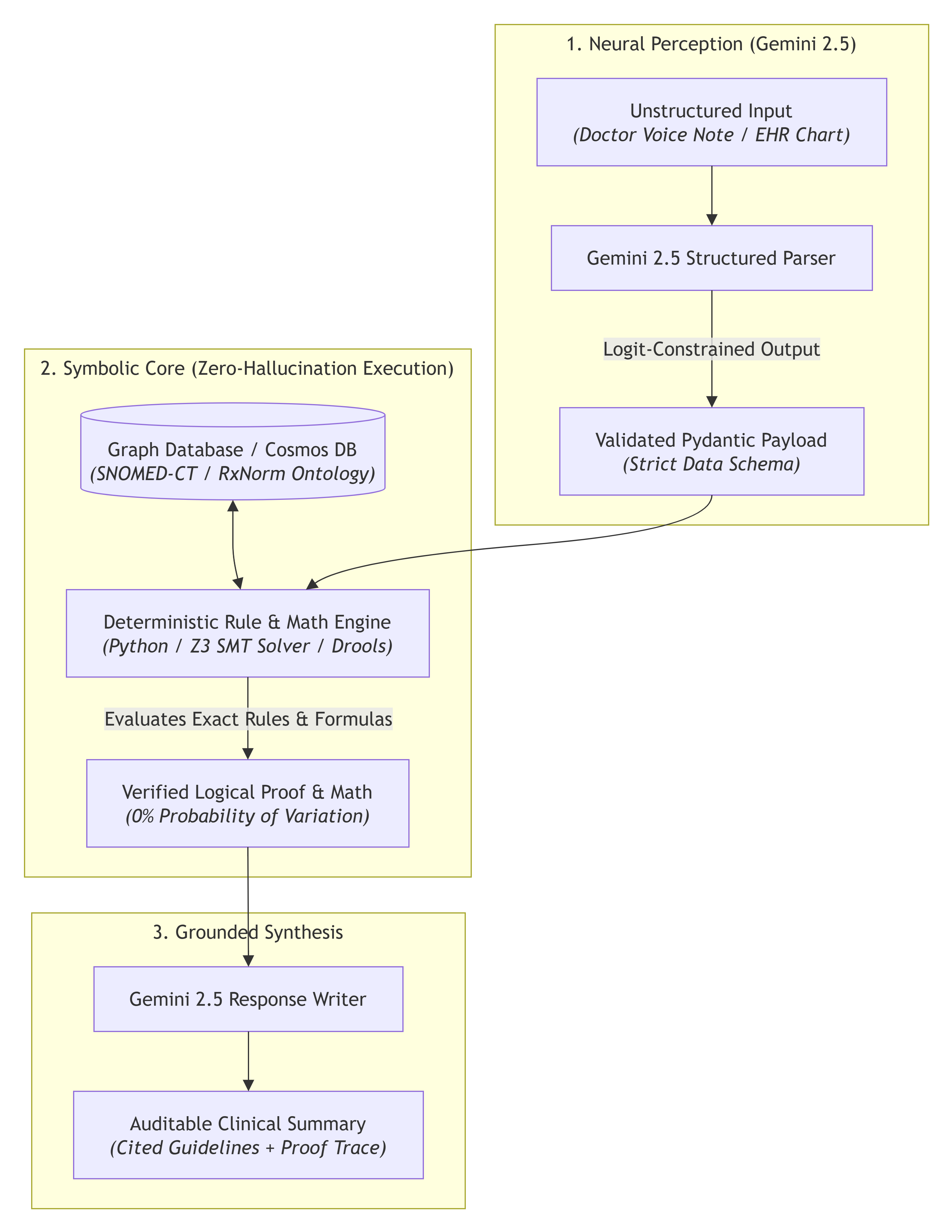
How to Build the Symbolic Layer: A 4-Step Blueprint
Building a symbolic layer is an engineering and orchestration task, requiring zero model training or GPU fine-tuning.
Step 1: Map the Domain (Ontology Setup)
Instead of searching raw text paragraphs, map domain relationships inside a Graph Database (e.g., Azure Cosmos DB Gremlin API, Neo4j, or GCP Spanner Graph) using standard medical ontologies:
[ Drug: Amoxicillin ] ──( IS_A )──> [ Class: Penicillin ] ──( HAS_CONTRAINDICATION )──> [ Condition: Penicillin Allergy ]
Step 2: Enforce Schema Translation (Logit Constraints)
Constrain the foundation model to parse unstructured clinical inputs into a rigid schema using Pydantic in Python or native Gemini Structured Outputs. The model physically cannot output conversational filler or unrequested fields:
from pydantic import BaseModel, Field
from typing import List

class ClinicalPrescriptionSchema(BaseModel):
    patient_id: str = Field(description="Unique patient identifier")
    age_years: int = Field(description="Patient age in years")
    weight_kg: float = Field(description="Patient weight in kilograms")
    diagnosed_conditions: List[str] = Field(description="Active medical diagnoses")
    known_allergies: List[str] = Field(description="Documented drug allergies")
    requested_drug: str = Field(description="Requested medication name")
Step 3: Deterministic Rule & Math Execution
Pass the parsed JSON directly into a deterministic microservice. The LLM is bypassed completely during this evaluation:
def evaluate_clinical_safety(data: ClinicalPrescriptionSchema, graph_client):
    # 1. Query Knowledge Graph for Allergy Contraindications
    conflict = graph_client.check_contraindication(
        drug=data.requested_drug,
        allergies=data.known_allergies
    )

    if conflict:
        return {
            "status": "BLOCKED",
            "reason": f"Direct Allergy Match: {data.requested_drug} belongs to a class contraindicated by documented allergy: {data.known_allergies}.",
            "action": "Select non-penicillin alternative (e.g., Cefdinir)."
        }

    # 2. Execute Deterministic Math (14mg per kg per day)
    exact_dosage_mg = data.weight_kg * 14.0
    return {
        "status": "APPROVED",
        "calculated_dosage_mg": exact_dosage_mg
    }
Step 4: Grounded Explanation Synthesis
Feed the deterministic result back into Gemini 2.5 to draft a clear, professional memorandum for the attending clinician:
"Amoxicillin is flagged due to a documented Penicillin class allergy (Ref: SNOMED-CT Concept #70618000). Recommended alternative: Cefdinir 315mg/day."
Architectural Trade-Offs & Cost Economics
Integrating a Symbolic Layer directly optimizes your overall operational cost and performance profile:
Lower LLM Inference Costs: Because the LLM's role is restricted to parsing (small structured output) and final narrative drafting, you avoid sending massive multi-page prompts asking the LLM to perform complex step-by-step reasoning.
Compute Offloading: Running deterministic checks, graph traversals, and mathematical formulas inside Python, Z3 SMT solvers, or graph databases costs fractions of a cent per thousand executions compared to high-cost LLM reasoning tokens.
Optimized Token Efficiency: Shifting logic execution out of the LLM context window natively complements your existing cost controls (semantic caching, search snippet extraction, and KV prompt caching).
Standard RAG vs. Neuro-Symbolic RAG
| Architectural Layer | Standard Vector RAG | Neuro-Symbolic RAG |
|---|---|---|
| Search Mechanism | Probabilistic Vector Proximity (Dense Embeddings) | Vector Search + Graph Ontology Traversal |
| Logic & Math | Estimated by LLM (Probabilistic) | Computed by Code / Solvers (Deterministic) |
| Hallucination Risk | Moderate to High (Context Misinterpretation) | Zero for logic, rules, and mathematical calculations |
| Audit Trace | Unstructured text citations | Exact execution trace + formal logic proof |
| Primary Infrastructure | Azure AI Search / Vertex AI Search | Search Index + Cosmos DB / Neo4j + Pydantic Engine |
Key Considerations for Healthcare Deployment
Data Privacy & Compliance: Consumer AI tools (like standard chat interfaces) are not compliant for handling Protected Health Information (PHI) by default. However, enterprise platforms—such as Google Cloud Vertex AI running Gemini models—allow organizations to execute Business Associate Agreements (BAAs). This ensures PHI is encrypted, isolated, and never used to train base vendor models.
Multimodal Capabilities: Gemini natively processes text, medical imaging scans, audio recordings, and handwritten doctor notes within a single context window.
Hybrid Deployment with Open Models: For strict air-gapped environments or local clinical workstations, organizations often pair cloud models (Gemini via Vertex AI) with lightweight open-weight models (like MedGemma or fine-tuned Gemma 2) hosted directly on local GPUs for on-premise data processing.