Designing and Scaling the Hybrid Enterprise Workforce: A CTAIO Playbook for AI Transformation
Executive Summary: The Modern AI Paradox & Paradigm Shift
The transition from traditional software automation to AI augmentation and autonomous agentic operating models marks an unprecedented architectural shift in enterprise engineering and organizational design. For decades, enterprise automation was fundamentally deterministic—relying on predefined scripts, deterministic robotic process automation (RPA), and static rule engines designed to execute fixed operational paths. While effective for standardized back-office workflows, script-based automation was brittle, failing whenever unstructured data, unanticipated exceptions, or dynamic market conditions arose.
The emergence of foundation models catalyzed the second phase: AI Augmentation. Here, AI copilots function as cognitive partners to human professionals—assisting with generative drafting, code synthesis, document comprehension, and ad-hoc analytics. In an augmentation regime, the human worker remains the proactive initiator and critical final evaluator of every action. Today, pioneering organizations are transitioning into the third phase: Agentic Operating Models. Autonomous AI agents are no longer passive query-response interfaces; they are goal-driven cognitive systems capable of proactive multi-step reasoning, dynamic planning, autonomous tool and API invocation, memory persistence, and end-to-end task execution within established guardrails.
This profound technological leap has created a stark organizational contradiction. According to the landmark AI & Data Leadership Executive Benchmark Survey conducted by Randy Bean, with a foreword by Thomas H. Davenport (2026), 97.1% of corporate leaders agree that AI will deliver net positive benefits in the long run, and 82.7% recognize AI as the single most transformational technology in a generation—up from 64.2% just two years prior. Yet, an overwhelming 93.2%—the highest figure recorded in the survey's history—of these same Fortune 1000 executives identify People, Culture, and Mindset as the greatest impediment to realizing enterprise AI value. Only a modest ~7% cite technological limitations or data infrastructure deficits as their primary blocker.
This empirical reality defines the modern mandate of the Chief Technology & AI Officer (CTAIO). Enterprise AI transformation is fundamentally not a software rollout or an infrastructure upgrade; it is an organizational and operational redesign. The CTAIO sits at the nexus of technology architecture, organizational culture, decision rights, and corporate governance. To convert technological promise into sustainable enterprise value, the CTAIO must orchestrate a cohesive hybrid workforce—defining how human professionals, interactive copilots, and autonomous agents collaborate, establishing clear decision rights, renewing the institutional expertise pipeline, and instituting risk-adjusted governance across every tier of the enterprise.
Architectural Overview: The 3 Evolutionary Phases of Automation

Work Decomposition & Hybrid Workforce Architecture
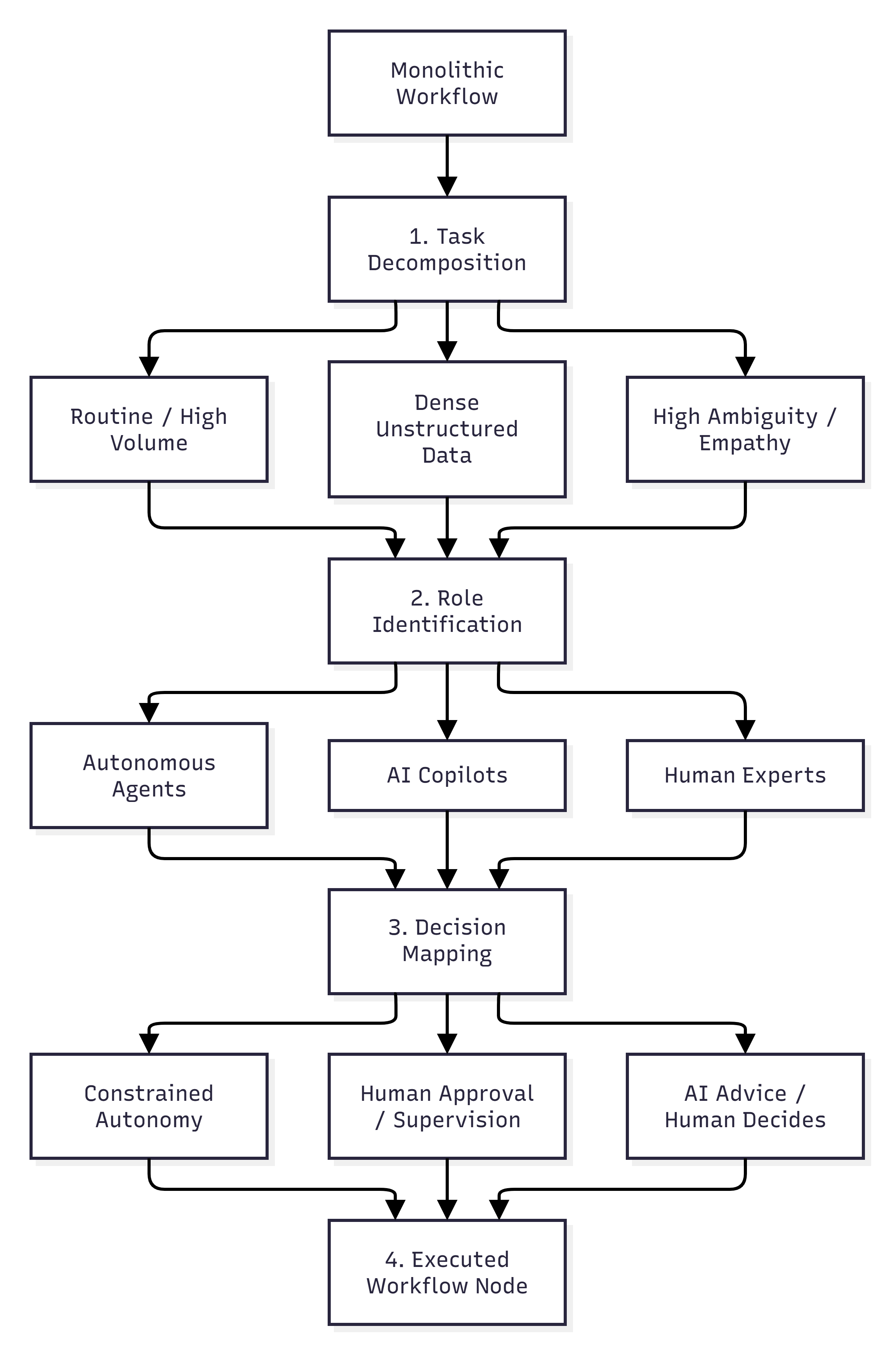
A cardinal error in enterprise transformation is attempting to redesign business operations around the latest technology capabilities. Successful transformations begin with work itself. By decomposing monolithic workflows into granular task components, leaders can systematically match each activity to the optimal workforce component—human talent, interactive copilots, or autonomous agents.
The 4-Step Work Decomposition Algorithm
- Task Decomposition: Break end-to-end workflows into discrete tasks. Categorize each task by whether it should be automated, assisted, or reserved strictly for human judgment.
- Role Identification: Map tasks across three distinct workforce components:
- Humans: Focus on high-empathy customer interaction, ethics, creative synthesis, non-routine problem solving, and overall strategic oversight.
- AI Copilots: Suggestion-based, interactive assistants that enhance human productivity in coding, document summarization, data analysis, and decision support.
- Autonomous Agents: Goal-driven systems that independently reason, plan, and execute multi-step workflows within strict guardrails.
- Decision Mapping: Define explicit authority for every decision node:
- Advice/Recommendation: AI provides context, options, or probabilities; humans decide.
- Approval/Supervision: AI formulates action; human reviews and signs off.
- Constrained Autonomy: AI executes independently within strictly defined parameters, monetary caps, and operational limits.
- Opportunity & Bottleneck Identification: Systematically audit operational flows to uncover high-friction bottlenecks and high-leverage opportunities. High-volume, structured tasks are earmarked for autonomous agents; dense, unstructured knowledge synthesis is assigned to copilot assistance; and high-ambiguity, high-empathy customer touchpoints are reserved for empowered human talent.
Work Decomposition Dataflow
Task Complexity vs. Emotional Intelligence Matrix
To operationalize work decomposition, enterprise tasks must be evaluated across two foundational operational dimensions: Task / Job Complexity and Emotional Intelligence Required.
- Task/Job Complexity: From routine execution (Level 1) to novel, ambiguous strategy (Level 5).
- Emotional Intelligence: From task-focused interaction (Level 1) to culture-shaping strategic leadership (Level 5).
The convergence of mid-tier complexity and moderate emotional intelligence defines the Hybrid Zone (Human-AI Teaming). Within this zone, neither pure human labor nor pure autonomous technology produces optimal outcomes; instead, value is maximized when copilots and agents execute heavy cognitive lifting while human professionals govern context, calibrate edge-case decisions, and provide ethical oversight.
Level | Task / Job Complexity | Emotional Intelligence | Dominant Delivery Archetype |
Level 1 | Routine, repetitive rules | Task-focused execution | Fully Automated / Agents |
Level 2 | Structured, standard patterns | Informational exchange | AI Copilots with Human Supervision |
Level 3 | Semi-structured, analytical | Empathy, stakeholder nuance | Hybrid Zone (Human-AI Teaming) |
Level 4 | Ambiguous, multi-domain | High-stakes negotiation & consensus | Human-Led with AI Copilot Support |
Level 5 | Novel, open-ended strategy | Culture-shaping, ethical judgment | Pure Human Leadership & Governance |
Decision & Action Space Design: The 3 Orchestration Models
Deploying agents and copilots requires architecting unambiguous decision rights and operational boundaries. The CTAIO must govern workflows through three primary human-AI orchestration archetypes:
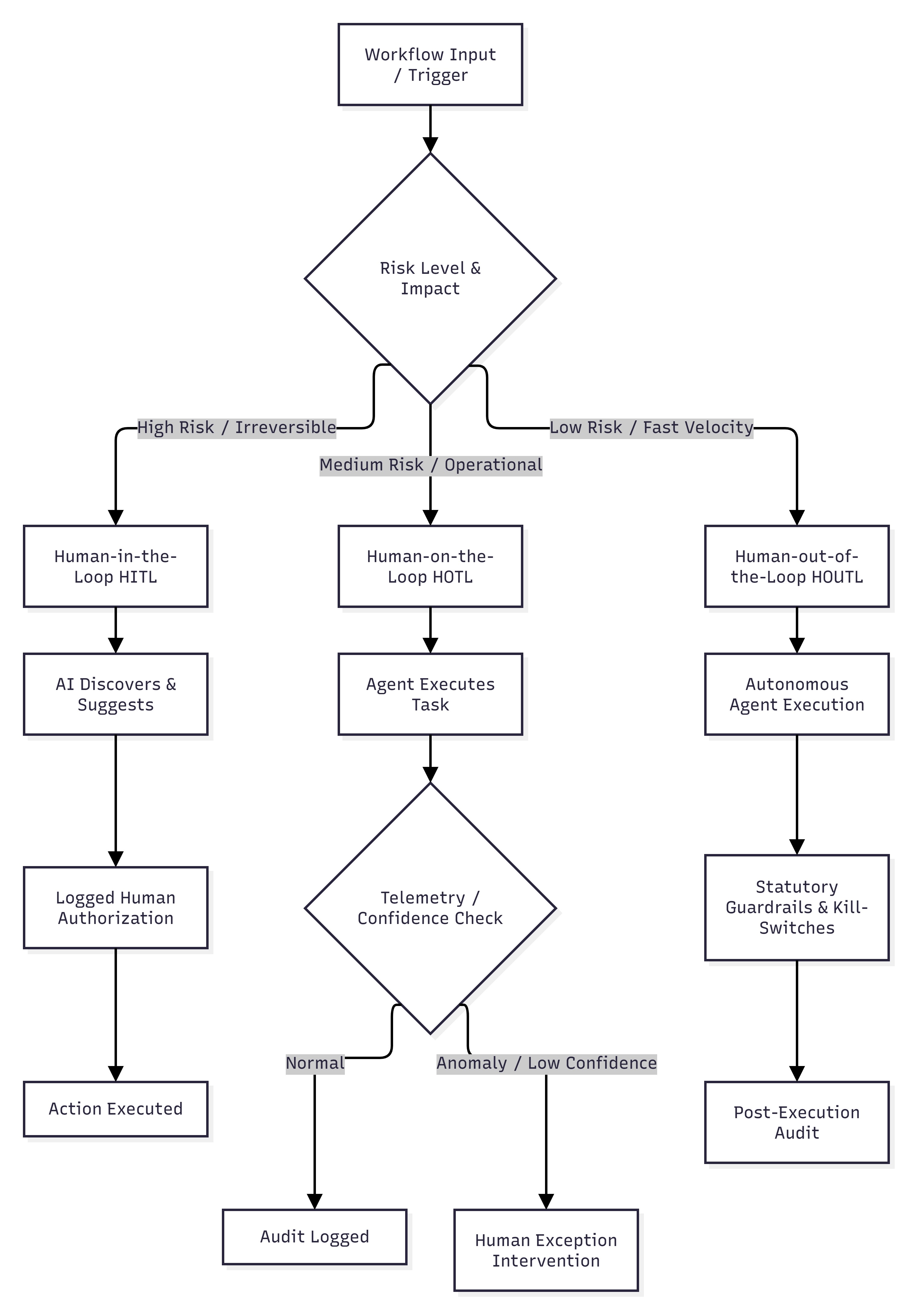
Human-in-the-Loop (HITL) / High-Touch Orchestration: Essential for high-risk, irreversible, or heavily regulated domains such as clinical diagnosis, legal contract execution, credit underwriting, and fraud litigation. The AI agent conducts discovery, aggregates contextual data, and formulates structured recommendations, but cannot execute without explicit, logged human authorization.
Human-on-the-Loop (HOTL) / Low-Touch Orchestration: Tailored for medium-risk operational workflows including customer support ticket triage, routine financial reconciliation, and automated procurement dispatch. Autonomous agents execute tasks independently, while human operators supervise aggregate telemetry dashboards, stepping in only when system confidence drops below preset thresholds or anomalies are flagged.
Human-out-of-the-Loop (HOUTL) / No-Touch Orchestration: Reserved for low-risk, high-velocity, deterministic, or statutory execution environments—such as algorithmic IT infrastructure healing, real-time inventory rebalancing, and dynamic digital ad bidding. The system executes autonomously under statutory guardrails and programmatic kill-switches, with humans reviewing post-execution audit logs.
Cross-Functional Enterprise Applications
The practical application of work decomposition spans core enterprise domains:
- Marketing & Growth: Transitioning from static campaign scheduling to agentic multi-variant optimization, synthetic content generation at scale, real-time customer sentiment clustering, and automated brand feedback summarization.
- Supply Chain & Operations: Deploying algorithmic orchestration models across fulfillment and logistics. Proven enterprise benchmarks include Amazon's warehouse robotics coordination, UPS Orion dynamic route optimization saving ~10 million gallons of fuel annually, DHL predictive logistics and freight capacity planning, Siemens IoT predictive maintenance preventing plant downtime, and Walmart and McDonald's predictive demand forecasting synchronizing real-time inventory replenishment.
- Knowledge Work & Enterprise Functions: Accelerating cognitive throughput across corporate functions through automated commercial contract review and compliance redlining, enterprise BI semantic conversational search, algorithmic investment recommendation drafting, and institutional credit risk assessment.
The Leadership Challenge & Renewing the Expertise Pipeline
The most insidious threat of aggressive AI automation is not immediate job displacement, but the silent erosion of the corporate expertise pipeline. Historically, enterprise capability was sustained through the "apprenticeship model": junior professionals performed entry-level, repetitive tasks (drafting basic memos, compiling data tables, conducting routine audits). Through thousands of hours of foundational exposure, they developed intuitive pattern recognition, learned to spot subtle anomalies, and gradually built the seasoned judgment required to become senior leaders.
When autonomous agents and copilots absorb 80% of entry-level tasks, the apprenticeship ladder is severed. If junior analysts never build financial models from scratch, and junior associates never draft base contracts, organizations risk an acute institutional expertise crisis within a decade.
The Renewed Pathway to Expertise
To avoid an enterprise expertise deficit by 2035, CTAIOs must replace passive exposure with intentional capability-building:

Learn Principles: Master core domain fundamentals and logic.
Practice Without & With AI: Perform tasks manually first to develop intuition, then introduce AI tools to analyze delta outputs.
Supervised Decisions: Make decisions on AI-generated recommendations under senior mentorship.
Exception Handling: Focus training directly on corner cases, hallucination detection, and ambiguous edge scenarios.
Independent Judgment: Execute complex trade-offs where AI recommendations conflict with organizational strategy or ethical norms.
Mastery: Strategic leadership, enterprise-level system architecture, and holistic workforce governance.
Concrete CTAIO Leadership Actions
- Identify What Creates Expertise: Map the specific tasks and decisions that cultivate judgment versus those that merely consume time.
- Preserve Critical Learning Experiences: Deliberately retain selected manual practice steps even when full automation is technically feasible.
- Create Synthetic Mechanisms for Experience: Utilize digital twins, simulations, and synthetic scenarios to expose junior personnel to years of edge cases in weeks.
- Accelerate Judgment Development: Transition employees earlier from routine processing to exception handling and trade-off evaluation.
- Redesign Recognition & Reward: Shift performance incentives away from raw task throughput or drafting speed toward judgment quality, rigorous AI critique, and defensible override decisions.
Everyday Leadership Behaviors: The "Do & Say" Framework
Cultural adaptation requires executive leaders and middle managers to actively model hybrid behaviors daily:
- Own Critical Decision Moments: Explicitly articulate when and why human accountability supersedes an AI recommendation. Say: "At this step, we need your expertise and judgment—not just AI output."
- Show Genuine Curiosity: Treat AI anomalies as collaborative learning opportunities rather than system failures. Say: "Help me understand this recommendation and what makes sense to do now."
- Normalize Productive Tension: Encourage team members to question algorithmic recommendations openly without fear of slowing delivery. Say: "It's okay to be unsure—that's often where judgment matters most."
- Make Judgment Visible: Require practitioners to narrate their cognitive evaluation process rather than presenting AI deliverables as completed artifacts. Say: "I value how you handled this and how you made your decision."
Designing for Mastery over Metrics: Guarding Against Attention Degradation
A critical psychological risk in hybrid systems is cognitive offloading and human reviewer attention degradation. As AI agent recommendations reach high accuracy levels, human supervisors experience cognitive fatigue, devolving into passive "rubber stampers" who blindly approve system outputs. To ensure genuine vigilance and preserve operational safety, CTAIOs must engineer defensive interaction mechanics:
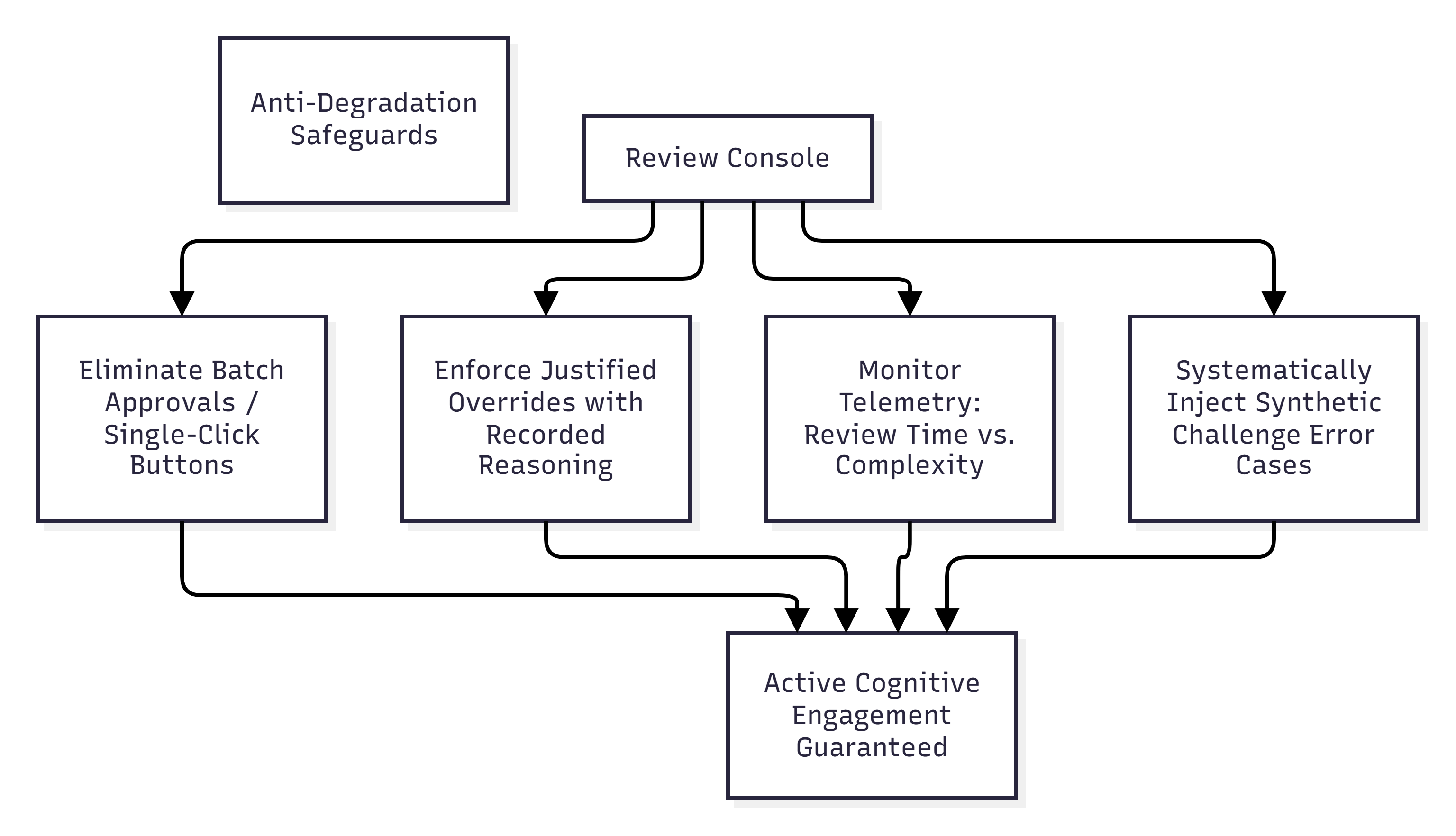
- Eliminate Batch Approvals: Remove all single-click "Approve All" buttons from enterprise review consoles; force reviewers to interact with discrete decision parameters.
- Enforce Justified Overrides: Mandate that overrides and critical approvals include recorded qualitative reasoning, creating traceable accountability.
- Monitor Attention Telemetry: Track reviewer engagement telemetry, correlating time-spent-reviewing against statistical complexity and override rates to detect rubber-stamping behaviors.
- Inject Synthetic Challenge Cases: Systematically inject calibrated, synthetic edge-case errors into production queues to measure reviewer vigilance, rewarding teams that catch subtle hallucinations.
The Enterprise Scaling Framework (SELECT - SCALE - GOVERN)
Lessons from Enterprise Scaling Pioneers
Pioneer Enterprise | Strategic Lens | Deployment Scope & Operational Impact | Key Takeaway for the CTAIO |
DBS Bank | Enterprise Capability Lens | Scaled AI across core operations, generating ~SGD 1bn in economic value in 2025 across 430+ use cases and 2,000+ production models. | Established control groups to isolate pure AI value; enforced full business-unit P&L ownership and governed models under the unified enterprise PURE framework. |
Air India | Customer Journey Lens | Deployed GenAI virtual agent (AI.g, formerly branded Maharaja) on Azure OpenAI with RAG, managing ~40,000 queries daily (up from ~30,000 in 2024) across 1,300+ topics, having resolved 13M+ conversations since launch at a 97% autonomous containment rate. | Targeted a single high-volume customer journey; maintained flat call center volumes even as passenger volume doubled, freeing human agents for complex escalations. |
Klarna | Automation vs. CX Trade-off | Automated 2.3M chats/month (2/3 of all service chats; equivalent to ~700 FTEs) yielding a $40M profit improvement and reducing cost per transaction from $0.32 to $0.19. | Over-indexing on pure cost reduction degraded customer experience; rebalanced in 2025 to guarantee seamless human escalation, proving that efficiency must never compromise CX. |
Framework 1: SELECT (Value Prioritization & Realized Economics)
Scaling enterprise AI demands ruthless portfolio prioritization. The SELECT framework evaluates potential use cases across six rigorous dimensions:
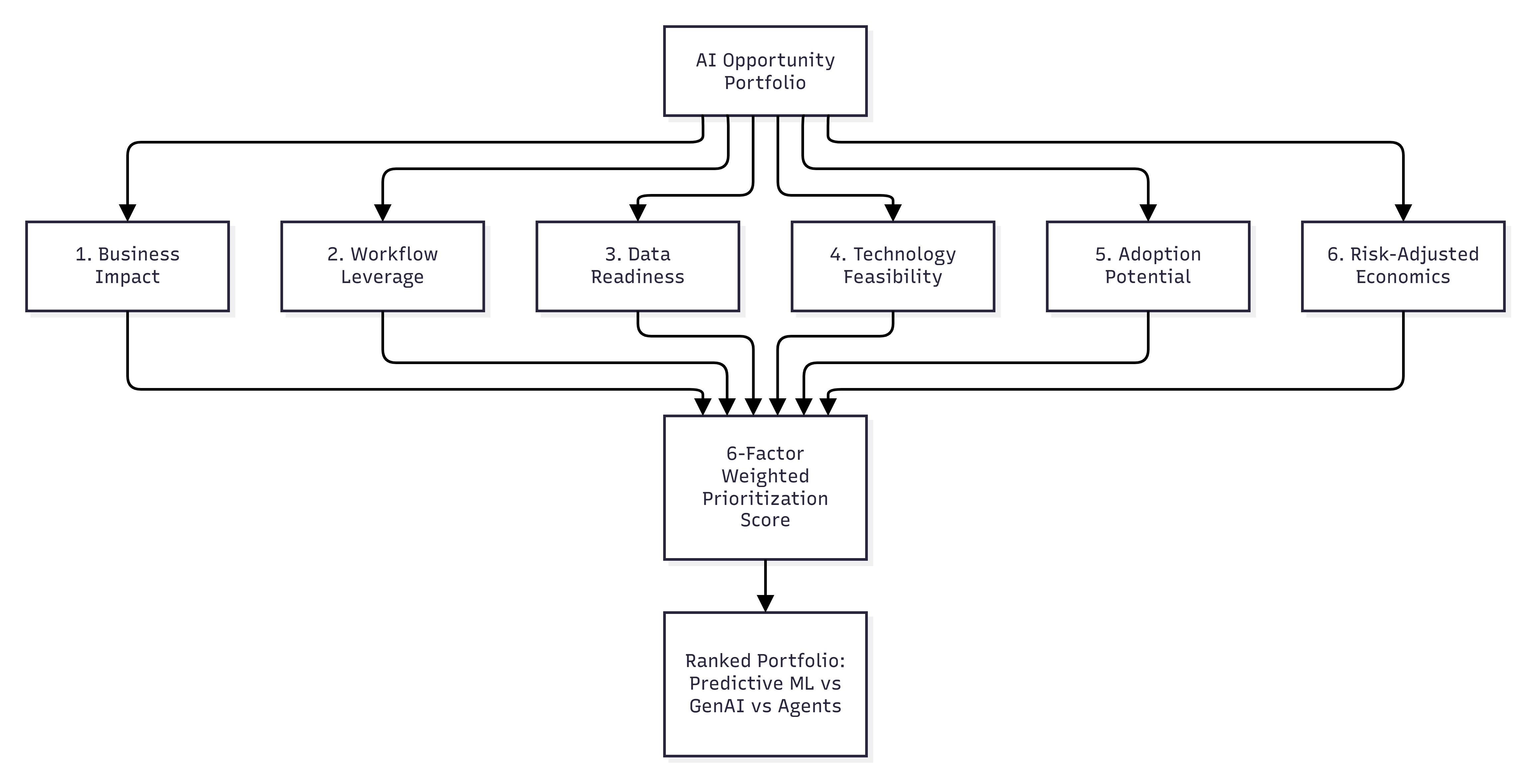
Business Impact: Quantifiable revenue growth, operational margin expansion, or regulatory de-risking.
Workflow Leverage: Reusability of assets, agents, and data across multiple enterprise workflows.
Data Readiness: Availability, cleanliness, latency, and compliance posture of underlying corporate datasets.
Technology Feasibility: Maturity of foundation models, tool integrations, retrieval pipelines, and latency budgets.
Adoption Potential: Willingness of business units, frontline workers, and leadership to adapt operating habits.
Risk-Adjusted Economics: Total cost of ownership (TCO) inclusive of inference, retraining, and human oversight weighed against downside risks.
The ROI Realism Rule
A primary reason enterprise AI initiatives fail to produce bottom-line results is the conflation of theoretical capacity with realized financial value. Calculating "hours saved multiplied by average hourly wage" produces vanity metrics. Time saved only converts to enterprise profit if that capacity is explicitly eliminated (cost reduction) or redeployed to measurable, revenue-generating commercial work (top-line growth).
$$\text{Annual Net Benefit} = (\text{Time Saved} \times \text{Realization Rate %}) - \text{AI Running Costs}$$
Only count capacity that is directly eliminated, hiring avoided, or redeployed to measured, revenue-generating activities net of inference and platform costs.
Framework 2: SCALE (The 5 Pillars & Federated Operating Model)
Moving beyond isolated proofs of concept requires institutionalizing capabilities across the five interdependent SCALE pillars:
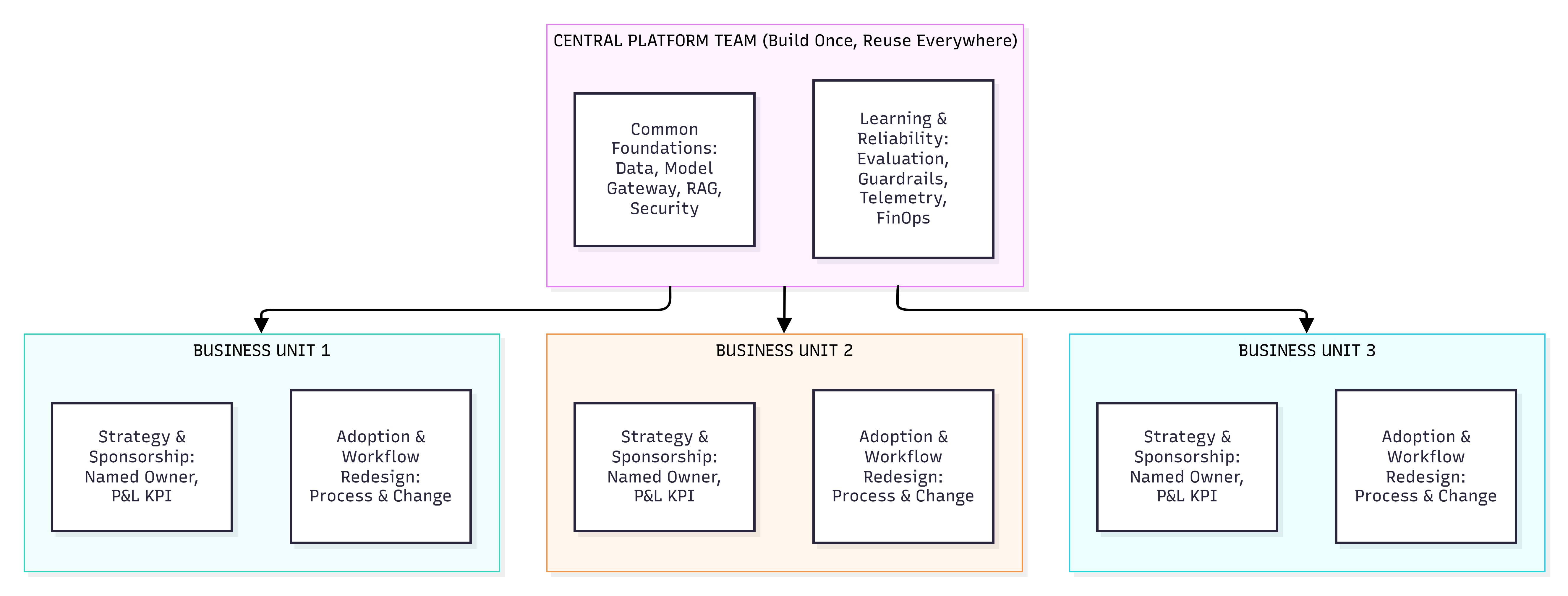
- S - Strategy & Sponsorship: Named executive business owner, P&L-tied KPIs, stage-gated funding.
- C - Common Technology Foundations: Shared data platforms, model gateways, secure RAG pipelines, reusable accelerators.
- A - Adoption & Workflow Redesign: End-to-end process restructuring, user change enablement.
- L - Learning & Reliability Operations: Continuous monitoring, evaluation harnesses, drift detection, incident handling.
- E - Economics & Value Realization: Unit economics tracking (cost per successful business outcome), FinOps guardrails.
The Federated Operating Model Architecture
To scale sustainably, CTAIOs must reject both completely centralized bottlenecks and uncontrolled decentralized silos. The target architecture is a Federated Model:
Framework 3: GOVERN (Risk-Adjusted Deployment Gates & Behavioral Governance)
Governance must transition from bureaucratic, static compliance checklists into dynamic, continuous technical and behavioral safeguards. Deployments are managed through four evidence-based gates:

- Gate 1 (PROVE): Rigorous offline benchmarking, gold-standard baseline validation, prompt evaluation, value hypothesis, and alignment with corporate risk appetite.
- Gate 2 (CONTAIN): Controlled canary rollouts, strict network sandboxing, Policy-as-Code enforcement, and verified escalation channels.
- Gate 3 (OPERATE): Live telemetry tracking task completion rates, inference latency, token cost-per-query, drift, hallucination frequency, and kill-switch responsiveness.
- Gate 4 (EXPAND): Audit of audited financial net benefits, operational resilience certification, designated business executive sign-off, and automated rollback capability.
Autonomy Levels, Risk Controls & Behavioral Governance Mechanics
Higher autonomy levels mandate stricter programmatic guardrails:
- Monetary and Action Thresholds: Autonomous customer refund or procurement agents operate with strict monetary caps (e.g., auto-executing up to $50, but requiring human sign-off beyond that limit).
- Policy-as-Code & Hard Guardrails: System prompts and safety filters programmatically block unauthorized API invocations, data exfiltration, or out-of-domain reasoning before execution occurs.
- Comprehensive Auditability & Telemetry: Maintain immutable, structured logs recording inputs, retrieved context, intermediate tool calls, confidence scores, and downstream actions to ensure regulatory explainability.
- Dynamic Kill-Switches & Rollback Protocols: Provide immediate operational circuits allowing human controllers to instantly revert an agent from autonomous execution back to supervised HITL mode upon anomaly detection.
- Behavioral Governance: Continuously monitor human-AI interactions for behavioral drift, ensuring human reviewers do not become desensitized or uncritical over time.
The Executive 90-Day CTAIO Action Plan
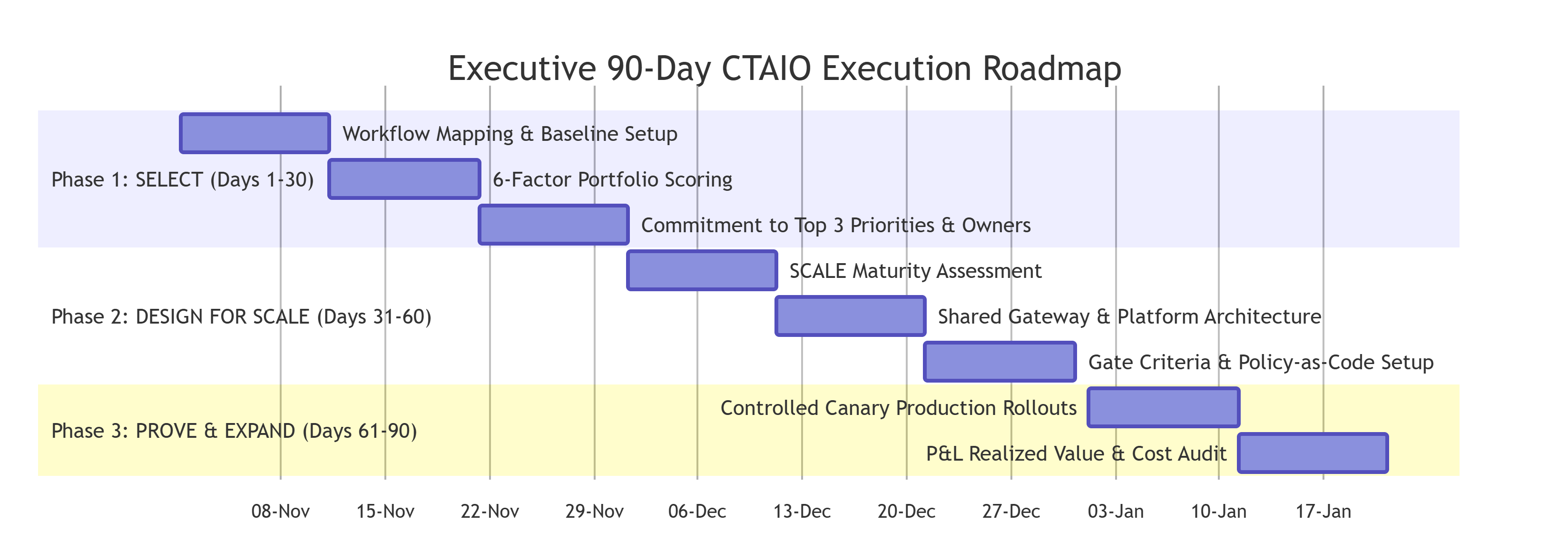
Days 1–30: SELECT
- Workflow Mapping & Baselines: Map core end-to-end workflows across business units and establish empirical pre-AI performance baselines.
- Portfolio Scoring: Score all proposed AI use cases using the 6-factor SELECT matrix to filter out vanity experiments.
- Priority Selection & Ownership: Commit to the top 3 high-leverage initiatives, each backed by a named business P&L executive sponsor.
Days 31–60: DESIGN FOR SCALE
- Maturity Assessment: Audit organizational readiness across the 5 SCALE pillars to resolve architectural bottlenecks.
- Common Platform Architecture: Deploy centralized model gateways, standardized retrieval pipelines (RAG), and reusable tooling frameworks.
- Governance & Controls: Codify Gate 1 and Gate 2 evaluation rubrics, Policy-as-Code safety rules, and monetary execution caps.
Days 61–90: PROVE & EXPAND
- Controlled Production Rollouts: Deploy the top 3 priority initiatives into limited production environments under Gate 2 and Gate 3 telemetry monitoring.
- P&L Value Realization Audit: Audit hard realized economic benefits, verifying time elimination/redeployment and unit economics against running costs.
- Expand, Pivot, or Terminate: Enforce Gate 4 evidence standards—scaling validated solutions across BUs, refactoring underperforming architectures, or decisively terminating low-yield pilots.
Conclusion: Leading the Hybrid Enterprise Workforce
Scaling enterprise AI is ultimately an organizational and leadership challenge, not a technology problem. To transition from isolated pilots to sustainable enterprise value, Chief Technology & AI Officers (CTAIOs) must focus on four strategic imperatives:
- Decompose Work Before Automating: Break down processes into granular tasks and map explicit decision rights across Humans, Copilots, and Autonomous Agents based on task complexity and emotional intelligence.
- Protect the Institutional Expertise Pipeline: Rebuild pathways from entry-level execution to senior domain mastery through deliberate practice, simulation environments, and exception handling.
- Enforce Financial Realism (SELECT & SCALE): Measure AI value in realized P&L impact—eliminating capacity or redeploying it to revenue—rather than relying on vanity hours-saved metrics, supported by a federated operating model.
- Implement Dynamic Behavioral Governance: Manage autonomy through evidence-based deployment gates, Policy-as-Code guardrails, active reviewer oversight mechanisms, and full auditability.
Core Takeaway: Enterprise AI transformation is not about deploying more models; it is about selecting the right opportunities, building reusable enterprise capabilities, and governing human-AI collaboration to deliver measurable, risk-adjusted value.
Comments
Join the discussionNo comments yet. Be the first to comment.