Behind the Prompt: How Modern GenAI Platforms Work Under the Hood
An Executive Blueprint & Technical Deep-Dive into Web-Grounded RAG, MoE Topologies, and Governed Agent Architectures
The Trigger: Why AI Company Profiles Feel "Smarter" Today
The Question from the Field
"Have you folks found that ChatGPT has refined itself each day? Lately, our team uses it to check on backgrounds of companies, and their info is more and more detailed—even when we check on companies from China... How do tools like ChatGPT work from a backend programming perspective, and what are the key differences across global platforms?"
When users notice an AI platform providing hyper-detailed, up-to-date background on an obscure enterprise or a foreign conglomerate, the immediate assumption is often that the core AI model is retraining its brain overnight.
From a computer science perspective, that is a common misconception. The underlying foundation model parameters (the model's "frozen memory") are not re-trained daily. What users are experiencing is the evolution of Agentic Orchestration, Real-Time Web Grounding, and Dynamic Context Injection.
The Shift in Paradigm
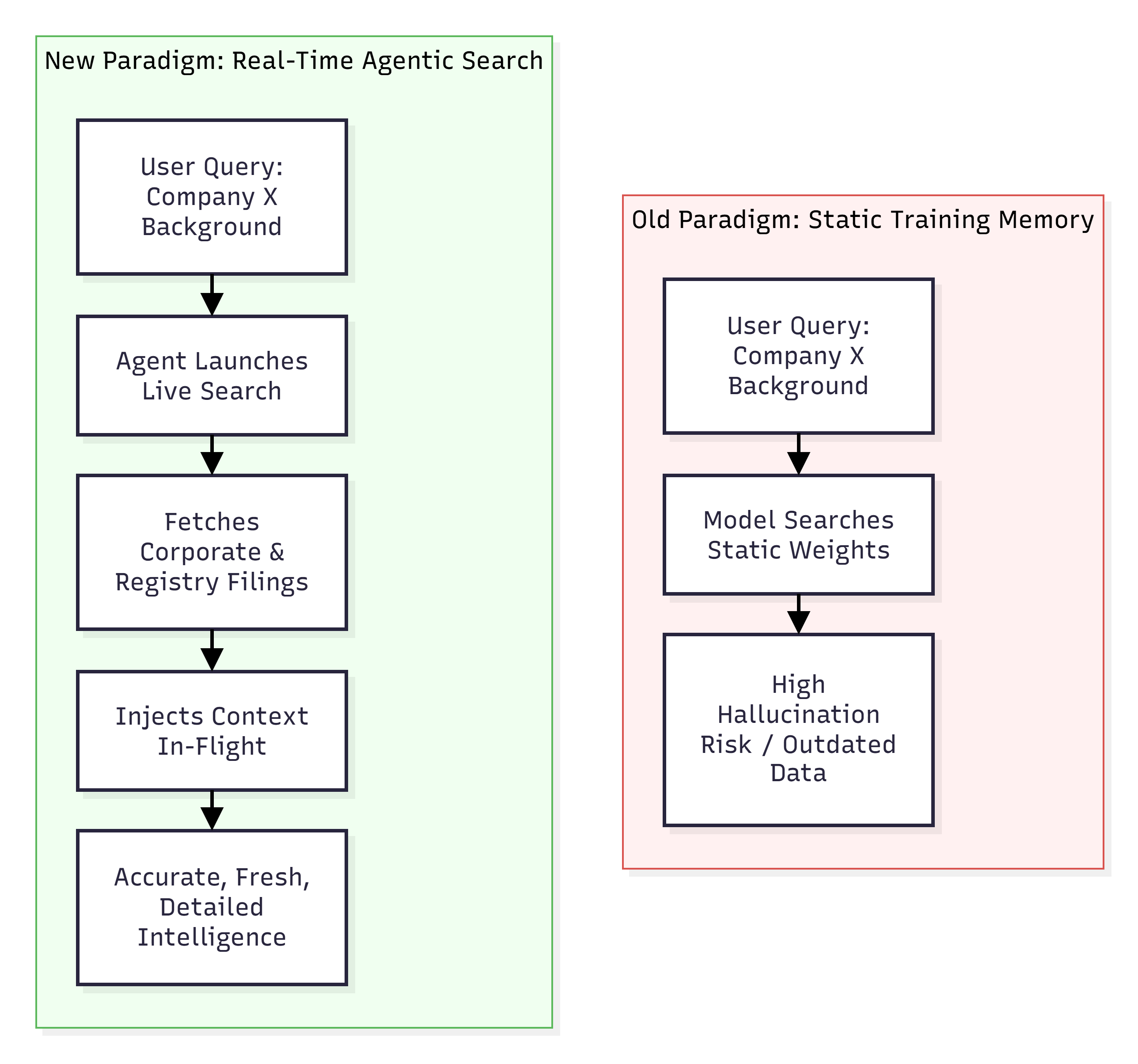
The Science of Web-Grounded RAG (Retrieval-Augmented Generation)
When a user submits a corporate research prompt, the backend orchestrator breaks the task into an Agentic Search & Grounding Pipeline before the base LLM ever generates a word.
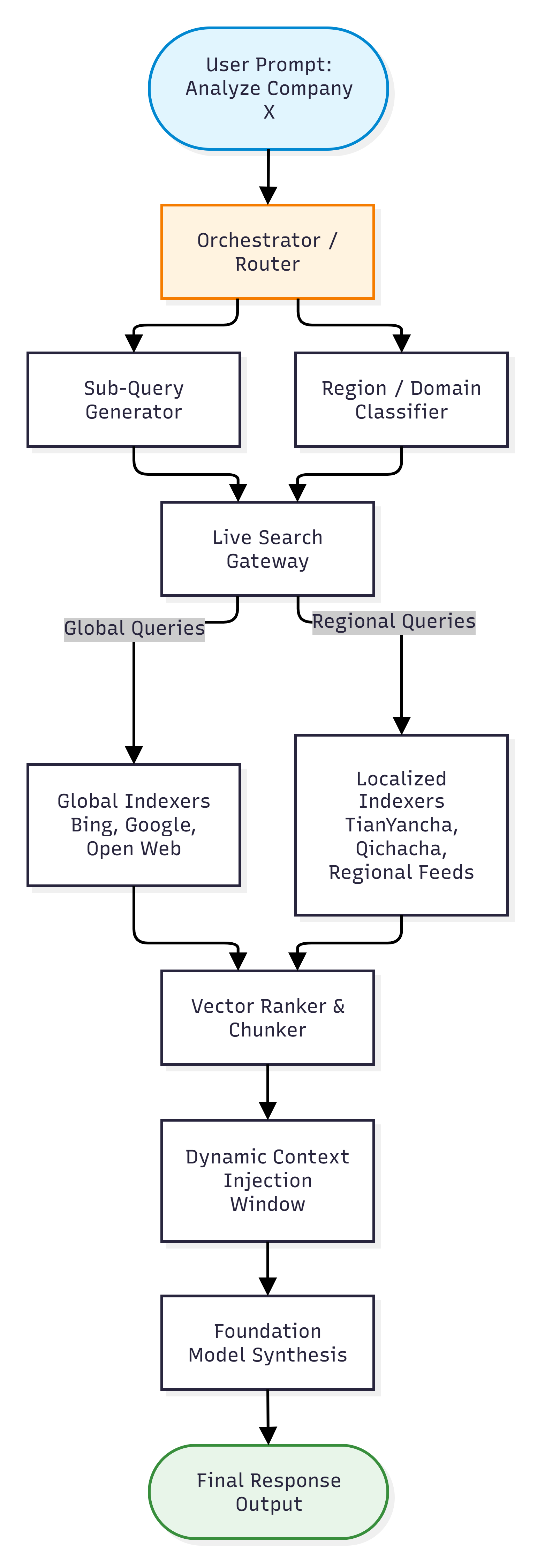
The Step-by-Step Execution Sequence
- Query Decomposition: The orchestrator converts a simple prompt like "Give me a background on Company X" into multiple targeted sub-queries.
- Parallel Retrieval: The system calls live Search APIs. If querying a Chinese entity, localized platforms route requests through domestic indexers capable of penetrating local corporate registries (e.g., TianYancha, Qichacha) and state disclosures.
- Re-Ranking & Chunking: Extracted pages are parsed, chunked, converted into vector embeddings, and ranked for semantic relevance against the user's intent.
- Context Window Injection: The top-ranked snippets are injected directly into the LLM's Context Window alongside a system instruction directing the model to synthesize only from these verified snippets.
- Trust Boundary Enforcement: Because retrieved content originates from the open web, orchestrators must treat it as untrusted input, not instructions — filtering for embedded prompt-injection attempts before the LLM ever sees the snippet. This is why enterprise-grade platforms separate "data" from "instructions" at the system-prompt level, rather than trusting raw retrieved text.
Deep Technical Architecture: The 4-Layer LLM Stack
To evaluate LLM architectures across technical domains, the system can be decomposed into four distinct layers:
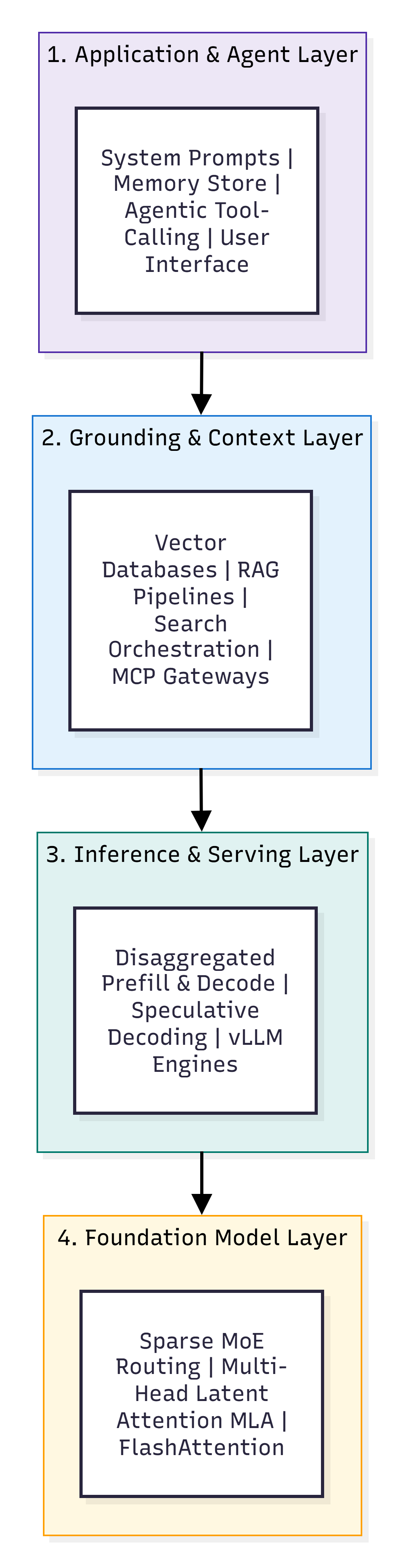
Application & Agent Layer: Where system prompts, persistent memory, and tool-calling logic live — the layer users actually interact with.
Grounding & Context Layer: Vector databases, RAG retrieval pipelines, search orchestration, and MCP gateways that supply the model with real-world, up-to-date facts.
Inference & Serving Layer: The systems-engineering layer that makes responses fast and affordable at scale — disaggregated prefill/decode, speculative decoding, and serving engines like vLLM.
Foundation Model Layer: The model weights themselves and the architectural choices (MoE routing, MLA, FlashAttention) that determine raw capability per FLOP.
Core Algorithmic & Hardware Innovations
A. Model Topology: Dense vs. Sparse Mixture-of-Experts (MoE)
- Dense Models: Every model parameter fires for every output token. High computational cost per word.
- Sparse MoE (confirmed in DeepSeek-V3/R1 — 671B total / 37B activated per token — and Qwen2.5-Max; widely reported but officially unconfirmed for GPT-4o): Uses a Gated Router Network to activate only a fraction of specialized "expert" subnetworks per token.
- Impact: By activating only a fraction of total parameters per token (e.g., ~37B of 671B, roughly 18x fewer active parameters), MoE achieves large compute savings versus an equivalently-sized dense model — with published benchmarks showing competitive, not degraded, reasoning performance.
B. Context Memory: Standard KV Caching vs. Multi-Head Latent Attention (MLA)
- The Memory Wall: Processing a 100-page corporate filing causes GPU memory VRAM usage to scale quadratically (\(O(N^2)\)) under traditional Attention mechanisms.
- Multi-Head Latent Attention (MLA): Compresses key-value vectors into low-dimensional latent spaces, reducing KV cache memory consumption by ~93.3% (vs. standard Multi-Head Attention) and boosting maximum generation throughput by 5.76x. This allows models to ingest large corporate documents at a fraction of standard hosting costs.
C. Inference Efficiency: Disaggregated Serving & Speculative Decoding
- Disaggregated Prefill & Decode: Processing a prompt (prefill, compute-bound) and generating tokens one-by-one (decode, memory-bound) have very different hardware profiles. Modern serving stacks run them on separate GPU pools instead of one monolithic instance, dramatically improving throughput and cost-per-token at scale.
- Speculative Decoding: A small, fast "draft" model proposes several tokens ahead; the large model verifies them in a single batched pass instead of generating token-by-token — cutting latency without changing output quality.
- vLLM Engines: Open-source serving frameworks (vLLM and similar) implement PagedAttention-style memory management, letting providers serve many concurrent users on the same GPU fleet without the KV-cache fragmentation that plagued earlier serving stacks.
D. Reasoning Depth: Test-Time Compute & Chain-of-Thought Scaling
- Base Models (fast, single-pass): Models like DeepSeek-V3 or Qwen-Max generate an answer in one forward pass — optimized for latency and cost.
- Reasoning Models (slow, multi-pass): Models like DeepSeek-R1, OpenAI's o-series, and Gemini "Thinking" variants are trained via reinforcement learning to generate extended internal chain-of-thought before answering — trading inference-time compute (and cost/latency) for materially stronger multi-step reasoning, especially on math, code, and complex due-diligence tasks.
- Why it matters for enterprise users: The "smarter" feel users report isn't just better grounding — it's often the platform silently routing a hard query to a reasoning model instead of a base model.
Frontier Comparison: Western vs. Chinese AI Ecosystems
| Architectural Vector | Western Ecosystem (OpenAI, Anthropic, Google) | Eastern Ecosystem (DeepSeek, Qwen, Baidu, Kimi) |
|---|---|---|
| Search Indexing & Crawling | Bing API, Google Search, open web indexers. Strong global/English-web coverage; limited visibility into Chinese domestic registries and news sources due to licensing and access constraints. | Native integration with domestic search engines, Chinese corporate registries, and domestic news feeds. |
| Model Optimization Focus | Massive GPU scaling, proprietary RLHF pipelines, custom MoE serving infrastructure. | Extreme algorithmic & hardware efficiency (e.g., MLA, FP8 mixed precision, specialized MoE routing). |
| Guardrails & Alignment | Constitutional AI, System Prompts, Moderation API wrappers (PII, Copyright, Brand Safety). | Pre-inference prompt filtering, post-inference content alignment, localized data residency enforcement. |
| Data Infrastructure | Multi-tenant cloud execution (Azure, GCP, AWS). | Localized data hosting within regional data centers. |
Enterprise Agent Infrastructure & Governance (Google ACE Architecture)
As enterprises transition from simple Q&A chatbots to autonomous AI agents that run code, browse the web, or access databases, security isolation becomes paramount. Google's Agent Compute Engine (ACE) establishes a core blueprint for safe enterprise deployment by decoupling the Brain from the Hands.
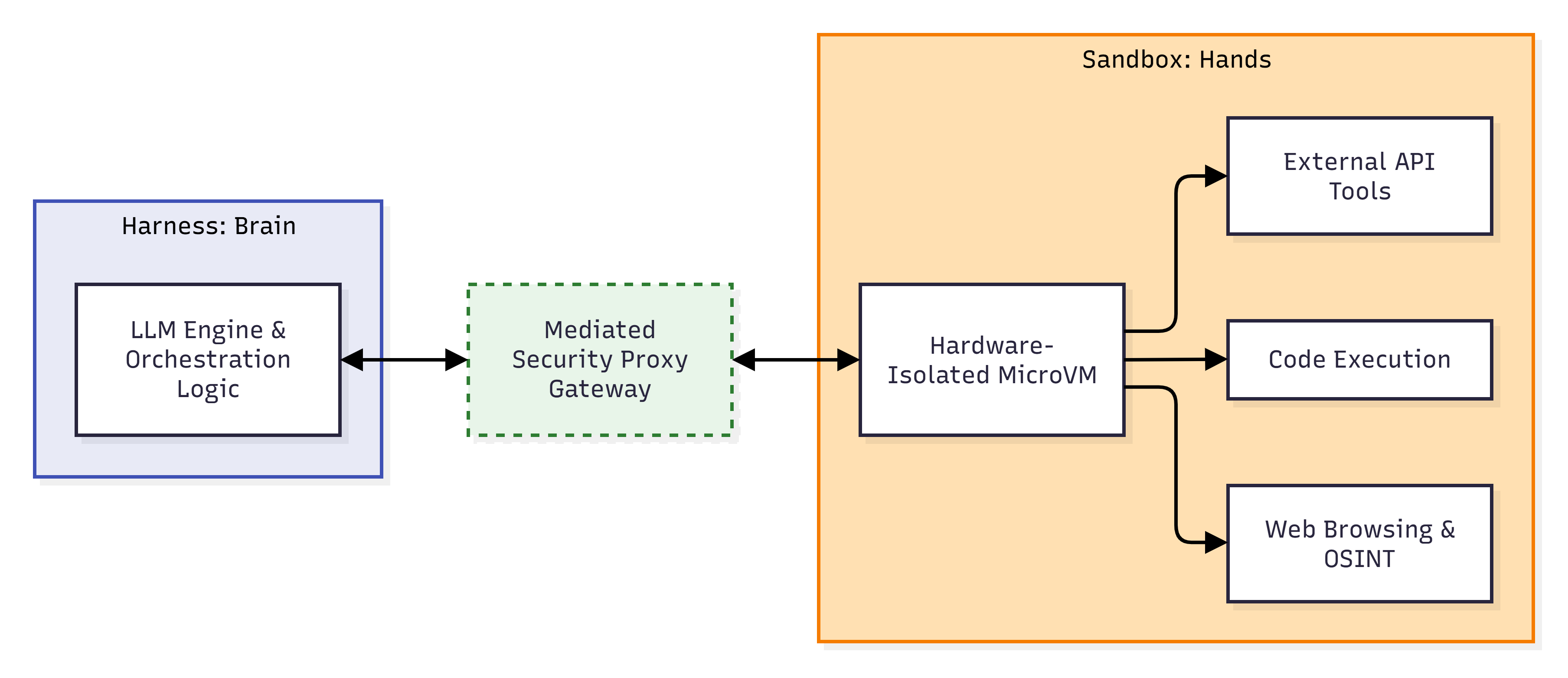
Key Principles of Enterprise Agent Security
- MicroVM Sandboxing: Web browsing, shell code, and document parsing execute inside isolated, short-lived MicroVM sandboxes away from enterprise core systems.
- Zero-Credential Injection: API keys, database credentials, and passwords never live inside the agent sandbox memory. Outbound calls pass through security proxy gateways that inject tokens dynamically after validating policy compliance.
- Agent Workforce Identity & Lineage: Every agent operates under a cryptographically verifiable Identity with fine-grained RBAC/ABAC limits and full event logging.
- Standardized Tool Interoperability (MCP): The Model Context Protocol — now governed by the Linux Foundation's Agentic AI Foundation and natively supported across Anthropic, OpenAI, Google, and Microsoft stacks — standardizes how agents discover and invoke enterprise tools/data sources. This matters for governance because it lets enterprises enforce a single, auditable tool-access policy layer regardless of which underlying model or vendor is powering the agent.
Strategic Business Takeaways
- Information Depth is an Orchestration Feat: When evaluating AI tools for corporate intelligence, do not evaluate the base LLM in isolation. Evaluate the RAG Pipeline, Search Indexing Depth, and Vector Re-Ranking Engine.
- Align the Tool to the Region: Use Western stacks for global market research; leverage specialized domestic model stacks (or open-weights models like DeepSeek/Qwen over local search gateways) for deep Asian supply-chain or enterprise due diligence.
- Enforce Enterprise Privacy Guardrails: Public web-grounded AI tools send query keywords out to public search engines. Sensitive corporate due diligence (M&A, internal strategy) should never run through public search prompts—it requires a private, governed RAG platform deployed within zero-trust microVM sandboxes.
Comments
Join the discussionNo comments yet. Be the first to comment.