Engineering Production Legal GenAI: True Neuro-Symbolic Architectures, Knowledge Graphs, and Singapore Common Law
When legal tech vendors pitch their AI platforms, the marketing narrative often sounds remarkably polished:
"Our platform uses a domain-specific neural network trained on millions of legal judgments to reason like a senior partner."
For engineering leaders and cloud architects, this narrative creates an immediate set of difficult questions:
Do we actually need to train or fine-tune a custom legal LLM from scratch?
How do we eliminate probabilistic hallucinations when calculating filing deadlines or checking precedent status?
How do neural perception, knowledge graphs, and deterministic legal logic safely interoperate in production?
The truth is that zero-hallucination legal AI isn't built by fine-tuning a single massive language model, nor is it achieved by bolting simple if/else procedural scripts and schema filters onto an LLM's output. True reliability requires a Neuro-Symbolic Architecture—a hybrid system where probabilistic LLMs act purely as semantic translators, parsing unstructured text into structured propositions, which are then evaluated by a declarative logic engine executing statutory rules and Common Law deduction.
Here is the comprehensive engineering blueprint for how production legal AI systems are actually built under the hood.
The Universal Control Plane: Probabilistic Perception vs. Deterministic Execution
Whether engineering legal AI platforms, autonomous Security Operations Centers (SOC), or enterprise data architectures, a single architectural principle holds true:
LLMs excel at probabilistic intent and entity parsing (System 1), but enterprise-grade legal determination, statutory compliance, and execution require deterministic symbolic control (System 2).
Relying solely on naive Vector RAG or procedural prompt filters introduces critical structural vulnerabilities:
Vector RAG Failure Mode: Vector databases operate on semantic distance, not veracity or rule hierarchy. They break documents into disjointed text chunks, stripping away relational logic, schema hierarchies, and strict policy conditions.
Procedural/Schema Guardrail Failure Mode: Pydantic type-checkers, regular expressions, and date calculators validate data formats, but they do not evaluate legal logic. If an LLM is asked to determine whether an exclusion clause is reasonable under statutory guidelines or whether a breach grants a right to terminate, leaving that judgment inside the LLM keeps the core reasoning path probabilistic.
To achieve zero-hallucination execution, modern enterprise legal architectures separate perception from formal deduction across four distinct stages:
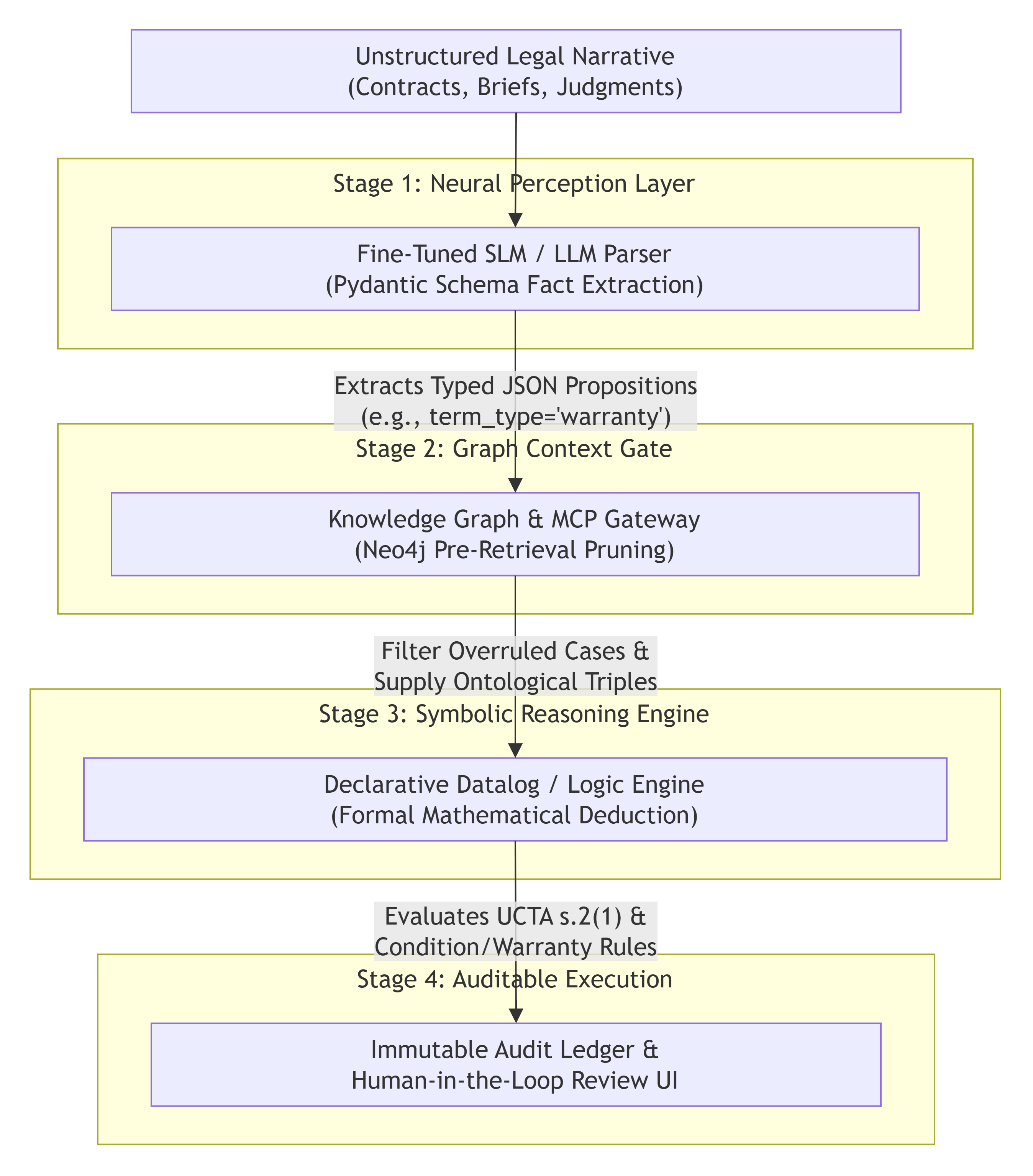
The Enterprise Legal AI Triad
Production legal AI separates non-deterministic language processing from deterministic legal logic across three distinct system layers:
1. The LLM (Perception & Natural Language Layer)
Acts as System 1 (Neural Parsing). It ingests messy 100-page contracts or unstructured litigation briefs and converts them into rigid, typed propositions (e.g., party_in_breach="Vendor_Corp", term_type="warranty", exclusion_scope="personal_injury_or_death"). The LLM is forbidden from deriving legal remedies or statutory consequences directly — those are delegated to the symbolic layer. Classification of underlying facts (e.g., term type) is still produced by the LLM and is a known trust boundary (see Limitations).
2. The Context & Knowledge Graph Layer (Ontology & Pre-Retrieval Filtering)
Handles structured schema resolution and precedent validity. It answers questions where truth depends on hierarchical authority and current status (e.g., checking if a precedent has been overruled or if a clause falls under specific statutory jurisdictions).
3. The Symbolic Execution Engine (Datalog & Rule Engines)
Handles System 2 (Deterministic Execution). This layer executes where zero variance is tolerated: deriving legal remedies using formal logic rules, calculating statutory limitation periods, and enforcing statutory invalidity (e.g., Unfair Contract Terms Act).
Deep-Dive into the Architecture Pillars
Pillar 1: Neural Fine-Tuning & Semantic Parsing (SLMs)
When legal tech vendors claim their system is "trained on legal data," engineering teams are rarely pre-training a foundation model from scratch. Instead, fine-tuning targets two specific areas:
Legal Dense Retrieval (Embedding Models): Fine-tuning specialized embedding models (e.g., Legal-BERT) ensures vector search retrieves legally relevant clauses rather than merely similar-sounding sentences.
Structured Fact Extraction (Fine-Tuned SLMs): Small Language Models (SLMs) are fine-tuned specifically to convert unstructured legal documents into strictly validated JSON schemas, guaranteeing zero missing fields when passing facts to backend symbolic engines.
Pillar 2: Knowledge Graphs & Pre-Retrieval Deterministic Filtering
Legal reasoning in Singapore Common Law is inherently hierarchical:
$$\text{Constitution} \longrightarrow \text{Statutes / Acts} \longrightarrow \text{Subsidiary Legislation} \longrightarrow \text{Judicial Precedents}$$
In Singapore:
Decisions of the Court of Appeal (SGCA) bind the General Division of the High Court (SGHC) and State Courts.
Decisions of the SGHC bind State Courts.
Commonwealth decisions (e.g., UK Supreme Court, High Court of Australia) are persuasive but non-binding.
If a Court of Appeal overrules a landmark judgment, a purely neural vector search might still retrieve that case because its text remains semantically relevant to the user's prompt.
To prevent LLMs from citing dead law, the architecture loads legal jurisdictions into a Graph Database (e.g., Neo4j, Spanner Graph):
Nodes:
Statute,Section,CourtJudgment,Judge,ContractClause.Edges:
OVERRULES,AMENDS,DISTINGUISHES_FROM,APPLIES_TO.
// Neo4j Pre-Retrieval Filter Query
MATCH (c:CourtJudgment {citation: $retrieved_citation})
OPTIONAL MATCH (c)<-[:OVERRULES]-(overruling:CourtJudgment)
RETURN c.citation AS citation,
       c.status AS status,
       count(overruling) > 0 AS is_overruled
If is_overruled returns true, the retrieval layer automatically prunes the precedent before it ever reaches the LLM's context window.
Pillar 3: True Symbolic Reasoning Engine (Datalog Integration)
To move beyond simple filters and procedural calculators, we introduce a declarative symbolic logic engine (pyDatalog / Datalog) into the execution path.
In Singapore Contract Law:
Breach of Condition: Grants the innocent party the right to terminate the contract and claim damages (RDC Concrete Pte Ltd v Sato Kogyo (S) Pte Ltd [2007] 4 SLR(R) 413).
Breach of Warranty: Grants the right to claim damages only—no right to terminate.
UCTA Section 2(1) (Cap. 396): A contractual term cannot exclude or restrict liability for death or personal injury resulting from negligence. Any such clause is automatically void.
UCTA Section 11 & Second Schedule: For exclusion clauses other than personal injury/death, validity depends on a reasonableness test — weighing factors such as relative bargaining power and whether the contract was on standard terms. Unlike s.2(1), this is not automatic and requires balancing multiple factors.
"Note: term_classification is asserted as an input fact from the LLM's extraction, not derived by the rule engine — the rules formalize the consequence of a classification, not the classification test itself. Rule 4 models a simplified proxy for the s.11 reasonableness test using two Second Schedule factors (bargaining position, standard form use); it is not exhaustive of all statutory factors and should not be treated as a complete reasonableness determination.
Step 1: Pydantic Schema for Neural Fact Parsing
The LLM extracts factual propositions into this strict schema:
# ============================================================
# Step 1: Pydantic Schema for Neural Fact Parsing
# ============================================================
from enum import Enum
from typing import Optional
from pydantic import BaseModel, Field

class TermClassification(str, Enum):
    CONDITION = "condition"
    WARRANTY = "warranty"
    INNOMINATE = "innominate"

class ExclusionScope(str, Enum):
    PERSONAL_INJURY_DEATH = "personal_injury_or_death"
    PROPERTY_DAMAGE = "property_damage"
    FINANCIAL_LOSS = "financial_loss"

class BargainingPosition(str, Enum):
    WEAK = "weak"
    EQUAL = "equal"

class ContractType(str, Enum):
    STANDARD_FORM = "standard_form"
    NEGOTIATED = "negotiated"

class FactExtractionPayload(BaseModel):
    case_id: str = Field(description="Unique identifier for the dispute/contract")
    party_in_breach: str
    term_classification: TermClassification
    has_exemption_clause: bool
    exclusion_scope: Optional[ExclusionScope] = None
    # Second Schedule (UCTA s.11) reasonableness inputs — required only when
    # exclusion_scope is not personal_injury_or_death, since s.2(1) is an
    # automatic bar and needs no reasonableness balancing.
    bargaining_position: Optional[BargainingPosition] = None
    contract_type: Optional[ContractType] = None
Step 2: The Datalog Symbolic Reasoner
The extracted payload is passed into a Datalog logic engine. The engine, not the LLM, evaluates the legal consequences:
# ============================================================
# Step 2: The Datalog Symbolic Reasoner
# ============================================================
# symbolic_reasoner.py
from pyDatalog import pyDatalog

def initialize_singapore_legal_logic():
    """
    Initializes Datalog terms and declares statutory and common law rules
    for Singapore Contract Law & UCTA.
    """
    pyDatalog.create_terms(
        'Case, TermType, ExclusionType, Position, ContractForm, '
        'breach, right_to_terminate, claim_damages, '
        'exemption_clause, bargaining_position, contract_type, '
        'clause_void_ucta'
    )

    # --- Rule 1: Breach of Condition -> Right to Terminate + Claim Damages ---
    right_to_terminate(Case) <= breach(Case, TermType) & (TermType == 'condition')
    claim_damages(Case) <= breach(Case, TermType) & (TermType == 'condition')

    # --- Rule 2: Breach of Warranty -> Claim Damages ONLY ---
    claim_damages(Case) <= breach(Case, TermType) & (TermType == 'warranty')

    # --- Rule 3: Statutory Invalidity under UCTA Section 2(1) ---
    # Automatic bar — no reasonableness balancing applies to personal injury/death.
    clause_void_ucta(Case) <= exemption_clause(Case, ExclusionType) & (ExclusionType == 'personal_injury_or_death')

    # --- Rule 4: UCTA Section 11 Reasonableness Test (Second Schedule factors) ---
    # Simplified proxy over two Second Schedule factors; not exhaustive of all factors.
    clause_void_ucta(Case) <= (
        exemption_clause(Case, ExclusionType) &
        (ExclusionType != 'personal_injury_or_death') &
        bargaining_position(Case, Position) & (Position == 'weak') &
        contract_type(Case, ContractForm) & (ContractForm == 'standard_form')
    )

    return pyDatalog

def evaluate_legal_facts(payload: FactExtractionPayload):
    pyDatalog = initialize_singapore_legal_logic()

    # Assert extracted facts into the Datalog engine
    + pyDatalog.breach(payload.case_id, payload.term_classification.value)
    if payload.has_exemption_clause and payload.exclusion_scope:
        + pyDatalog.exemption_clause(payload.case_id, payload.exclusion_scope.value)
    if payload.bargaining_position:
        + pyDatalog.bargaining_position(payload.case_id, payload.bargaining_position.value)
    if payload.contract_type:
        + pyDatalog.contract_type(payload.case_id, payload.contract_type.value)

    # Execute Formal Deduction
    can_terminate = bool(pyDatalog.right_to_terminate(payload.case_id))
    can_claim_damages = bool(pyDatalog.claim_damages(payload.case_id))
    is_void_ucta = bool(pyDatalog.clause_void_ucta(payload.case_id))

    return {
        "case_id": payload.case_id,
        "legal_deduction": {
            "right_to_terminate": can_terminate,
            "right_to_claim_damages": can_claim_damages,
            "exclusion_clause_void_ucta": is_void_ucta
        },
        "symbolic_proof_trace": [
            f"Rule 'right_to_terminate' evaluated to {can_terminate} for term_type='{payload.term_classification.value}'",
            f"Rule 'clause_void_ucta' evaluated to {is_void_ucta} for scope="
            f"'{payload.exclusion_scope.value if payload.exclusion_scope else 'None'}', "
            f"bargaining_position="
            f"'{payload.bargaining_position.value if payload.bargaining_position else 'None'}', "
            f"contract_type="
            f"'{payload.contract_type.value if payload.contract_type else 'None'}'"
        ]
    }
Pillar 4: Procedural Calculators (Statutory Limitation Math)
For pure numerical and date operations (such as statutory filing windows under the Singapore Limitation Act 1959), procedural code execution handles exact calendar calculations:
from datetime import date

def calculate_singapore_limitation_deadline(cause_of_action_date: date, claim_type: str) -> dict:
    """
    Exact calendar calculation for Singapore Limitation Act 1959.
    Executes in pure Python with zero LLM variance.
    """
    def _add_years(start_date: date, years: int) -> date:
        try:
            return start_date.replace(year=start_date.year + years)
        except ValueError:
            return start_date.replace(month=2, day=28, year=start_date.year + years)

    periods = {
        "PERSONAL_INJURY_NEGLIGENCE": (3, "Limitation Act 1959, Section 24A"),
        "CONTRACT_BREACH": (6, "Limitation Act 1959, Section 6(1)(a)"),
        "TORT_NEGLIGENCE": (6, "Limitation Act 1959, Section 6(1)(a)"),
        "DEED_SPECIALTY": (12, "Limitation Act 1959, Section 6(3)")
    }

    if claim_type not in periods:
        return {"is_actionable": False, "reason": "Unsupported or unrecognized claim type"}

    years, statute = periods[claim_type]
    deadline = _add_years(cause_of_action_date, years)

    return {
        "is_actionable": date.today() <= deadline,
        "filing_deadline": deadline.isoformat(),
        "governing_statute": statute,
        "statutory_period_years": years,
        "calculation_method": "Deterministic exact calendar math"
    }
Reference Architecture Mapping (Singapore Legal Framework)
| Legal Domain | Governing Statutory / Precedent Framework | Architectural Processing Layer |
|---|---|---|
| Limitation Periods | Limitation Act 1959, Section 6(1)(a) | Procedural Calculator: Exact calendar math microservice |
| Exclusion Clauses (Personal Injury/Death) | Unfair Contract Terms Act 1977 (UCTA) s.2(1) | Symbolic Engine: Datalog automatic-bar rule (no reasonableness balancing required) |
| Exclusion Clauses (Other Loss) | Unfair Contract Terms Act 1977 (UCTA) s.11 & Second Schedule | Symbolic Engine: Datalog reasonableness-factor rule (bargaining position, standard form use) |
| Contract Breach Remedies | RDC Concrete Pte Ltd v Sato Kogyo (S) Pte Ltd [2007] 4 SLR(R) 413 | Hybrid: Term classification (condition/warranty) via Neural SLM Parser; remedy consequence via Symbolic Engine deduction |
| Precedent Status | Doctrine of Stare Decisis (SGCA \(\rightarrow\) SGHC) | Knowledge Graph: Neo4j traversal & OVERRULES edge filtering |
| Fact Parsing | Unstructured Contracts & Court Opinions | Neural SLM Parser: Pydantic JSON schema extraction |
Marketing Claims vs. Engineering Reality
| Vendor Marketing Claim | Production Engineering Reality |
|---|---|
| "We built a custom neural network that understands legal reasoning." | Fine-tuned SLMs for JSON fact parsing + a declarative Datalog symbolic logic engine. |
| "Our AI reasons through complex litigation precedent." | An LLM Agent queries a Knowledge Graph (Neo4j) to prune overruled cases via precedent hierarchy traversal; the graph stores authority status and citation relationships, not the substantive content of what those authorities require. |
| "Zero-Hallucination Legal Intelligence." | Deterministic Datalog rules and procedural APIs handle remedy derivation, UCTA voidness/reasonableness checks, and date math with zero variance. Term classification (condition vs. warranty) is still produced by the LLM as an input fact and is not independently verified by the symbolic layer — this step remains probabilistic and subject to human review. |
Classification inputs (term type) are asserted by the LLM, not symbolically derived or checked.
Only UCTA s.2(1)'s automatic bar is rule-encoded; the s.11 reasonableness test is out of scope in this reference implementation.
Rules shown are single-antecedent; production systems should validate the engine against multi-fact/conflicting-rule scenarios before relying on it for defeasible reasoning.
Architecture layers & how they interact

A production-grade demonstration of a true neuro-symbolic AI architecture for Singapore common law and statutory compliance reasoning, wrapped in a real-time chatbot interface with full GovOps runtime governance. It strictly separates:
Neural Semantic Parsing (LLM) — extracts structured facts only, never a legal verdict.
Knowledge Graph Context (Neo4j / NetworkX) — filters out overruled precedents (stare decisis) before reasoning.
Declarative Symbolic Deduction (
pyDatalog+ a plain-Python rules engine) — the only components allowed to decide legal outcomes.Procedural Math — exact calendar arithmetic for limitation periods.
GovOps Runtime Governance — OpenTelemetry distributed tracing with W3C
traceparentpropagation, FinOps token/cost tracking with circuit breakers, iteration caps, and a MAS SAFR disposition envelope (AUTO_EXECUTE/OBSERVE/ESCALATE/DENY).Chatbot safety & routing — every message is screened by a content-safety guardrail before anything else runs, and is routed to either the deterministic legal pipeline or a generic conversational reply.
Conclusion
Building defensible, enterprise-grade AI for high-stakes industries like legal or healthcare doesn't require reinventing foundation models or trusting probabilistic language models with logical deduction.
The real engineering moat lies in constructing a rigorous Neuro-Symbolic Control Plane: delegating semantic parsing to the neural layer (System 1) while enforcing legal determinations, precedent validation, and statutory calculations through declarative Datalog logic engines and Knowledge Graphs (System 2).
By decoupling perception from deduction, enterprise architectures transition legal GenAI from unpredictable chatbots into trusted, zero-hallucination execution platforms. ...trusted, zero-hallucination execution platforms for the deterministic slice of the workflow — with classification and open-textured judgment still requiring human-in-the-loop review.
Architectural Note & Technical Precision
Special thanks to industry peers for valuable feedback regarding terminology precision.
In early drafts of legal GenAI systems, pre-retrieval graph queries, Pydantic schemas, and procedural calculators are often loosely referred to as "neuro-symbolic." In this framework, we strictly distinguish between Deterministic Guardrails (filters/calculators) and a True Symbolic Reasoner (a declarative Datalog logic engine). By delegating all legal deduction to the Datalog engine—and restricting the LLM purely to semantic fact extraction—the architecture achieves true mathematical deduction and complete proof traceability under Singapore Common Law.
GitHub Repository & Control Plane Architecture:
Comments
Join the discussionThank you for this spot-on critique—it forced a fundamental shift in my architectural design. I’ve rewritten the paper to decouple neural semantic parsing from a true declarative Datalog engine (pyDatalog), where encoded statutory rules (UCTA & Singapore Common Law) perform the actual logical deduction instead of the LLM. Really appreciate you calling out the gap between filters and true reasoners—v2 is much stronger because of it!
The architecture isn't neuro-symbolic because nothing in it symbolically reasons. . What this article describes instead is a neural system with deterministic guardrails bolted to its inputs and outputs: a graph query strips overruled precedents before retrieval, Pydantic schemas typecheck the extraction, and a hardcoded function does calendar arithmetic for limitation periods. Every one of those is a filter or a calculator, not a reasoner. The actual legal determination — whether a term is a condition or a warranty, whether an exclusion clause is reasonable under UCTA, is still produced by the LLM, and no symbolic layer ever evaluates it, because there are no rules encoded to evaluate it against. The knowledge graph stores metadata about authorities (status, citation relationships); it does not represent what those authorities require. So the "zero-hallucination" claim holds only for the thin slice delegated to the calculators, while the reasoning path remains fully probabilistic.