Architecting Agentic AI in Enterprise Logistics: System Patterns, Guardrails, Vendor Ecosystem, and Production Realities
The deployment of generative AI in enterprise supply chains has evolved beyond basic document parsing and chatbot interfaces. Modern logistics platforms require Agentic AI—autonomous systems capable of perceiving environmental inputs, reasoning across multi-constraint domains, executing API tool calls, and resolving operational disruptions proactively.
This article synthesizes key operational blueprints, system prompt guardrails, failure modes, real-world vendor implementations, and a step-by-step roadmap for building enterprise-grade logistics agents.
1. Industry Scale & Market Friction
Enterprise supply chains operate under heavy communication volume and structural fragmentation:
High Unstructured Volume: Global carriers handle hundreds of thousands of operational emails and millions of voice-dispatch minutes annually.
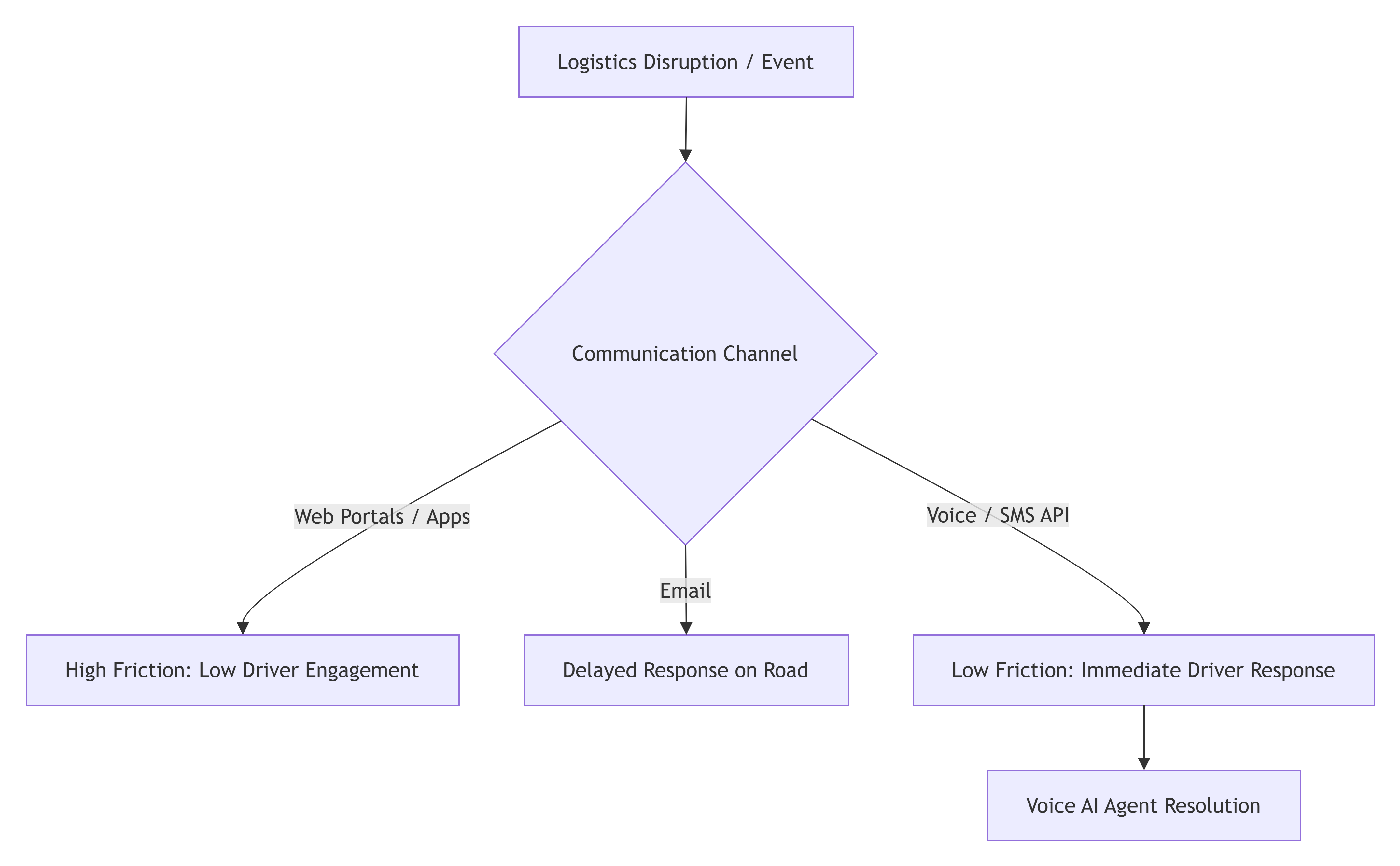
Channel Friction in Fragmented Markets: Over 80% of the freight market consists of independent operators running fleets of 1 to 5 trucks. These operators rarely log into proprietary web portals or check emails while en route. However, drivers consistently answer phone calls.
The Voice AI Advantage: Autonomous voice and conversational agents succeed by meeting carriers on their existing channels (Voice/SMS APIs) to handle routine appointment scheduling, driver follow-ups, and dock coordination.
2. High-ROI Use Cases & Strategy
Rather than attempting broad domain automation, agentic workflows pay off fastest when focused on targeted operational bottlenecks:
Initial Selection Framework
When selecting the first agentic process to automate, use a two-variable selection matrix:
High Frequency: Select workflows occurring hundreds of times per week to amortize initial setup and orchestration costs over high transaction volume.
Low Blast Radius: Choose processes where an agent error results in an embarrassing oversight (e.g., an unnecessary follow-up email) rather than an expensive operational failure (e.g., misquoted freight rates or lost customs status).

3. Production Architecture: "The Pattern to Copy"
To ensure predictable behavior across real-time freight networks, agentic systems should adhere to a simple, event-driven pattern:
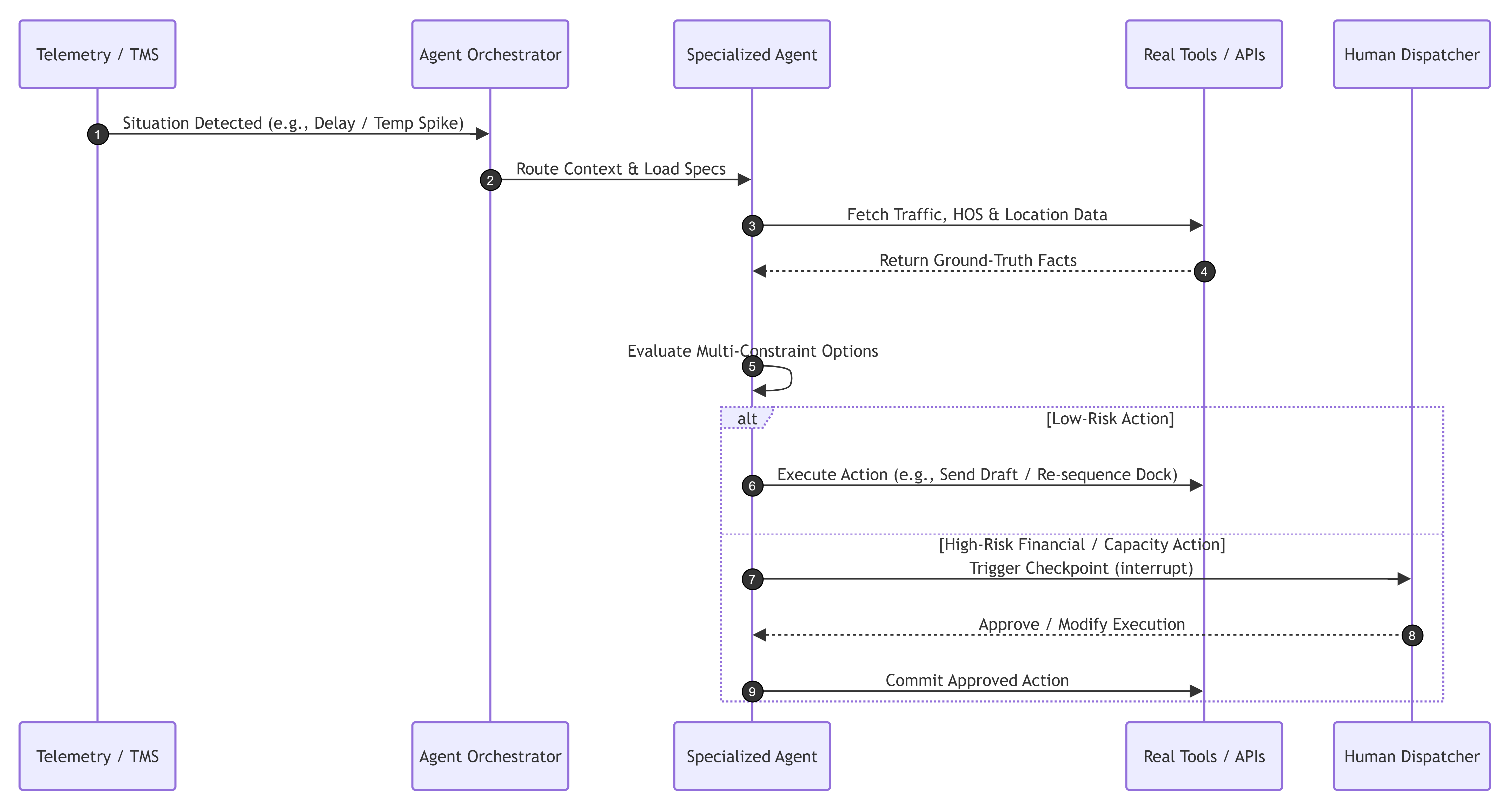
Action over Alerts: Agents must execute resolution paths (e.g., re-booking capacity, dispatching notifications) rather than generating passive dashboard alerts.
Context-Driven Autonomy: Action selection dynamically responds to real-time ground truths (traffic delays, cold-chain temperature limits, driver hours-of-service).
Single-Responsibility Micro-Agents: Maintain narrow agent scopes—such as separate micro-agents for Route Analysis and Carrier Communication—rather than a single monolithic model.
4. Hard Guardrails & Code Implementation
To prevent financial and legal liability, LLM agents require deterministic boundaries enforced directly at the prompt and framework level.
System Prompt & Execution State Flow
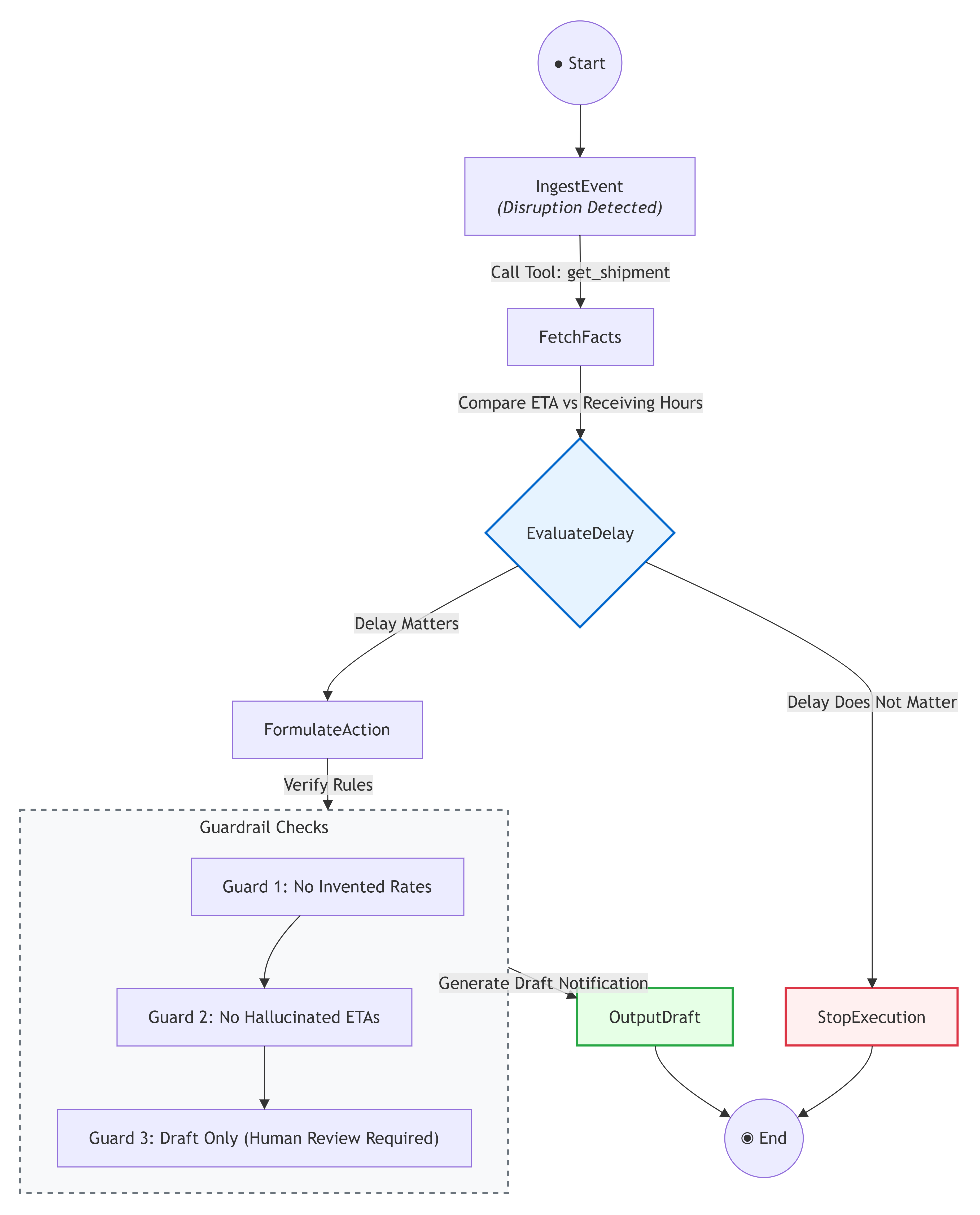
Prompt Enforcement
System prompts must explicitly restrict parametric hallucination:
from langgraph.prebuilt import ToolNode, tools_condition
from tools import get_shipment, check_traffic, send_customer_email

TOOLS = [get_shipment, check_traffic, send_customer_email]

SYSTEM = """You are a freight operations agent for a US truckload carrier.

When a shipment is at risk, find out what is actually going on before you do
anything. Judge whether the delay matters against the promised arrival and the
customer's receiving hours. If it matters, notify the customer with a short,
specific message. If it does not matter, say so and stop.

Never invent a rate, an arrival time, or a reason for a delay. If you need a fact,
use a tool to get it."""

llm = ChatAnthropic(model="claude-sonnet-5", max_tokens=2048).bind_tools(TOOLS)
Specialized Sub-Agent Workflows
In orchestrated multi-agent environments, distinct markdown prompts govern sub-agent behaviors:
Route Analysis Sub-Agent: Analyzes route options (wait, reroute, split load, re-cover) against transit time costs. Enforces strict factual constraints: Read shipment details from project files. Never invent distances, transit times, or road conditions.
Carrier Communication Sub-Agent: Formulates direct outreach messages. Enforces strict policies: Never quote a rate, never promise delivery times unsupported by routing analysis, and keep customer messages under 90 words. All outputs default to Draft Only status for human approval.
5. Production Limits & Mitigation Strategies
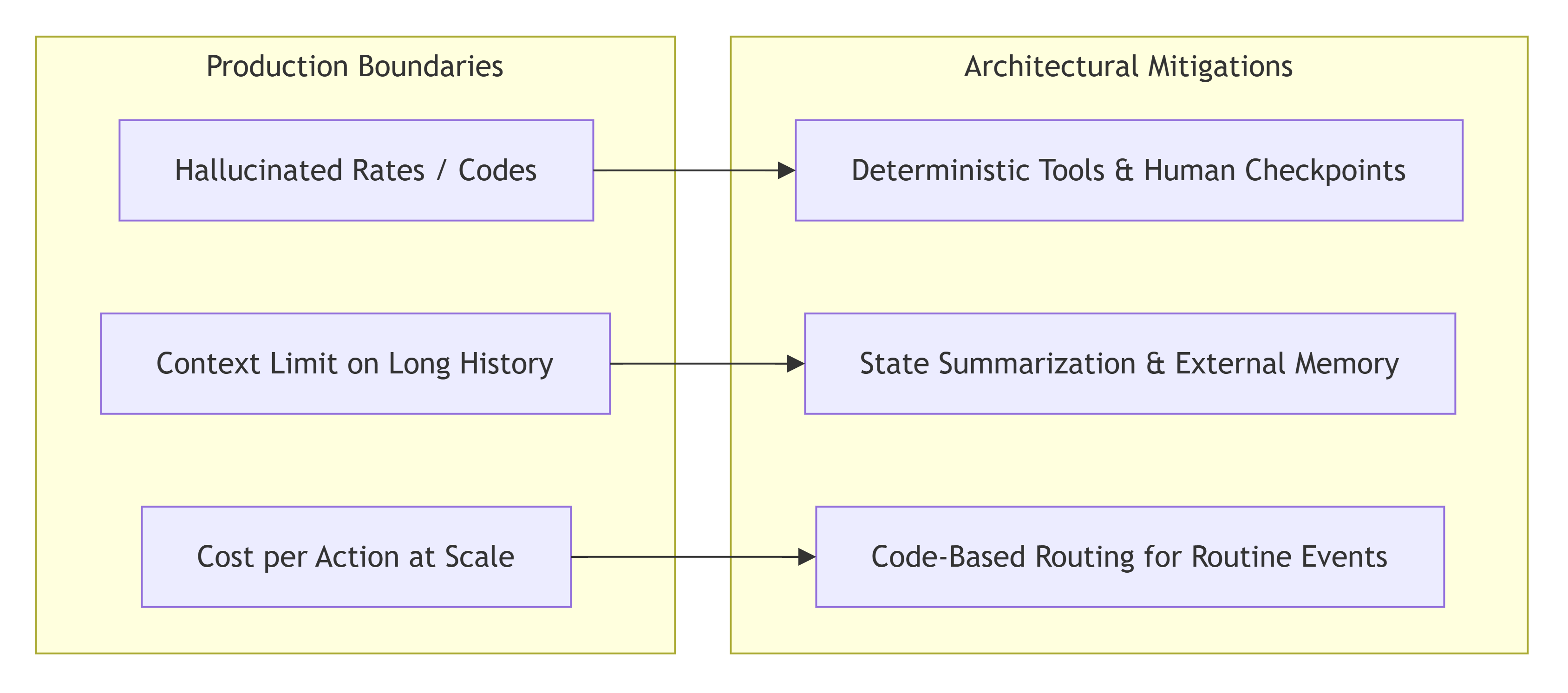
Architecting logistics agents for enterprise scale requires planning around three core technical limits:
| Production Boundary | Operational Impact | Mitigation Architecture |
|---|---|---|
| Hallucinated Rates & Customs Codes | Invalid HS codes or false rate quotes cause regulatory fines and direct financial losses. | Require API tool verification for all factual queries; gate financial commitments behind Human-in-the-Loop (interrupt()) steps. |
| Context Limits on Long Histories | Multi-stop loads generate extensive telemetry, tracking logs, and check calls that overwhelm LLM context windows. | Summarize graph state, prune chat histories in memory states, and persist raw telemetry in external relational/vector storage. |
| Cost per Action at Scale | Unchecked LLM reasoning loops over routine telemetry updates inflate API execution costs. | Restrict LLM invocations to exception-handling triggers; process standard status updates through deterministic code paths. |
6. Vendor Ecosystem Alignment
Leading logistics technology providers specialize across different operational layers of the agentic stack:
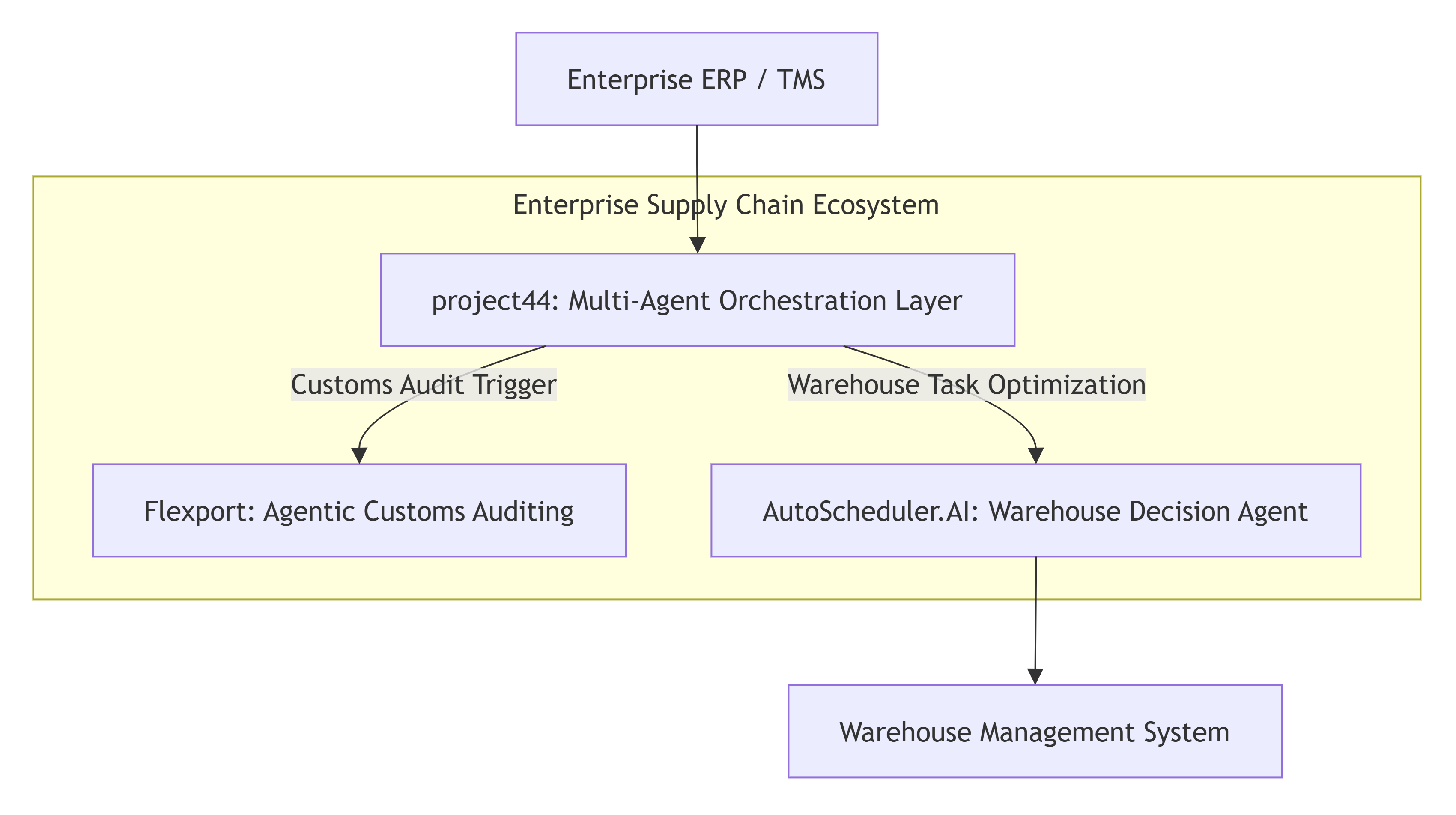
Flexport (Agentic Customs Auditing): Deploys compliance agents that scan historical customs entries to identify tariff errors, incorrect Harmonized System (HS) classifications, and duty overpayment refund opportunities.
project44 (Multi-Agent Orchestration): Coordinates multi-agent workflows across ocean, rail, and over-the-road networks—linking disruption detection agents with routing and carrier engagement agents.
AutoScheduler.AI (The Warehouse Decision Agent): Sits as an intelligent decision layer above existing Warehouse Management Systems (WMS) to resequence labor, dock allocation, and task prioritization in real time as operational exceptions occur.
7. Implementation Roadmap: Next Four Steps
To transition agentic logistics from concept to production, execute this four-phase adoption framework:

Pick One High-Frequency Exception: Identify a single operational scenario occurring many times per week where errors carry low financial blast radius (e.g., chasing carrier status updates or auditing linehaul documentation).
List the Tools the Agent Needs: Map out the exact deterministic APIs, database connectors, and external lookup services required for the agent to retrieve ground-truth facts without hallucination.
Pilot with an Approval Checkpoint: Deploy the agent with mandatory Human-in-the-Loop gates (
interrupt()) for high-stakes decisions (e.g., committing budget, rebooking capacity, or issuing customer notifications).Measure Against Your Reactive Baseline: Evaluate performance metrics—such as time to exception resolution, manual effort reduction, and exception recovery speed—against traditional manual processes.
Executive Summary
Logistics runs on exceptions, and agentic AI represents the first wave of systems capable of perceiving, reasoning, and acting on operational disruptions rather than merely reporting them on dashboard alerts.
Enterprise platforms like Uber Freight, DHL, and Flexport actively run autonomous workflows in production. To ensure safety and ROI:
$$\text{Production Agent} = \text{Narrow Job} + \text{Real Tools} + \text{Human Accountability for Big Calls}$$
Let agents act autonomously on reversible work, enforce approval checkpoints for financial commitments or capacity changes, and start implementation with a single high-frequency exception scenario.
Comments
Join the discussionThank you for the article, very interesting especially because it brings the topic of Agentic AI outside the demo and into a context where an error can have real economic consequences.
Linking the agent's autonomy and automation to actions for which an error is reversible also through rollback or human in the loop is actually an intelligent way to manage this process. For example, it makes me think of dynamics related to autonomous driving, which over the years has had to deal with errors and responsibilities and still hides some legal grey areas.
Off topic aside, retrieving through APIs and deterministic tools elements that should not be interpreted and the ground truth is equally important. Actually, progressively increasing autonomy while reducing the possibility and consequences of errors seems like an oxymoron, but by reasoning element by element and introducing guardrails we can gradually get closer to it.
Congratulations again and thank you for the article
The issue is that "prompt-based guardrails" are insufficient to ensure safety.
The article emphasizes that system prompts can prevent an agent from fabricating shipping rates, delivery times, or reasons for delays. However, prompts serve only as a layer of soft guidance. An agent can still:
Misinterpret data from APIs. Invoke the wrong tool. Misjudge the severity of an incident. Send inappropriate notifications. Execute a sequence of actions that is syntactically correct but violates business logic. Be influenced by malicious or unreliable input data.
In other words, prompts should not be viewed as the primary control mechanism. Critical actions require safeguards such as API permissions, schema validation, policy engines, transaction limits, audit logs, and rollback mechanisms.
Spot-on analysis, Playmodgame1111—I completely agree. System prompts are at best a "soft steering mechanism," not a security or compliance boundary.
If an architecture relies solely on a system prompt saying "Never invent a rate," it will eventually fail in production. That’s why the article framing emphasizes that prompts are only one layer in a broader defense-in-depth model:
- Deterministic API & Schema Validation: Factual inputs (rates, ETAs, HS codes) must be retrieved through deterministic tools with strong typing and schema validation before reaching the LLM context.
- Policy Engines & Execution Gates: The prompt acts as local guidance, but the orchestrator (e.g., LangGraph state machine) enforces hard limits—forcing high-stakes financial commitments or capacity re-bookings behind Human-in-the-Loop (
interrupt()) state checkpoints. - Non-LLM Routing for Routine Telemetry: High-frequency, standard state transitions are moved out of the LLM entirely and handled via deterministic code paths to bound both execution risk and API costs.
Prompts provide intent alignment, but enterprise safety strictly requires hard deterministic policy layers, API-level scope permissions, and transactional circuit breakers around the agent. Appreciate you highlighting this crucial distinction!
Thanks Puneet! Absolutely—there’s often a massive gap between a prototype that looks great in a demo and an enterprise agent handling multi-stop loads with messy telemetry, noisy API responses, and real financial liability.
Getting the guardrails right before pushing to production—especially around rate verification, context pruning, and human approval gates—is the difference between an agent that saves dispatchers 10 hours a week and one that accidentally commits budget on bad data. Glad those production realities resonated with you!
The part about production realities hits home. Too many teams ignore the guardrails until something breaks in transit.