
Beyond Monolithic RAG: Architectural Blueprints for Persistent, Long-Horizon AI Agents
Executive Summary
The rapid evolution of Generative AI from passive conversational interfaces to enterprise-grade autonomous systems has exposed the limitations of traditional implementation paradigms. Monolithic Retrieval-Augmented Generation (RAG), single-shot prompt loops, and stateless agent scripts fail under the demands of multi-day execution, complex tool use, and stringent regulatory environments.
When multi-agent systems interact, dynamically route tasks, and execute API calls in production, they encounter significant challenges: state loss during model migration, quadratic token inflation, context degradation, and unbounded execution loops.
This blueprint presents a unified, production-ready architectural stack for next-generation agentic systems. By integrating persistent identity substrates, symbolic world-model verification, declarative attention control, and runtime governance (GovOps), enterprise technology leaders can deploy scalable, resilient, and verifiable autonomous agents.
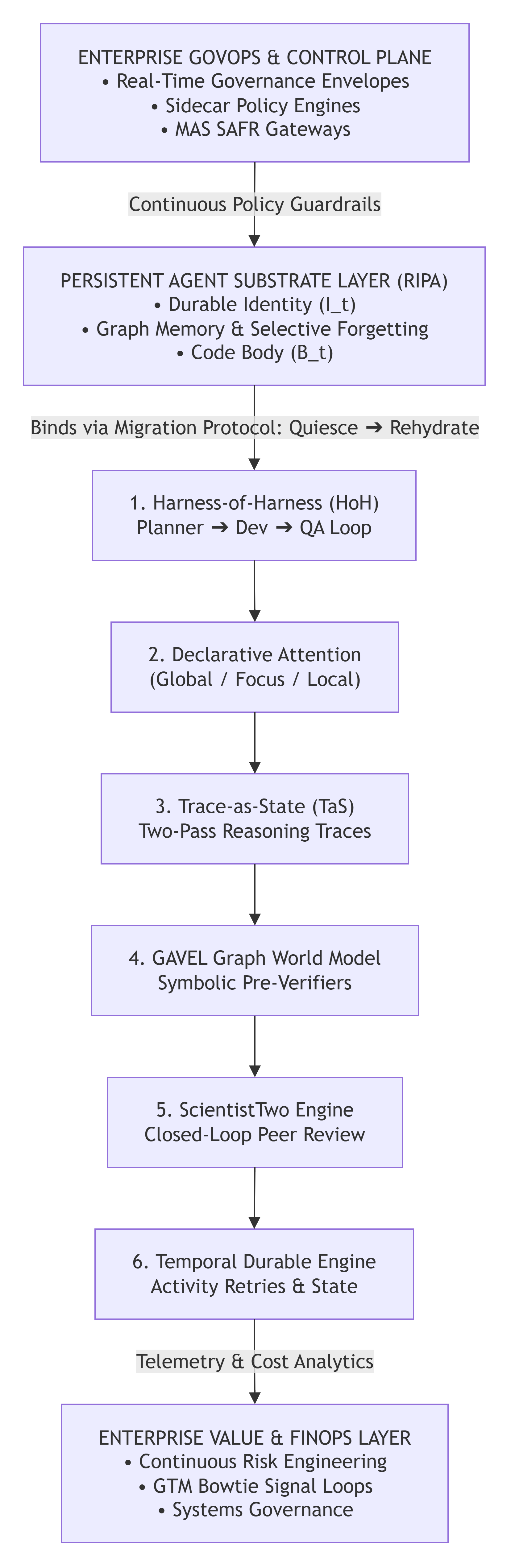
Pillar 1: Persistent Substrates & Graph State Management
Stateless runtime engines treat agents as transient processes. When underlying foundational models are updated or hosted environments change, the agent's context, behavioral alignment, and execution history are often lost. Modern enterprise architectures must decouple the Agent Substrate from the Execution Engine.
1. Runtime-Independent Persistent Agents (RIPA)
The RIPA paradigm defines an agent as a persistent tuple:
P_t = (I_t, M_t, B_t)
Where I_t represents immutable cryptographic identity and authority, M_t is private durable memory, and B_t is the versioned executable code body. The execution environment E_t = (R_t, H_t, D_t)—composed of the LLM reasoner (R_t), orchestration harness (H_t), and hosting infrastructure (D_t)—is treated as an interchangeable runtime.
State migrations follow a strict six-stage lifecycle protocol:
Quiesce ➔ Checkpoint ➔ Validate ➔ Bind ➔ Rehydrate ➔ Resume
This decoupling allows enterprise teams to swap underlying foundation models or migrate across cloud providers without losing execution history, state, or governance lineage.
2. Graph-Based Memory with Selective Forgetting
Vector-only RAG systems frequently struggle with multi-hop reasoning, relationship drift, and context noise. Moving to a graph-structured memory model represents turn-by-turn interactions as typed entity nodes and directed relation edges.
To prevent infinite graph expansion from causing context bloat and performance degradation, systems incorporate a neuro-inspired Selective Forgetting Engine. Graph nodes are dynamically scored and pruned according to a multi-factor retention function:
S(v) = (w1 * R(v)) + (w2 * F(v)) + (w3 * C(v)) - (w4 * A(v))
Where:
R(v) is Recency (exponential decay based on last access time).
F(v) is Access Frequency over a sliding window.
C(v) is Degree Centrality within the knowledge graph.
A(v) is absolute node Age.
Pruning low-scoring nodes maintains bounded context sizes, preserving direct recall efficiency and eliminating unnecessary reasoning loops.
Pillar 2: Execution Engineering & Inference Efficiency
Scaling autonomous systems to handle multi-day, long-horizon tasks requires dedicated execution harnesses and attention management.
1. The Harness-of-Harness (HoH) Meta-Loop
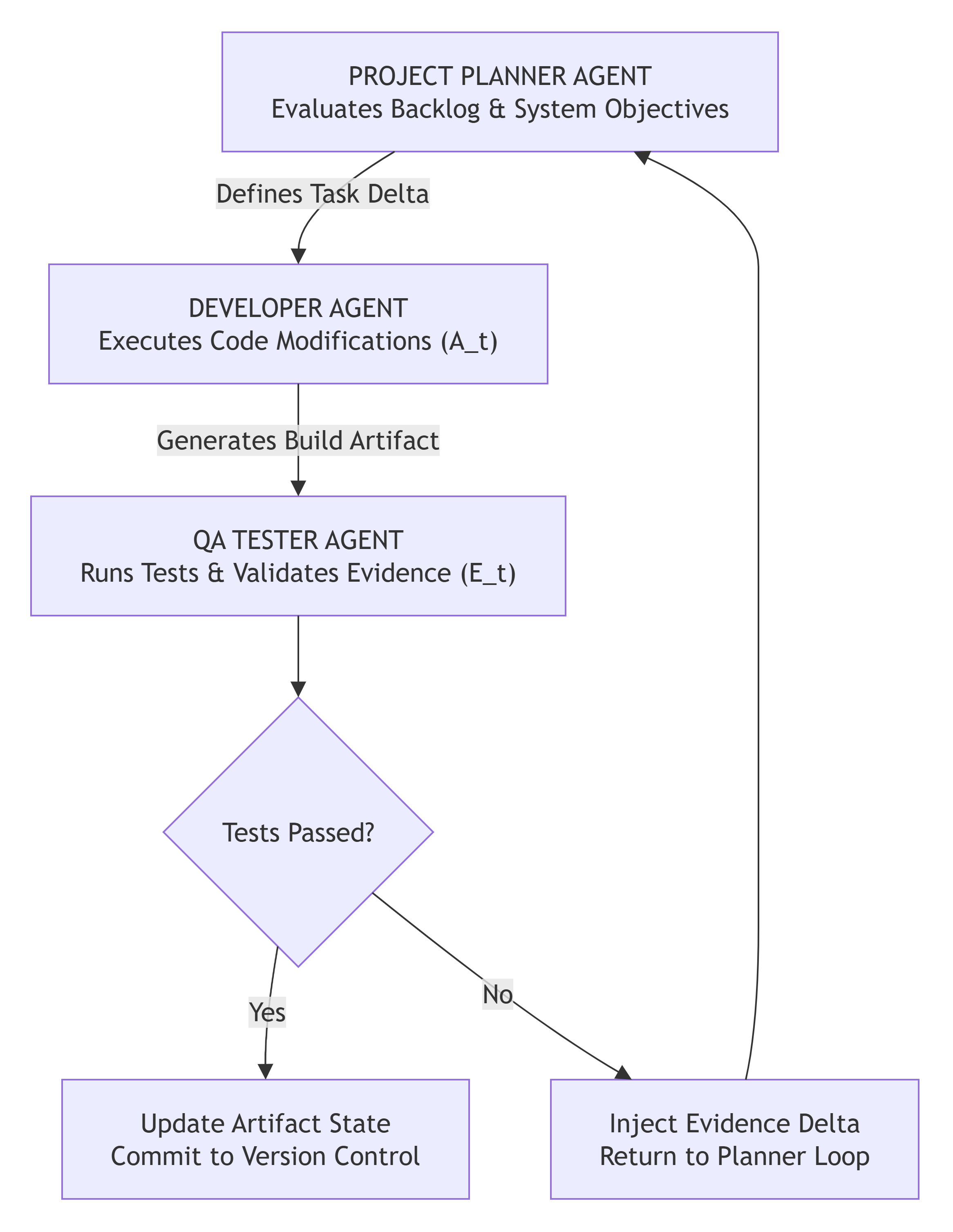
Multi-day software engineering tasks often fail when single-agent harnesses run out of context or get stuck in regression loops. The Harness-of-Harness (HoH) architecture uses a multi-agent framework operating across three specialized roles:
Project Planner: Breaks high-level requirements into incremental task deltas.
Developer: Writes source code and configuration files.
QA Tester: Executes test suites and validates runtime execution.
State management is split into two explicit tracking streams:
Artifact State (A_t): The evolving source code tree, configuration files, and build assets.
Evidence State (E_t): Verifiable records of test results, error logs, execution traces, and performance metrics.
Through Progressive Disclosure, detailed build logs are offloaded to disk while high-level summary states are passed into context. This prevents context exhaustion and supports long-horizon execution cycles.
2. Declarative Attention & Trace-as-State Optimization
Expanding LLM context windows can introduce latency and attention dilution. Modern inference architectures address this using two complementary techniques:
Declarative Attention (DA): The model explicitly manages its Key-Value (KV) cache allocation by emitting structured mode tags within its reasoning process:
<ATTN:GLOBAL>: Scans the full context window during discovery phases.<ATTN:FOCUS[range]>: Restricts attention to specific token ranges during retrieval.<ATTN:LOCAL>: Limits attention to the active prompt and immediate generated output during step-by-step reasoning.
Restricting attention to relevant context segments reduces KV-cache computation during decoding, improving generation throughput.
- Trace-as-State (TaS): To resolve causal attention bottlenecks in lengthy inputs—where key context appears late in the sequence—TaS uses a two-pass inference process. First, the model generates an initial reasoning trace. This trace is then prepended to the original prompt as a conditional state proxy on a second pass, establishing a bidirectional context structure that improves multi-step accuracy.
3. Symbolic Verification with GAVEL
To prevent hallucinated actions from executing in physical or digital environments, GAVEL (Graph World Models) integrates symbolic verification into the planning phase. Proposed plan steps are rolled forward against an explicit graph world model representing object states, relative spatial relations, and action preconditions.
If a precondition violation occurs (e.g., attempting an operation on an uninitialized resource), GAVEL executes a symbolic local plan repair directly within the graph. This fixes constraint issues instantly without triggering expensive LLM replanning loops.
Pillar 3: Integration with Continuous GovOps & Enterprise Economics
Technical frameworks must align with operational governance and corporate economics. Deploying autonomous agents without continuous, real-time oversight introduces compliance, operational, and financial risks.
1. Continuous GovOps & Runtime Policy Enforcement
Static compliance audits and point-in-time certifications are insufficient for dynamic multi-agent systems. As agents interact and evolve their runtime paths, compliance checks must be evaluated continuously.
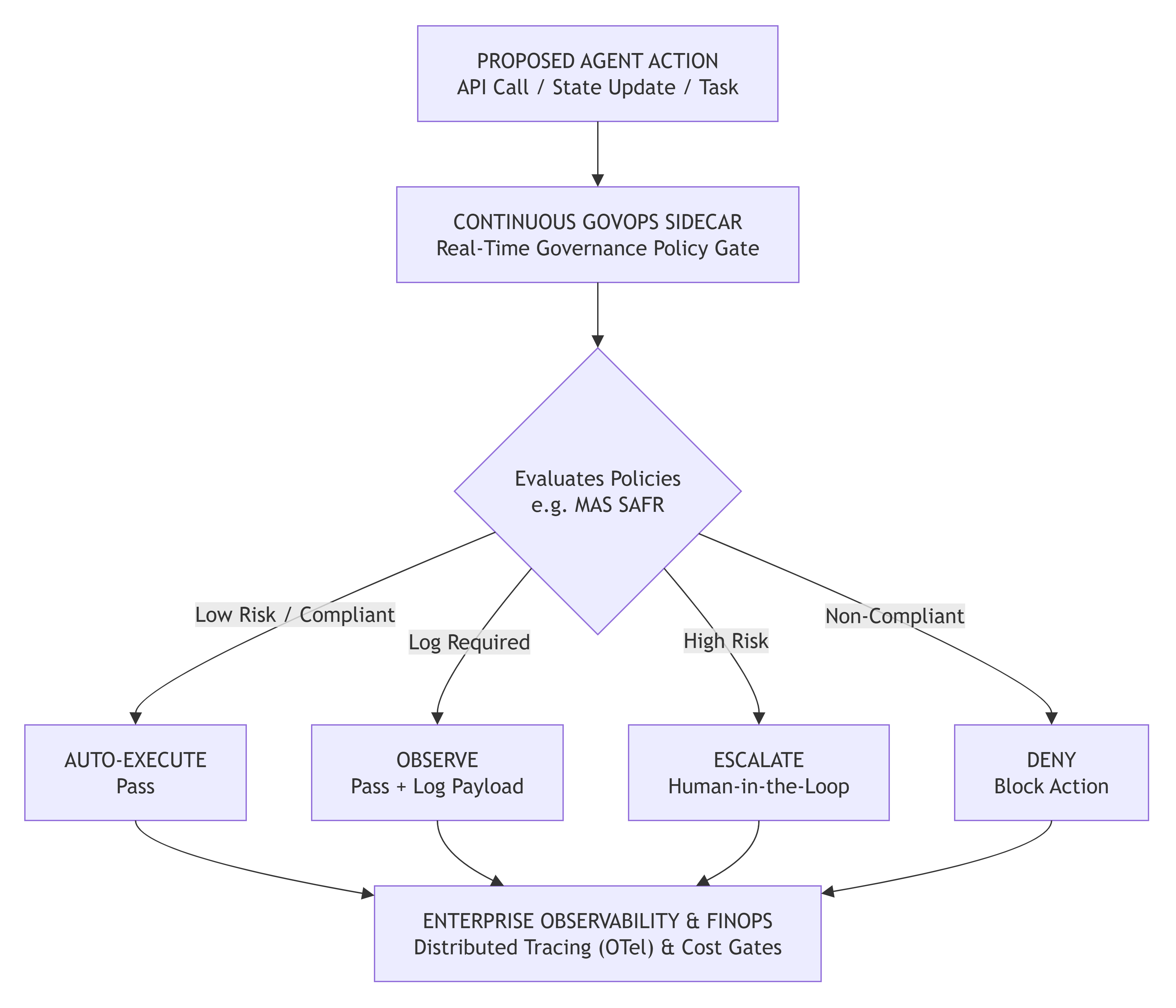
By inserting GovOps Sidecar Engines into the execution pipeline, every proposed agent action is evaluated in real time against enterprise policy baselines. Actions are routed through four deterministic execution paths:
Auto-Execute: Compliant, low-risk operations proceed immediately.
Observe: The action executes while emitting detailed telemetry for audit tracking.
Escalate: High-impact actions are paused for human review.
Deny: Non-compliant actions are blocked at runtime before execution.
All telemetry, spans, and policy checks stream directly into enterprise observability tools (e.g., OpenTelemetry), generating an immutable audit record for compliance and FinOps monitoring.
2. Shifting Enterprise Economics: The Go-To-Market (GTM) Bowtie Model
Implementing continuous governance and persistent agent architectures enables organizations to shift from reactive, manual execution to automated, real-time systems operations. This architectural evolution fundamentally redefines enterprise Go-To-Market (GTM) strategies and unit economics.
In complex, document-heavy industries like commercial insurance, administrative overhead historically accounts for 27% to 32% of total operational costs. Autonomous multi-agent pipelines streamline these workflows by automating unstructured data intake, continuous risk assessment, and real-time underwriting
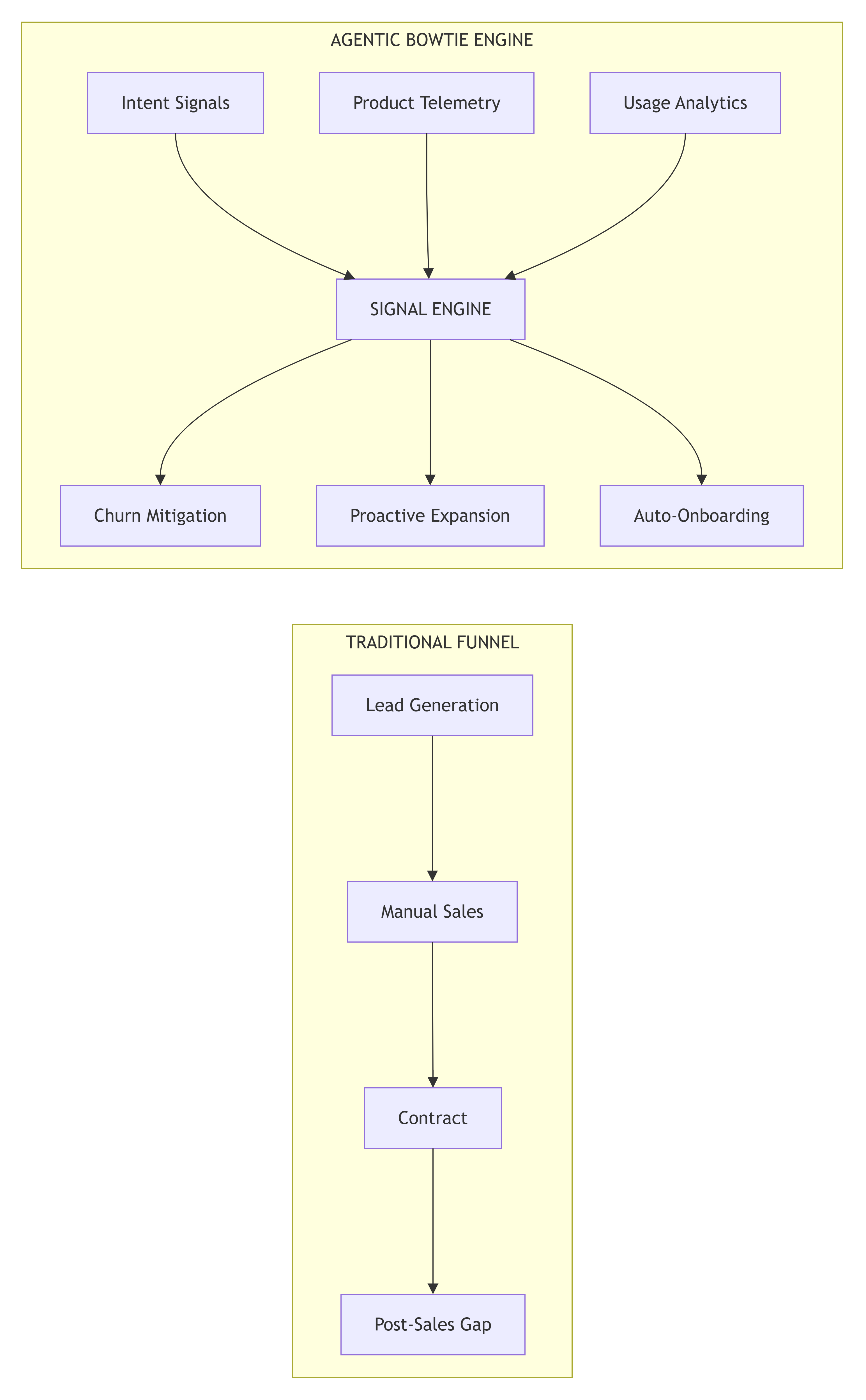
This operational transformation replaces traditional, linear sales and servicing funnels with an Agentic GTM Bowtie Signal Engine:
Automated Acquisition & Retention: Operational telemetry signals continuously feed intelligent agents that handle client onboarding, flag retention risks in real time, and trigger automated expansion paths.
Systems-First Operations: Technical and business domain teams transition from manual process execution to orchestrating, monitoring, and governing autonomous agent networks.
Strategic Implementation Roadmap
To deploy these capabilities across enterprise systems, organizations should execute a three-phase integration plan:
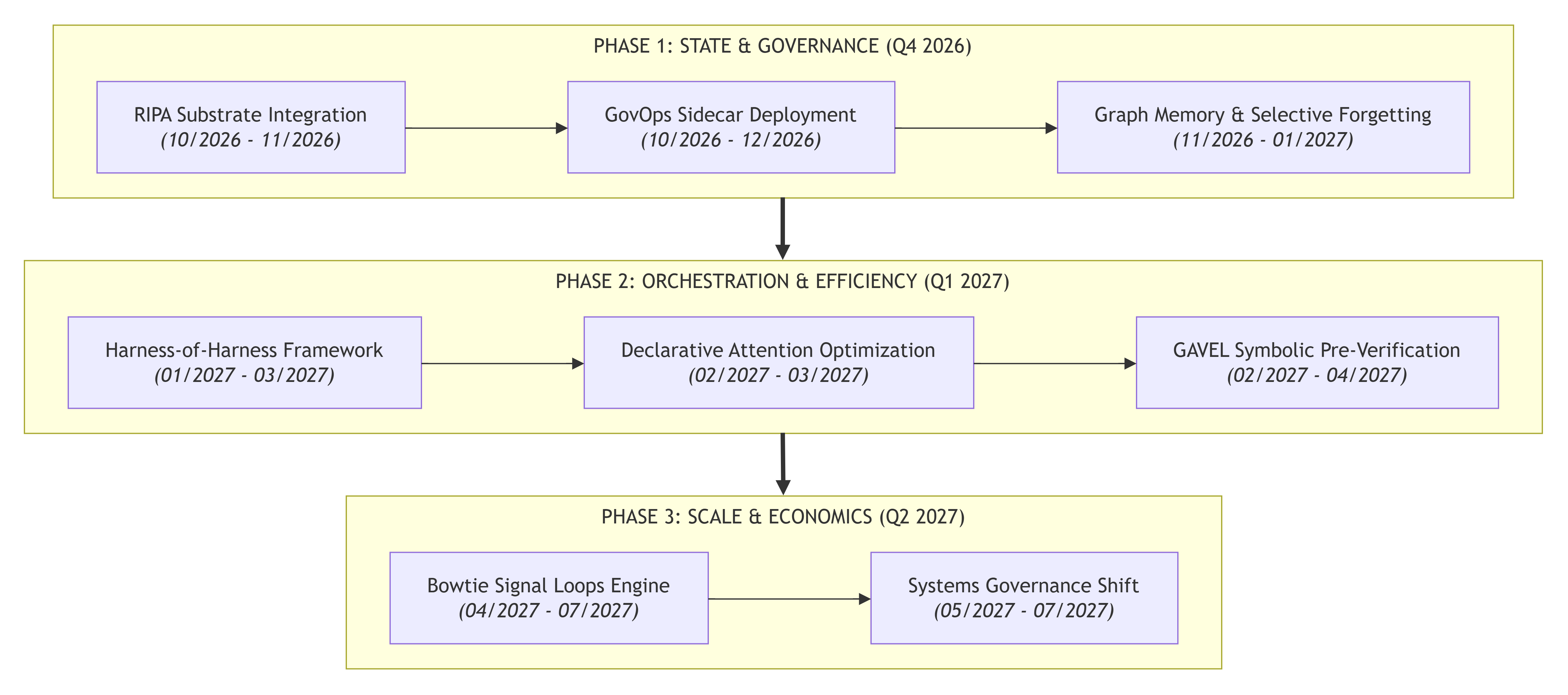
By combining persistent state architectures, explicit symbolic verification, inference optimization, and continuous GovOps guardrails, enterprise technology leaders can build reliable, cost-effective, and safe autonomous AI systems.