
The RIPA Blueprint: Decoupling Agent Substrates from Transient Model Runtimes
Executive Summary
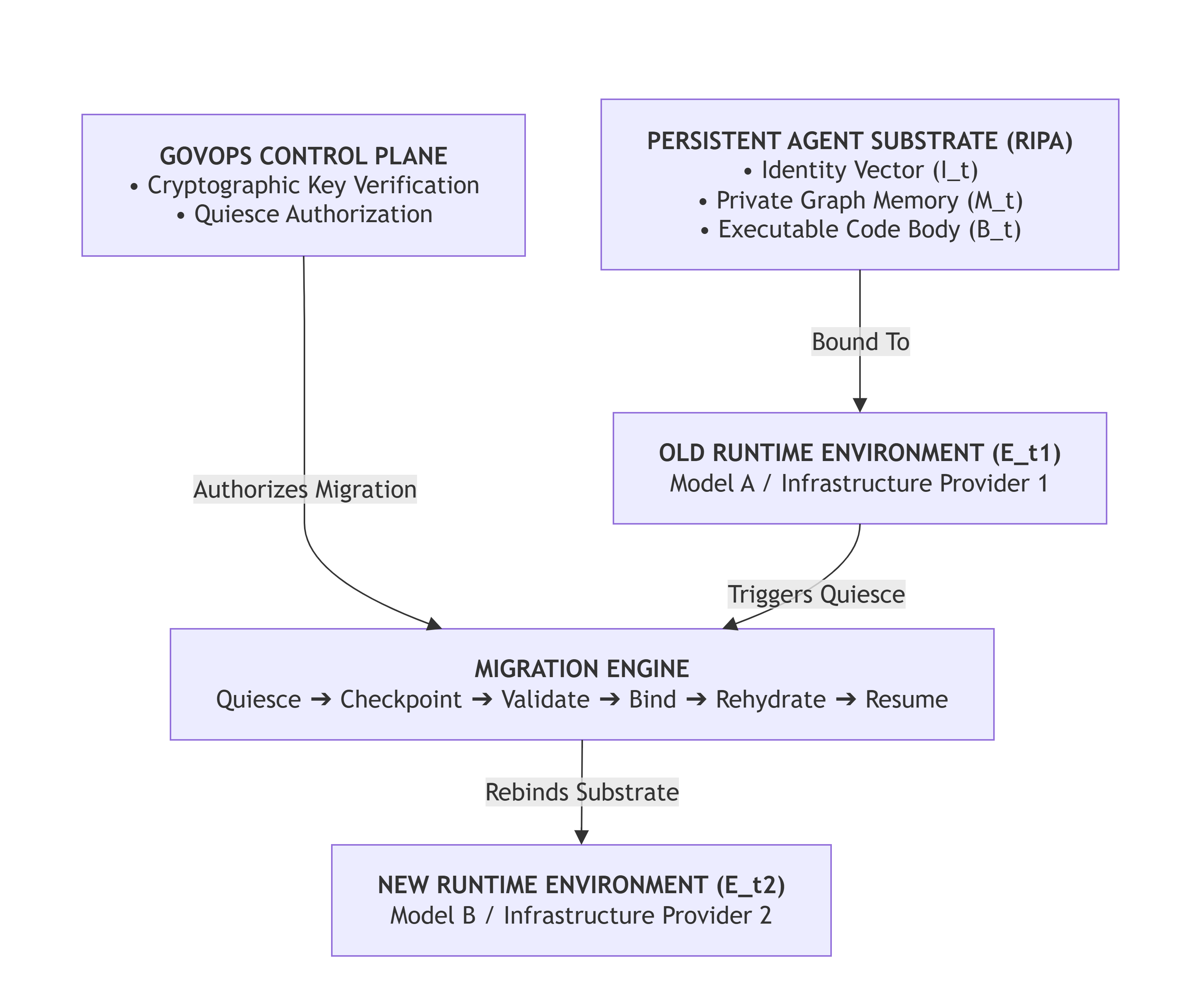
Most agentic deployments mistakenly couple agent state directly to the underlying foundational model execution context. When a model version is deprecated, a hosting provider fails, or an enterprise migrates between LLM vendors, the agent’s memory, tool history, and task state are completely lost.
The Runtime-Independent Persistent Agent (RIPA) pattern solves this by decoupling the agent substrate from transient execution runtimes. This article details the mathematical model, architectural layers, and state migration lifecycle needed to build durable enterprise AI agents.
The GovOps Sidecar Pattern
To enforce compliance policies without adding latency to the agent's core reasoning engine, governance is decoupled into a Sidecar Gateway. Every tool call or external API request generated by an agent passes through this sidecar before execution.
The Sidecar evaluates requests against four policy execution routes:
Auto-Execute: Safe, low-risk, read-only requests proceed instantly.
Observe & Log: The action executes while emitting detailed OpenTelemetry spans to the audit plane.
Human-in-the-Loop (Escalate): High-impact actions (e.g., database updates, financial transfers, external emails) are held until approved by a authorized human operator.
Deny: Non-compliant actions (e.g., unauthorized data exports, unencrypted payloads) are blocked immediately, returning a policy error message to the agent.
Real-Time FinOps & Loop Circuit Breakers
To prevent recursive agent loops from inflating cloud costs, the FinOps Control Plane monitors token usage and step counts across all active execution contexts:
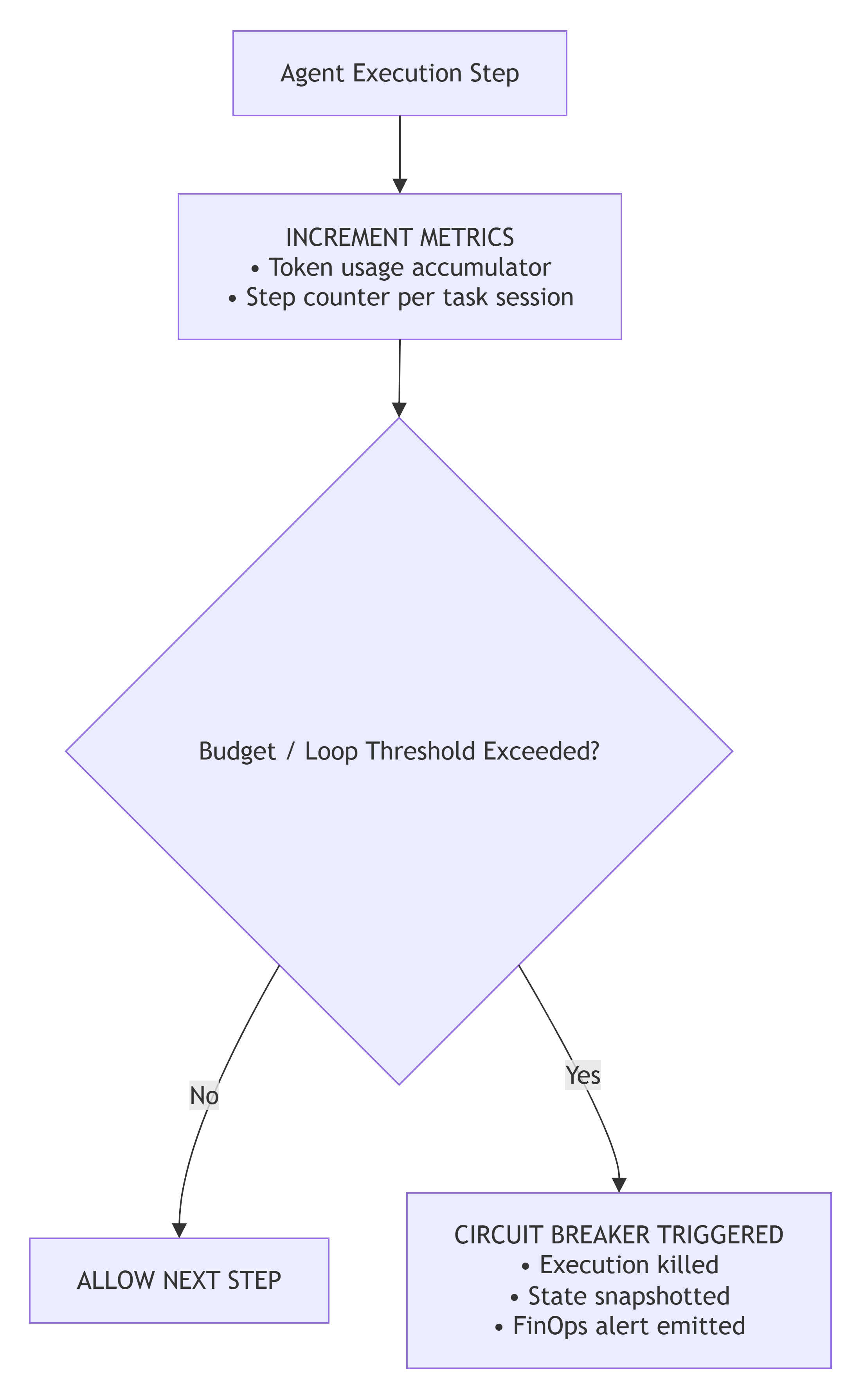
If an agent exceeds its assigned token budget or enters an unproductive loop, the circuit breaker triggers automatically. The engine halts execution, snapshots the current state, and alerts the platform team—ensuring enterprise AI systems remain safe, governed, and cost-predictable.