
Beyond the Monolith: Why AI-Native Enterprise Architecture Demands Data Products and Data Fabric Over Traditional UDPs
As Enterprise Architecture (EA) shifts from a static control mechanism into a real-time enabler of AI capability, our underlying data strategies must evolve.
For years, enterprise IT relied on the Unified Data Platform (UDP 1.0)—a centralized, monolithic repository (such as an enterprise Snowflake or Databricks lakehouse) managed exclusively by a central data engineering team. While the UDP promised a single source of truth, in practice, it often created a single bottleneck of operational friction.
In the industry today, pure, standalone "Data Mesh" implementations are fading. Instead of abandoning the platform, enterprises are evolving toward UDP 2.0: building domain-owned Data Products directly on top of modern lakehouse foundations, governed by a Data Fabric access layer.
Executive Elevator Pitch: The Library Analogy
C-suite leaders often struggle to understand why their expensive Unified Data Platforms (UDPs) and traditional Data Warehouses fall short when deploying generative agents:
Traditional UDP 1.0 = A Centralized Library: Everything is stored under one roof, but if 50 autonomous AI agents run into the building at once asking different complex questions, the single front desk collapses under the load.
Data Products (Data Mesh Framework) = Specialized Department Librarians: Every business department owns its own specialized librarians (Data Products like Fleet_Telematics_DP or Customer_Loyalty_DP) who know their domain's data, rules, and SLAs.
Data Fabric = Automated Conveyor Belts & Badges: An intelligent access layer provides automated conveyor belts and security controls (Metadata & Access Governance) so AI agents retrieve accurate, real-time context without breaking compliance.
The Core Problem with Traditional UDP 1.0
In a traditional UDP, central data teams spend months attempting to construct a single, universal Enterprise Data Model (EDM). Raw data from hundreds of legacy databases is pulled via scheduled ETL (Extract, Transform, Load) pipelines into one giant central repository.
This setup creates three critical friction points:
Context Fragmentation: To Sales, a "Customer" is a revenue account; to Logistics, a "Customer" is a physical delivery endpoint. Forcing both into one central schema destroys domain context.
The Bottleneck Effect: When business units need a new feature or pipeline for an AI model, they must wait in line for the central data team to write custom ETL scripts.
Batch Latency: Traditional ETL relies on overnight batch jobs. Modern AI models demand instant, event-driven responses.
The Target Paradigm: UDP 2.0 (Platform + Data Products + Fabric)
Instead of choosing between a pure central lakehouse, a pure Data Mesh, or a Data Fabric, modern architecture converges on a hybrid model: UDP 2.0.
[ Data Fabric Layer (Denodo / APIs) ]
  ├──► [ Domain 1: Fleet IoT Data Product ] ──┐
  └──► [ Domain 2: Customer Loyalty DP ] ─────┴─► [ AI Models / Apps ]
[ UDP 2.0 Lakehouse Platform (Batch + Streaming) ]
1. The UDP 2.0 Lakehouse Foundation
The data platform remains the engine providing storage, compute, batch reconciliation, real-time event streaming (e.g., Apache Kafka), and security baselines.
2. Domain-Owned Data Products
Instead of central IT owning the data schemas, domain teams build and maintain Data Products on top of the platform. Each Data Product includes clear data contracts, SLAs, and curated APIs/tables.
3. Data Fabric Access Layer
The Data Fabric sits above the Data Products. It uses virtualization, active metadata, and semantic mapping so AI agents, microservices, and BI tools can discover and query distributed domain datasets without needing physical data duplication or central ETL bottlenecks.
4: Grounding High-Assurance AI with Knowledge Graphs & Neuro-Symbolic Execution
Once an enterprise establishes UDP 2.0 with domain-owned Data Products and an active Data Fabric, a critical operational challenge emerges: How do autonomous AI agents safely process this virtualized data in high-stakes, regulated environments?
Relying solely on probabilistic Large Language Models (LLMs) or traditional vector search (Vector RAG) creates significant risks of hallucinations, opaque reasoning, and non-compliance with enterprise risk frameworks (such as MAS SAFR). To achieve deterministic, zero-hallucination execution, modern Enterprise Architecture must bridge data governance with Neuro-Symbolic Intelligence—separating LLM Perception (System 1) from Symbolic Reasoning and Procedural Execution (System 2) across a formal 5-Layer Enterprise Data & AI Stack.
Step-by-Step Layer Mapping
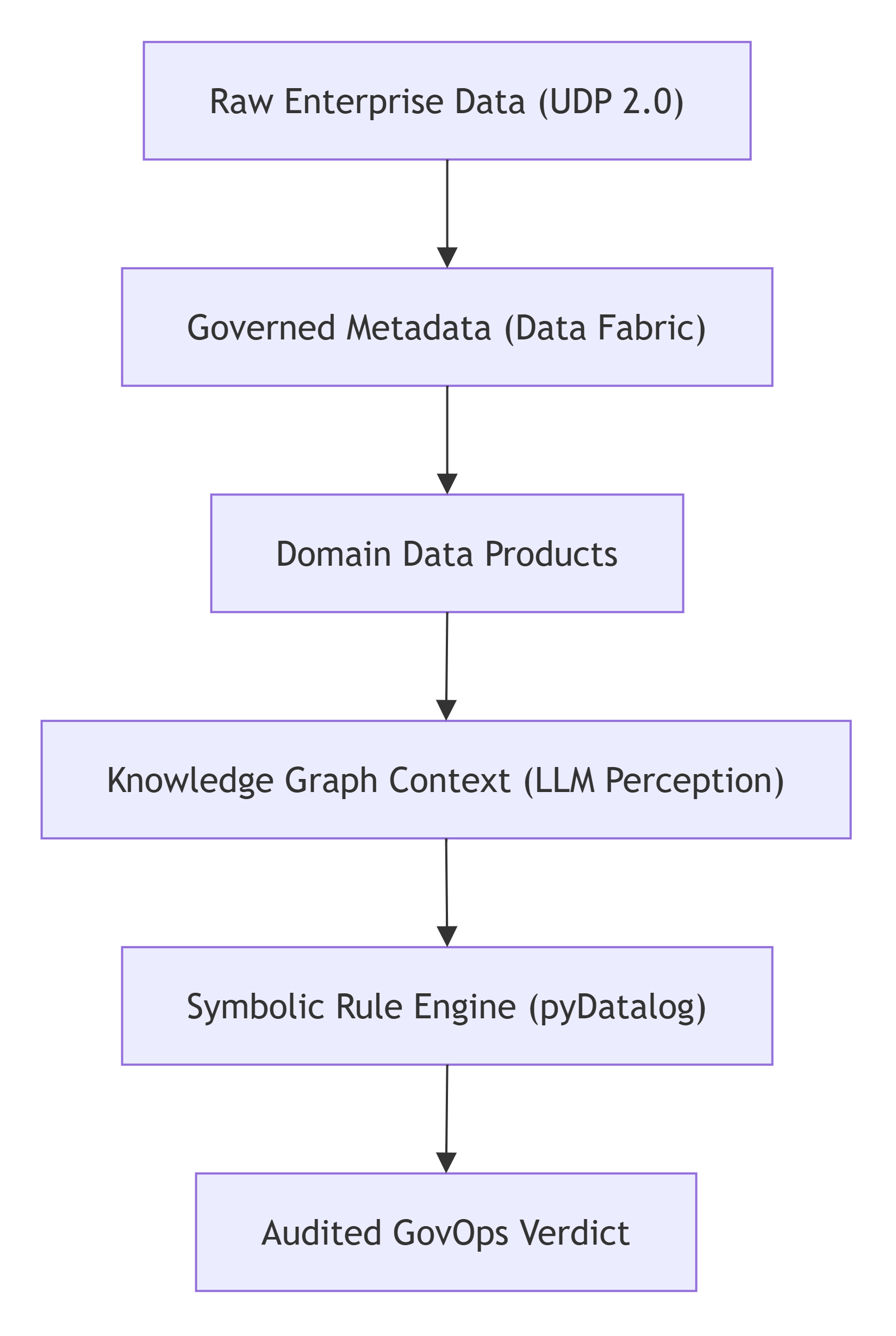
Unified Data Platform 2.0 (UDP 2.0) Data Model (Storage & Foundation Layer)
Role in EA: Serves as the centralized, physical, and virtualized foundation for raw and harmonized enterprise data. It implements a standardized Canonical Enterprise Data Model (EDM) across core entities—such as Party, Policy, Claim, Coverage, and Financial Loss.
Technical Components: Cloud Lakehouse architecture (e.g., Delta Lake, Apache Iceberg, or Azure Postgres / Cloud SQL).
Function: Eliminates data silos across regional operating entities. Whether a record originates from a legacy mainframe, a modern web app, or an external broker feed, it conforms to the unified structural schema.
Data Fabric 2.0 (Integration & Active Metadata Layer)
Role in EA: Acts as the virtualized, intelligent connective tissue spanning multi-cloud and hybrid environments. Instead of copying data into multiple silos, Data Fabric utilizes Active Metadata and automated discovery to connect datasets dynamically.
Technical Components: Data catalogs, automated lineage tools, API connectors, and security access policies (e.g., Azure Data Catalog, Collibra, or GCP Dataplex).
Function: Enforces real-time access controls, policy management, and lineage tracing. It continuously surfaces metadata about data freshness, quality, and origin to downstream consumers.
Data Products (Domain-Driven Ownership & Contracting Layer)
Role in EA: Packages raw UDP datasets into reusable, production-grade business assets managed by specific domain teams (e.g., Underwriting Data Product, Claims Data Product).
Technical Components: Data Contracts (OpenAPI/Protobuf schemas), versioned APIs, and explicit SLA/SLO definitions.
Function: Guarantees structural and semantic stability. When the AI system queries a domain Data Product, the contract guarantees that entity properties (e.g.,
effective_date,jurisdiction_code,deductible_amount) strictly adhere to validated data types, preventing unexpected schema drift from breaking downstream logic.
Semantic Knowledge Graph & LLM Perception (The Context Layer)
Role in EA: Converts flat data products and unstructured legal documents into an Active Knowledge Graph. This layer houses the LLM perception engine.
Technical Components: Neo4j, GCP Spanner Graph, or Azure Cosmos DB (Gremlin).
Function:
Neural Perception: The LLM acts purely as a System 1 perceptual parser, extracting typed entities and relationships from unstructured contracts, emails, or claim notes.
Context Pruning: The Knowledge Graph maps relationships and automatically prunes invalid context (e.g., overruling precedent cases or expired policy conditions) using explicit graph edges before any reasoning occurs.
Declarative Symbolic Reasoning & GovOps (Execution & Control Plane)
Role in EA: The top-level decision engine and runtime governance system.
Technical Components:
pyDatalogHorn Clause engine, OpenTelemetry spans, and MAS SAFR disposition envelopes.Function: The Symbolic Engine receives the validated facts and pruned graph context, evaluating verdicts strictly via mathematical logic (100% reproducible, zero hallucination).
Vector Search vs. GraphRAG: Structuring Context Beyond Vectors
Standard vector search relies on mathematical proximity in unstructured text embeddings. However, vector search frequently fails when processing complex structural dependencies, legal precedents, or hierarchical business rules.
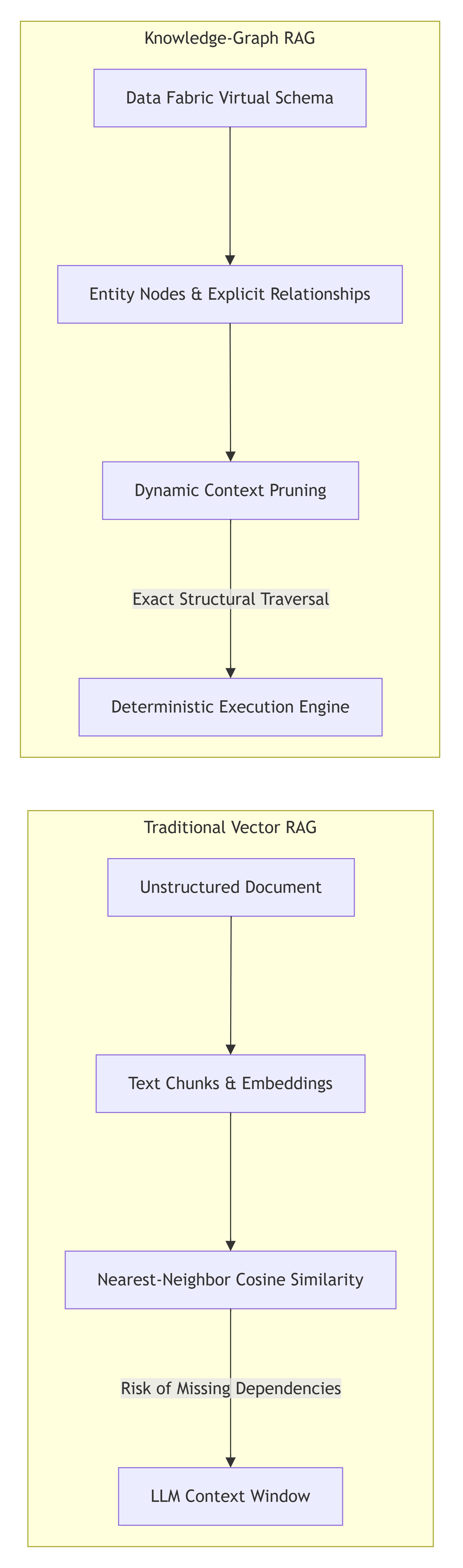
Dynamic Context Pruning: Before feeding data to downstream systems, the Knowledge Graph automatically prunes invalid path dependencies—such as expired policy coverage clauses, superseded corporate SOPs, or overruled legal precedents.
GraphRAG Execution: Rather than fetching loose text snippets, GraphRAG queries explicit entity relationships (e.g.,
[Claim_X] -> DEPENDS_ON -> [Policy_Y]), supplying downstream execution engines with verified structural context.
The Control Plane: Declarative Logic vs. Procedural Tooling
Within Layer 5, Enterprise Architecture must enforce a strict separation between Declarative Logic (Reasoning) and Procedural Skills (Execution):
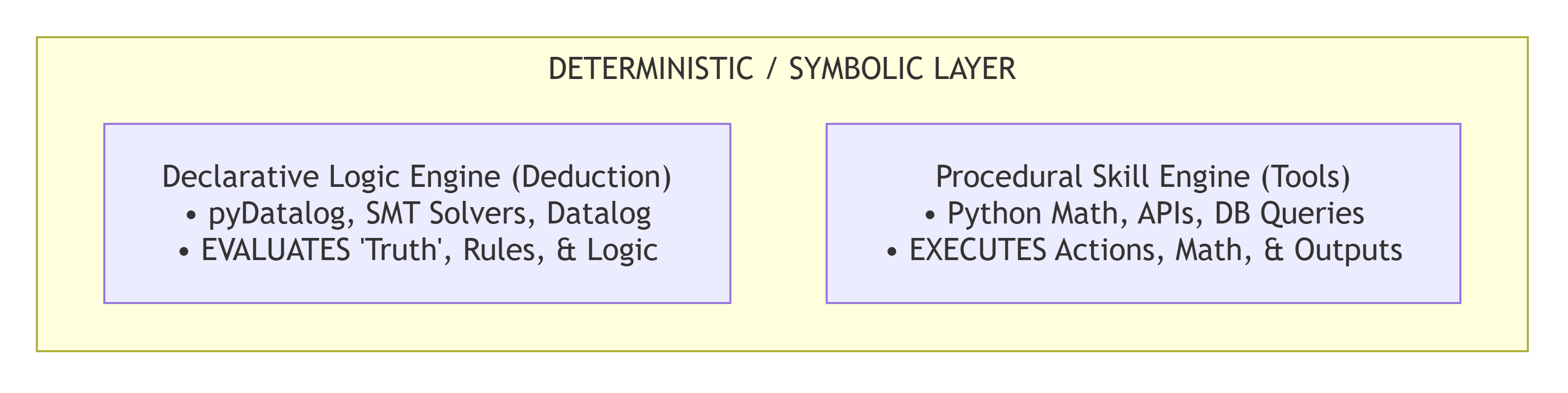
Declarative Reasoning: Evaluates policy rules, compliance constraints, and business logic using mathematical Horn clauses.
Procedural Execution: Invoked deterministically by the rule engine to execute side effects (e.g., computing exact calendar deadlines, executing database mutations, or generating output files).
The GovOps Framework tracks this entire pipeline via OpenTelemetry, enforces FinOps budget caps, and emits a final MAS SAFR disposition envelope (AUTO_EXECUTE, OBSERVE, ESCALATE, or DENY).
Neuro-Symbolic Sequence Flow
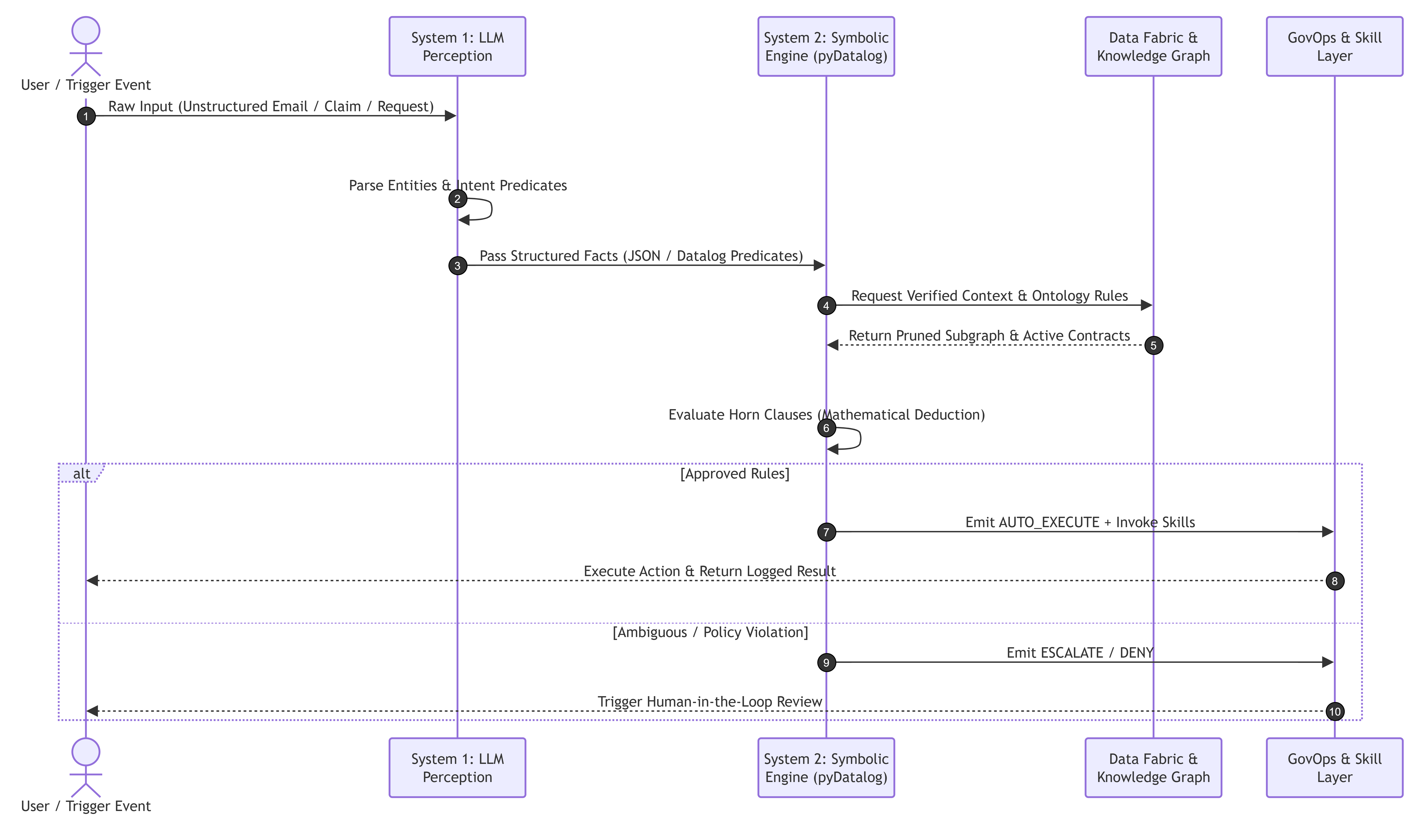
Understanding the Neuro-Symbolic Sequence Flow
To appreciate how this architecture eliminates hallucinations and ensures auditability, we can trace an unstructured request (such as an incoming claim notification or policy adjustment email) through the six discrete stages of execution:
Unstructured Ingestion & Neural Perception (System 1): The workflow begins when an unstructured trigger (an email, PDF document, or API payload) enters the pipeline. Rather than allowing the LLM to make business decisions, System 1 (LLM Perception) acts purely as an entity and intent parser. It transforms unstructured text into structured, strongly typed predicates (e.g., extracting claimant_id, incident_date, and loss_type).
Predicate Hand-off to Symbolic Logic (System 2): The extracted entities are passed as declarative facts into the System 2 Symbolic Engine (powered by first-order logic solver frameworks such as pyDatalog or SMT solvers). The LLM's involvement ends here; control is transferred entirely to the deterministic environment.
Graph-Grounded Context Retrieval & Pruning: System 2 queries the Active Data Fabric and Knowledge Graph to pull governing rules, active data contracts, and semantic relationships. The Knowledge Graph dynamically prunes obsolete dependencies—such as expired coverage clauses or superseded corporate guidelines—ensuring only valid paths are evaluated.
Mathematical Horn-Clause Deduction: Using the pruned subgraph and validated inputs, the symbolic engine evaluates formal Horn clauses. Because logical deduction is deterministic, evaluating the rules produces a mathematically verifiable result—completely free from LLM guesswork or probabilistic drift.
GovOps & MAS SAFR Disposition Envelope: The output of the deduction step is wrapped in a governed disposition envelope adhering to regulatory standards (such as MAS SAFR):
AUTO_EXECUTE: The request fully satisfies all policy rules and compliance constraints; external tools execute the action automatically.ESCALATE: The logic engine detects missing parameters, ambiguity, or edge cases, immediately routing the request to human-in-the-loop (HITL) review.DENY: The request violates underlying policies or compliance constraints, triggering an immediate refusal with a clear audit trail.
Deterministic Skill Invocation: If cleared for execution (AUTO_EXECUTE), the engine invokes procedural tools and skills (e.g., triggering precise financial math microservices, updating database state, or issuing confirmation documents). Every step, token, and database mutation is fully traced using OpenTelemetry spans for complete auditability.
Unpacking Key Technical Concepts
Shifting from ETL to Event Streaming
Moving away from traditional ETL does not mean stopping ingestion; it means replacing scheduled, delayed batch jobs with real-time event streaming. When an event occurs, it publishes directly onto an event broker. Consuming AI models react in milliseconds, while a copy drops into the lakehouse for historical auditing.
Storage & Cleansing Still Happen—at the Domain Level
Data must still be cleansed and modeled—dirty data ruins AI models. The shift in UDP 2.0 is that storage, cleansing, and modeling are owned by the domain product team at the source, rather than passed to a central IT team to figure out.
Practical Industry Case Studies
Case Study 1: Global Freight & Logistics (Data Products in Action)
The Problem: A global logistics company ran a centralized data warehouse (UDP). Whenever the AI Data Science team wanted to build real-time route optimization models, they had to wait weeks for the central team to run ETL batch scripts to pull telemetry data out of regional databases.
The Architecture: UDP 2.0 utilizing Domain Data Products mapped in Bizzdesign Horizzon and streamed via Apache Kafka.
[ Bizzdesign Horizzon (Governance) ]
  ├──► [ Fleet IoT Data Product ] ─────┐
  └──► [ Customs Clearance DP ] ──────┴─► [ Kafka ] ──► [ AI Route Model ]
How it Works Simply:
Domain Ownership: The Fleet Management Team owns its data end-to-end as a certified Data Product. They maintain their local database, clean their telemetry logs, and publish live GPS updates directly onto an enterprise Kafka event stream.
Governance Mapping: Enterprise architects use Bizzdesign Horizzon to map domain boundaries, document Data Contracts (SLAs), and trace data lineage across the enterprise.
Instant Consumption: When an AI team needs real-time telemetry to optimize delivery routes, they log into the internal data catalog, discover the "Fleet IoT Stream," and plug their model directly into the Kafka bus. No central IT ticket, no ETL waiting queue.
Case Study 2: Multi-Brand Enterprise Retail (Data Fabric in Action)
The Problem: A retail group operates modern e-commerce microservices in the cloud, but its customer loyalty records live in an on-premises Oracle database and stock inventory sits in legacy SAP mainframes. Copying all this data into a central lake via ETL was expensive, slow, and violated strict regional privacy laws.
The Architecture: Data Fabric powered by Denodo Data Virtualization across distributed domain stores.
[ AI Engine ] ──► [ Denodo (Virtual Fabric) ]
                    ├──► [ Cloud App ]
                    ├──► [ On-Prem Loyalty DB ]
                    └──► [ SAP Inventory ]
How it Works Simply:
Zero Data Movement: The retail group leaves the loyalty data in Oracle and inventory data in SAP.
Virtual Abstraction: They deploy Denodo as a Data Fabric layer over all three systems. Denodo reads the metadata and schemas of each source without physically moving the records.
On-the-Fly Querying: When a customer opens the mobile shopping app, an AI recommendation service asks Denodo for the user's purchase history, loyalty tier, and local stock level.
Denodo queries the underlying systems in parallel, combines the records into a clean JSON response in milliseconds, and feeds the AI model—completely eliminating the need for a centralized UDP storage middleman.
Architectural Comparison Summary
Traditional UDP 1.0
Ownership: Centralized IT team
Delivery: Scheduled batch ETL
Focus: Centralized storage & reporting
AI Impact: Slow; blocked by central team pipelines
UDP 2.0 + Data Products
Ownership: Decentralized business domains
Delivery: Real-time streams & domain APIs
Focus: Reusable domain Data Products
AI Impact: Fast; direct access to curated, SLA-backed data products
Data Fabric Layer
Ownership: Federated governance & technology layer
Delivery: On-demand virtual queries & lineage
Focus: Metadata, semantic access & policy enforcement
AI Impact: Fast; unified, secure access across distributed systems
Conclusion
Building an AI-native stack is not about choosing between platforms or standalone frameworks—it is about building UDP 2.0:
Data Products solve the organizational bottleneck by empowering business domains to manage their data as curated products.
Data Fabric solves the engineering bottleneck by virtually connecting distributed systems with built-in governance and lineage.
By shifting from static central warehouses to domain-owned Data Products connected by an intelligent Data Fabric, enterprise architects can build a living, real-time foundation ready for generative AI and agentic automation.