
Enterprise AI Architecture: Why Business Use Cases—Not 'Field of Dreams' Platforms—Must Drive AI Infrastructure
Executive Summary
Many technology organizations fall into a familiar enterprise trap: building a massive, all-encompassing "AI Platform" under a Field of Dreams philosophy ("Build it and they will come"). Millions are spent standing up complex infrastructure, model registries, and orchestration frameworks without anchoring them to specific business problems.
The result is predictable—rising compute and token costs, fragmented implementations, security bottlenecks, and negligible business ROI.
To successfully scale AI, technology leaders must flip the paradigm. Business use cases must drive platform capabilities, not the other way around. The enterprise AI platform should evolve as a shared, reusable, and governed set of capabilities that emerge naturally as high-value business use cases are deployed into production.
The AI Scaling Dilemma: Enterprise Pilots vs. Enterprise Reality
The fundamental question facing technology leaders has shifted rapidly over the past three years:
2023–2024: "Can we use Generative AI?"
2025: "Where can AI create measurable value?"
Today: "How do we scale AI safely, reliably, and economically across the enterprise?"
When enterprises attempt to move from localized pilots (copilots, chatbots, RAG apps) to enterprise-wide scale, they hit The Scaling Chasm:

In response, organizations often make one of two errors:
The Fragmented Wild West: Every business unit builds its own stack, leading to duplicated tools, unmanaged token spend, and compliance risks.
The Monolithic Platform Trap: Central IT halts development for 12 months to build an all-singing, all-dancing AI Platform before delivering any business value.
The solution is Use-Case Driven Platform Engineering. By using high-value business requirements (such as automated credit underwriting, real-time fraud detection, or dynamic customer servicing) as anchor points, organizations can justify platform investments iteratively while standardizing "Golden Paths" for delivery.
The Modern Enterprise AI Stack
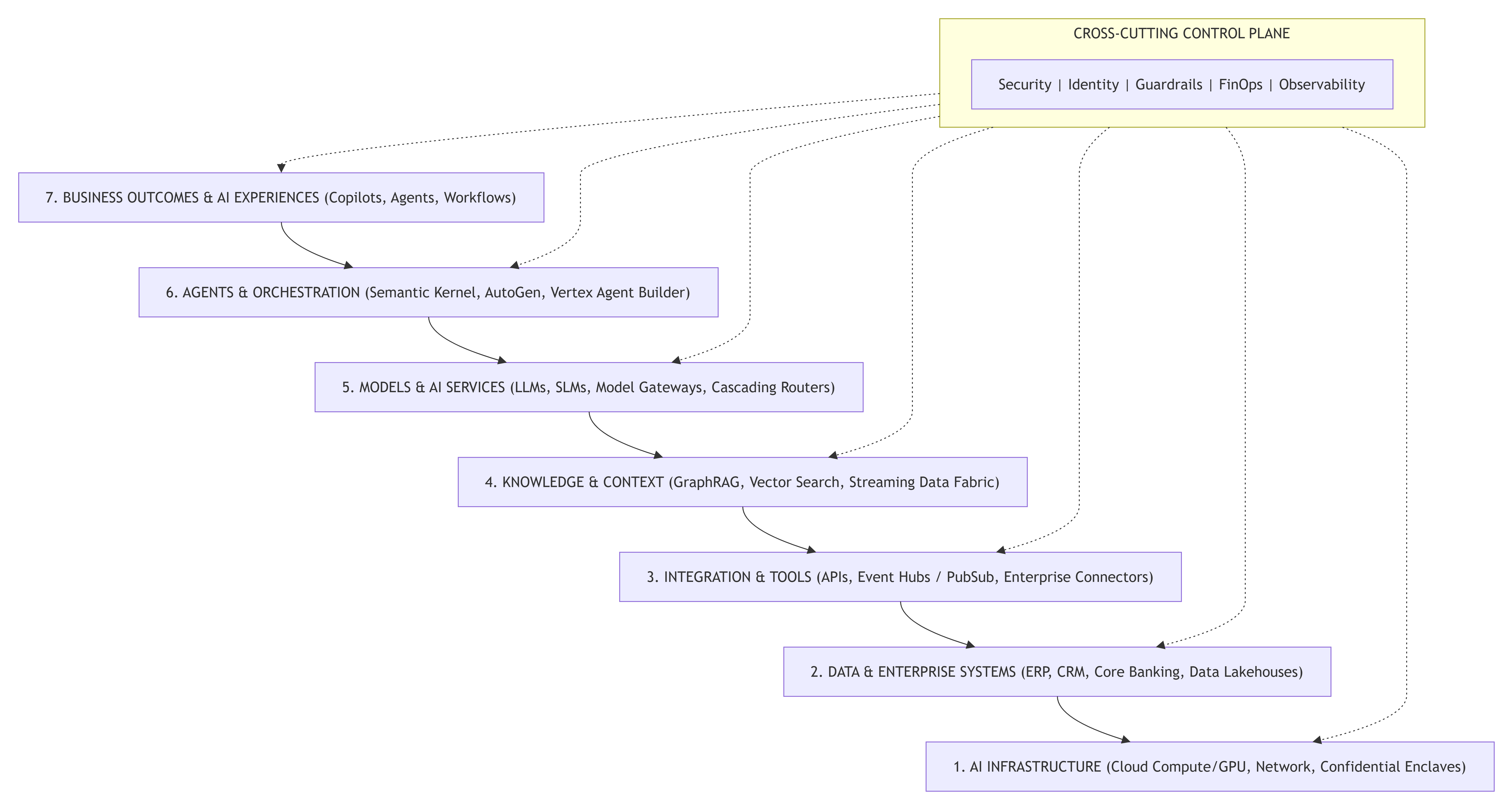
An Enterprise AI Architecture consists of seven functional layers bounded by a cross-cutting control plane:
10 Core Enterprise AI Platform Capabilities
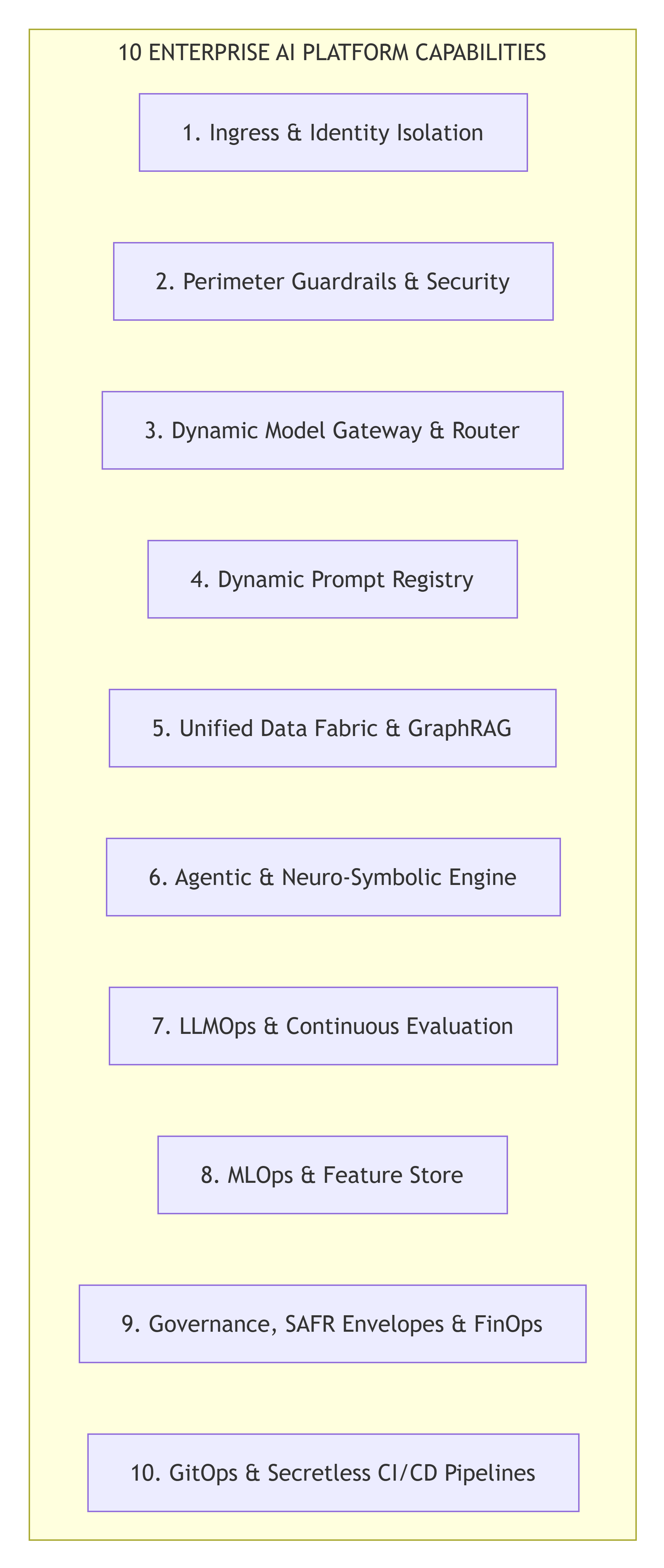
Below are the 10 core architectural capabilities required to scale enterprise AI solutions securely and reliably.
Capability 1: Ingress & Identity Isolation
Ensures that all incoming application requests are authenticated, rate-limited, and context-bound before touching downstream AI components.
Key Mechanics: Identity providers introspect token claims and validate quota usage at the platform edge. Non-compliant or throttled sessions are intercepted before initiating costly LLM invocations.
Cloud Infrastructure Mapping:
Azure: Azure Entra ID, Azure API Management (APIM), Azure Rate-Limiting Policy.
GCP: Google Cloud Identity & IAM, Apigee AI Gateway, Cloud Armor.

Capability 2: Perimeter Guardrails & Security
Screens incoming requests for prompt injection, jailbreaking attempts, and sensitive data exposure prior to model processing.
Key Mechanics: Real-time filters inspect input payloads. PII or sensitive assets are automatically redacted via confidential enclaves, while malicious payloads trigger instant blocking and security audit logging.
Cloud Infrastructure Mapping:
Azure: Azure AI Content Safety, Prompt Shields, Confidential Ledger.
GCP: Google Cloud Model Armor, Confidential Space, Sensitive Data Protection API.

Capability 3: Dynamic Model Gateway & Routing
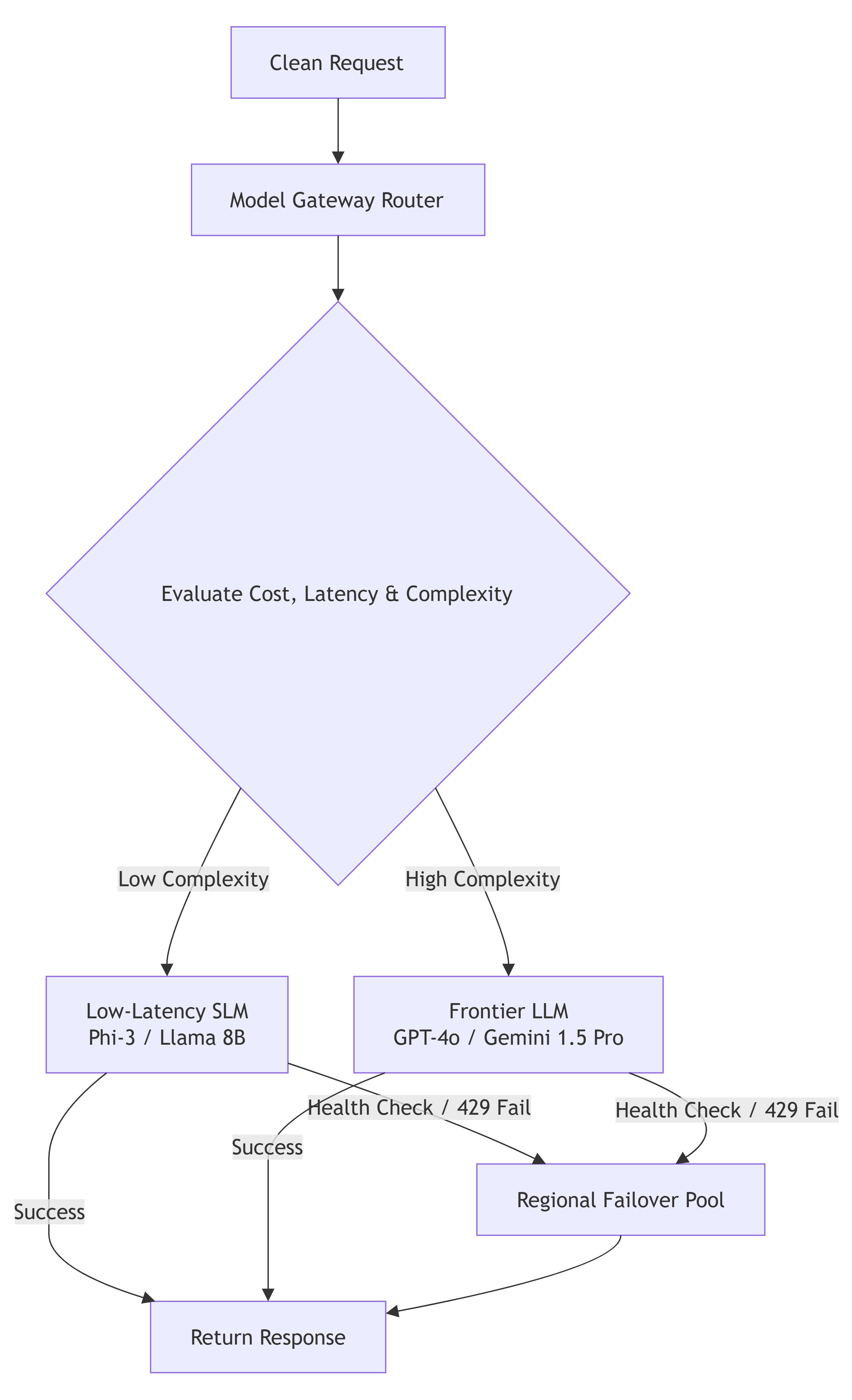
Decouples enterprise applications from vendor-specific model APIs, dynamically routing traffic based on task complexity, latency limits, and real-time cost.
Key Mechanics: Simple intent parsing or summarization tasks are routed to low-latency Small Language Models (SLMs). Complex analytical tasks are escalated to frontier LLMs, with automated multi-region failover handling API rate limits (HTTP 429).
Cloud Infrastructure Mapping:
Azure: Azure AI Model Gateway (APIM LLM Routing), Azure OpenAI Service, Azure ML Endpoints.
GCP: Vertex AI Model Gateway, Vertex AI Model Garden, Apigee AI Gateway.
Capability 4: Prompt Engineering & Asset Registry
Centralizes system prompts, variables, and context engineering templates outside application source code.
Key Mechanics: Dynamic compilers fetch versioned prompt templates from a central registry, hydrating system variables with tenant runtime data before execution.
Cloud Infrastructure Mapping:
Azure: Azure Prompt Flow, Azure AI Studio Prompt Catalog, Azure API Center.
GCP: Vertex AI Prompt Management, Vertex AI Prompt Optimizer, Artifact Registry.

Capability 5: Unified Data Fabric, Streaming & GraphRAG (UDP 2.0)
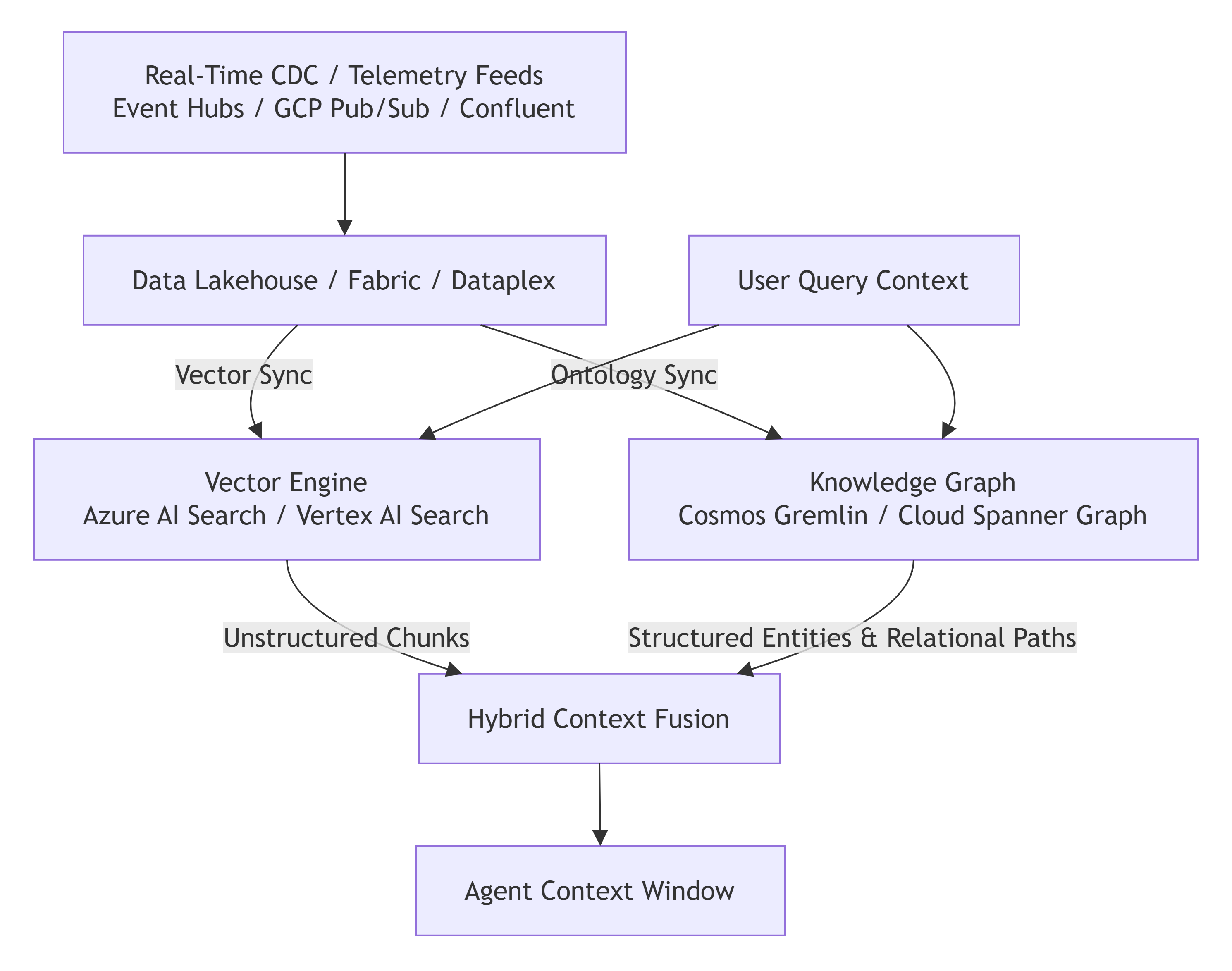
Supplies rich, multi-dimensional context to AI models by merging vector search with real-time event feeds and enterprise knowledge graphs.
Key Mechanics: Real-time event streams (CDC/telemetry) feed data platforms. User queries perform hybrid retrieval, blending unstructured vector chunks with relational graph entity paths to eliminate hallucinations.
Cloud Infrastructure Mapping:
Azure: Azure AI Search, Cosmos DB Gremlin API, Azure Event Hubs / Confluent Cloud, ADLS Gen2 / Fabric.
GCP: Vertex AI Search, Cloud Spanner Graph, Google Cloud Pub/Sub / Confluent Cloud, BigQuery Lakehouse.
Capability 6: Agentic & Neuro-Symbolic Engine
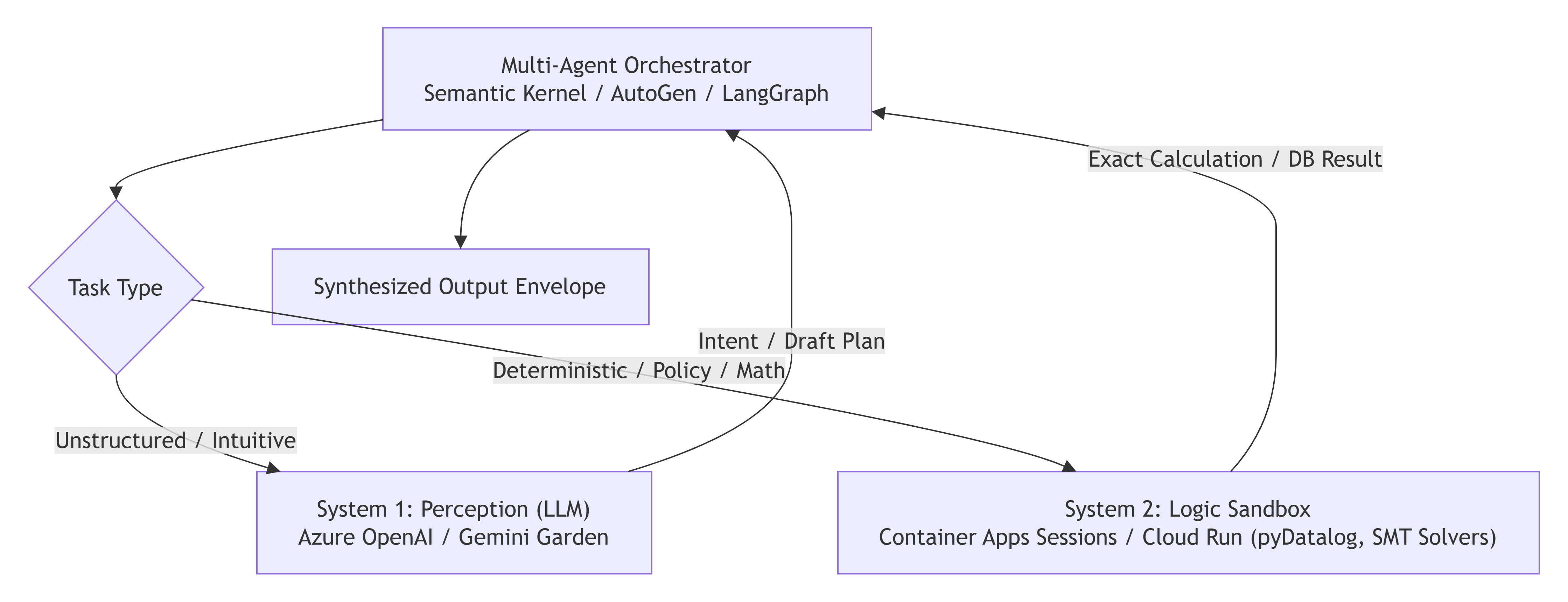
Orchestrates autonomous, multi-agent workflows by combining probabilistic AI reasoning with deterministic logic execution.
Key Mechanics: Task orchestrators split incoming jobs. "System 1" perception models handle intent generation and language processing, while "System 2" logic sandboxes run mathematical solvers, business rules, and API tools.
Cloud Infrastructure Mapping:
Azure: Semantic Kernel / AutoGen, Azure Container Apps Sessions, Azure OpenAI Service.
GCP: Vertex AI Agent Builder / LangGraph, Cloud Run / GKE Sandboxes, Vertex AI Model Garden.
Capability 7: LLMOps & Continuous Evaluation
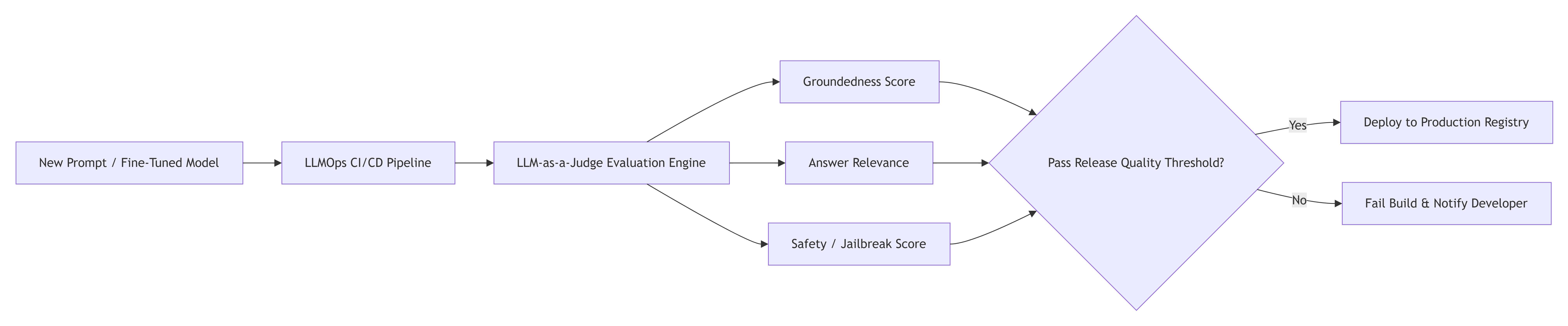
Automates quality, safety, and performance evaluations across prompt revisions and fine-tuned models before production deployment.
Key Mechanics: Automated CI/CD pipelines trigger LLM-as-a-Judge evaluators to score groundedness, answer relevance, and safety metrics. Output that falls below release thresholds fails the build automatically.
Cloud Infrastructure Mapping:
Azure: Azure ML Pipelines, Prompt Flow Evaluations, Azure DevOps.
GCP: Vertex AI Pipelines, Vertex AI Auto-Eval, Cloud Build.
Capability 8: Traditional MLOps & Feature Store
Serves low-latency, structured feature vectors for predictive machine learning and agentic tool execution while continuously monitoring drift.
Key Mechanics: Real-time feature pipelines maintain updated vectors in sub-millisecond serving stores. Monitoring systems observe inference data distributions and trigger retraining jobs when statistical drift thresholds are passed.
Cloud Infrastructure Mapping:
Azure: Azure Databricks Feature Store, Azure Machine Learning Model Monitoring.
GCP: Vertex AI Feature Store, Vertex AI Model Monitoring.

Capability 9: Governance, SAFR Envelopes & FinOps
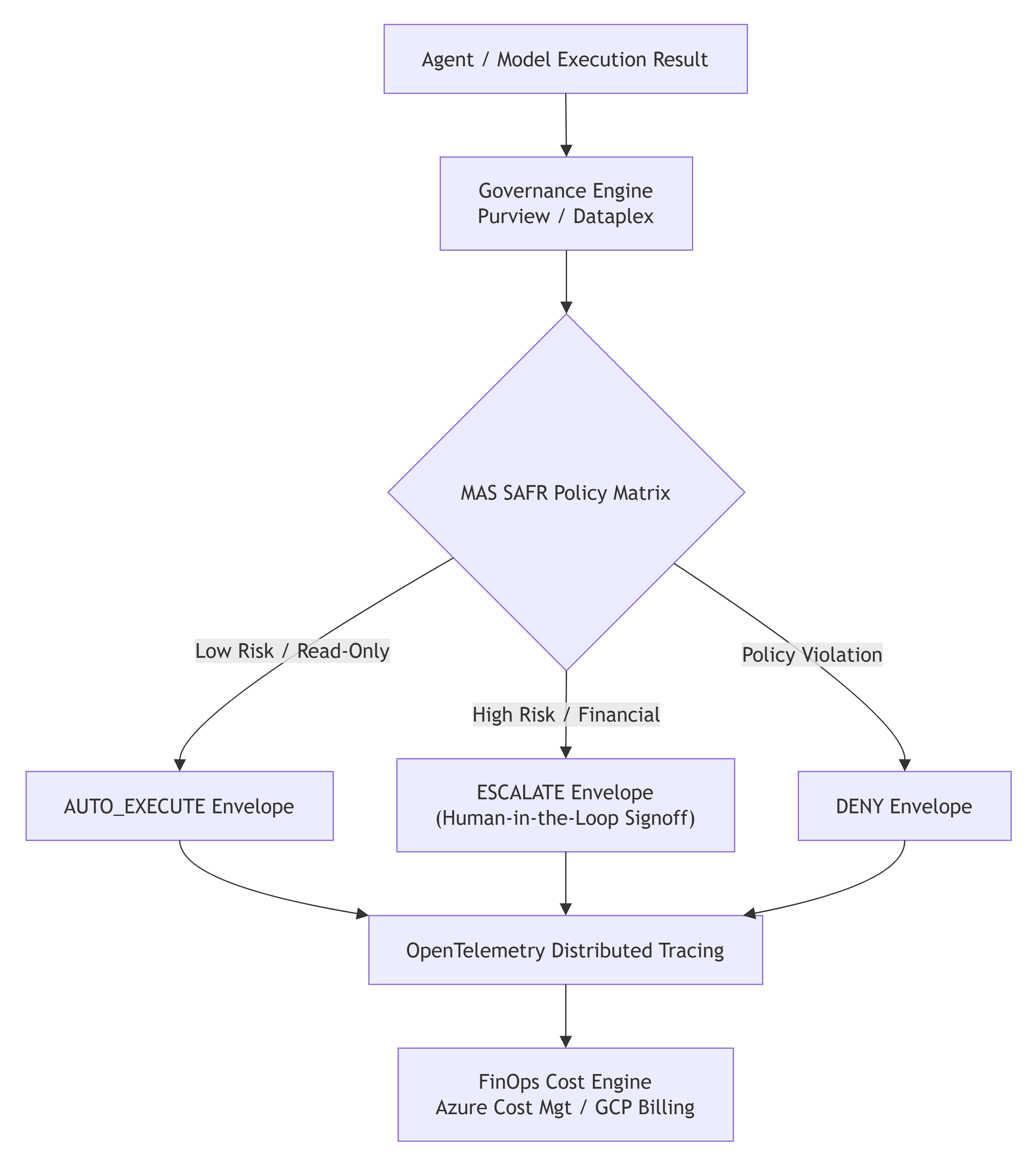
Enforces policy frameworks, controls autonomous agent actions, tracks token consumption, and maintains immutable telemetry.
Key Mechanics: Execution outputs are evaluated against regulatory policy matrices (e.g., MAS SAFR guidelines). Actions are wrapped into disposition envelopes:
AUTO_EXECUTEfor low-risk read actions,ESCALATEfor high-risk transactional actions requiring human approval, andDENYfor non-compliant outputs. Gateway telemetry logs token consumption for accurate cost distribution.Cloud Infrastructure Mapping:
Azure: Microsoft Purview, Azure Monitor / Application Insights, Azure Cost Management.
GCP: Dataplex Governance Engine, Cloud Trace & Monitoring, GCP Billing & Cost Management.
Capability 10: DevOps, GitOps & CI/CD Pipelines
Automates infrastructure provisioning, prompt deployment, and agent code releases through secure, secretless GitOps workflows.
Key Mechanics: Source control updates trigger secretless OIDC authentication to exchange short-lived cloud credentials. Runners evaluate Infrastructure-as-Code dry runs and automated quality gates before deploying to target environments.
Cloud Infrastructure Mapping:
Azure: GitHub Actions / Azure DevOps, Azure Bicep / Terraform, Azure Developer CLI (
azd), Workload Identity Federation.GCP: GitHub Actions / Cloud Build, Terraform, Developer Connect, Workload Identity Federation.

Operating Model: The Enterprise Hub-and-Spoke
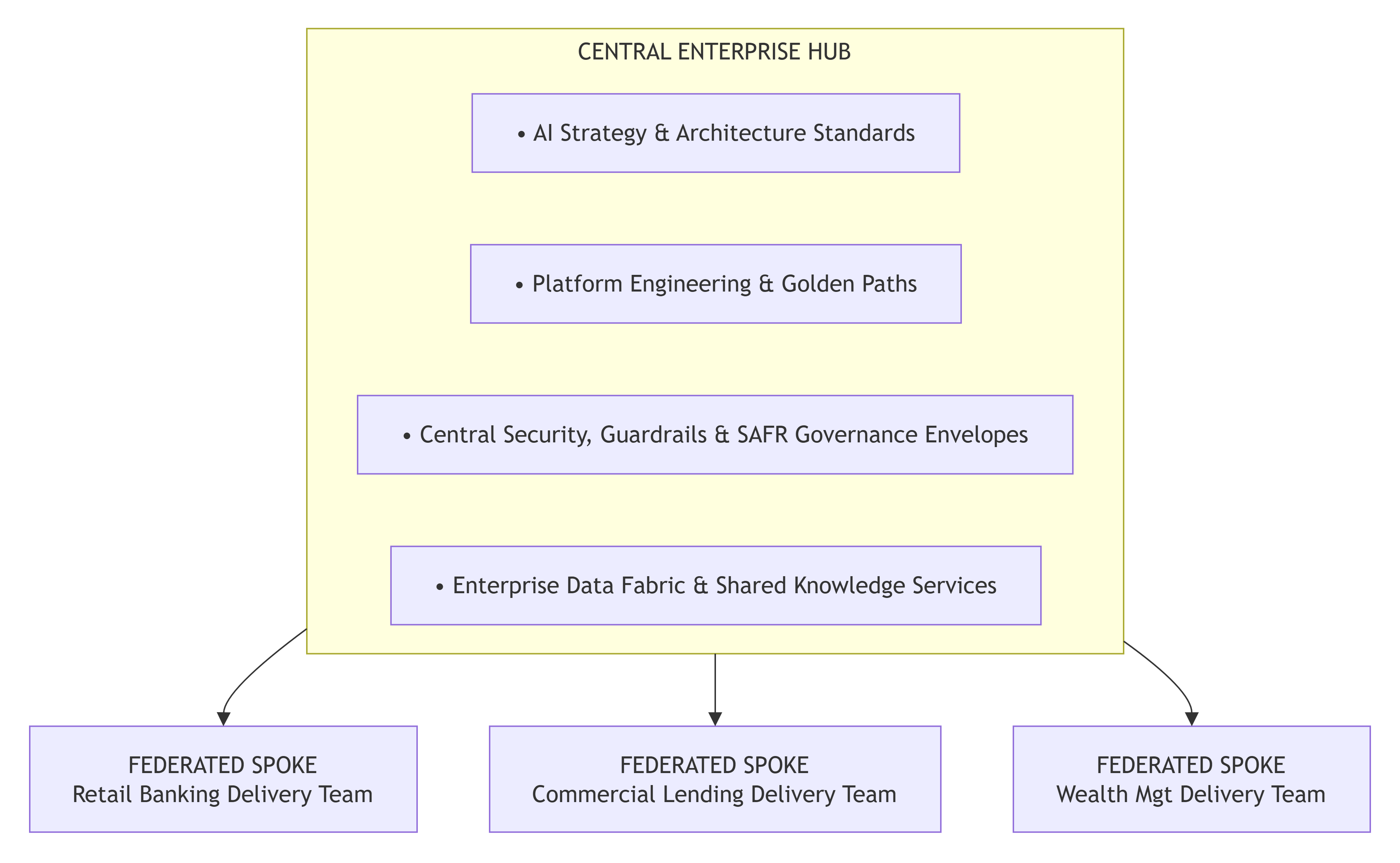
Platform capabilities alone cannot scale AI without an operational model that balances agility with enterprise control. Organizations should move away from pure Centralized Central CoEs (which create bottlenecks) and Fully Federated models (which create duplicate silos) in favor of the Enterprise Hub-and-Spoke Operating Model.
Core Operating Principles:
Centralize what must be common: Guardrails, identity isolation, model routing, audit logging, FinOps attribution, and infrastructure provisioning.
Federate what must be close to the business: Domain logic, specific prompt context, customer workflow design, and business outcome accountability.
Govern by Design, not by Approval: Replace manual review boards with automated CI/CD evaluation gates and automated SAFR governance envelopes.
Strategic Decision Framework: Build vs. Compose vs. Buy
When expanding the enterprise platform layer, engineering leadership must evaluate capability sourcing through a three-tier decision matrix:
When expanding the enterprise platform layer, engineering leadership must evaluate capability sourcing through a three-tier decision matrix:
Strategy | When to Use | Key Strengths | Strategic Trade-off | Enterprise Examples |
BUILD | Capability creates direct, proprietary market differentiation. | Complete operational control and custom IP generation. | High ongoing maintenance cost and engineering overhead. | Domain-specific proprietary algorithms, specialized multi-agent orchestrators. |
COMPOSE | Capability requires connecting multi-cloud platforms, legacy systems, and specialized models. | High architecture flexibility and vendor lock-in mitigation. | Integration complexity and cross-system maintenance. | GraphRAG pipelines, dynamic model gateways, hybrid search integrations. |
BUY | Capability is standardized across the industry with minimal differentiation. | Instant deployment, reduced time-to-value, lower initial overhead. | Higher long-term token pricing and vendor dependency. | SaaS Copilots, commodity foundation models, turnkey PII masking services. |
Strategic Execution Plan
Transitioning from fragmented AI projects to a business-driven Enterprise AI Platform should follow a phased 4-stage execution roadmap:

Phase 1: Anchor on High-Value Business Cases (Months 1 – 3)
Identify 2–3 high-impact business use cases (e.g., real-time fraud detection, automated credit underwriting, or dynamic customer servicing).
Establish baseline metrics for target business value, token costs, and acceptable risk profiles.
Phase 2: Standardize Core Control Planes (Months 4 – 6)
Implement ingress identity controls (Capability 1) and in-line perimeter guardrails (Capability 2).
Deploy a Dynamic Model Gateway (Capability 3) to prevent vendor lock-in and optimize token spend.
Stand up a central prompt asset registry (Capability 4).
Phase 3: Platformize & Build Self-Service Golden Paths (Months 7 – 12)
Formalize the Unified Data Fabric with GraphRAG and streaming ingestion (Capability 5).
Stand up automated LLMOps evaluation pipelines (Capability 7) and secretless GitOps workflows (Capability 10).
Establish the Enterprise Hub-and-Spoke operating model to enable federated delivery teams.
Phase 4: Autonomize through Governed Multi-Agent Systems (Months 12+)
Deploy Agentic & Neuro-Symbolic orchestration engines (Capability 6).
Implement policy evaluation engines with MAS SAFR envelopes (
AUTO_EXECUTE,ESCALATE,DENY) (Capability 9).Integrate real-time FinOps attribution to continuously measure compute efficiency against business outcomes.
Conclusion
Building an Enterprise AI Platform is not about standing up infrastructure ahead of demand—it is about engineering a repeatable foundation that powers continuous business value.
By grounding platform investments in real-world business use cases, technology leaders can avoid the trap of unconstrained complexity and rising costs. Anchoring architecture around reusable, governed, and composable capabilities ensures the organization can scale safely from early pilots to autonomous enterprise operations.