
Escaping “Framework Fatigue”: The Full-Lifecycle Architecture for Production AI Engines
Every week brings another wave of groundbreaking research papers—new memory representations, automated agent harness optimizers, model-routing studies, and long-horizon execution loops.
For enterprise engineering leaders, this rapid influx creates a critical challenge: How do we convert raw academic breakthroughs into a coherent, production-ready system architecture without rewriting our core platform every quarter?
The answer lies in stepping back from individual papers and designing a Whole-System Production Ecosystem. Academic research addresses isolated components of the execution lifecycle. By mapping these breakthroughs to explicit operational layers, enterprise teams can integrate bleeding-edge research into a stable, maintainable production platform.
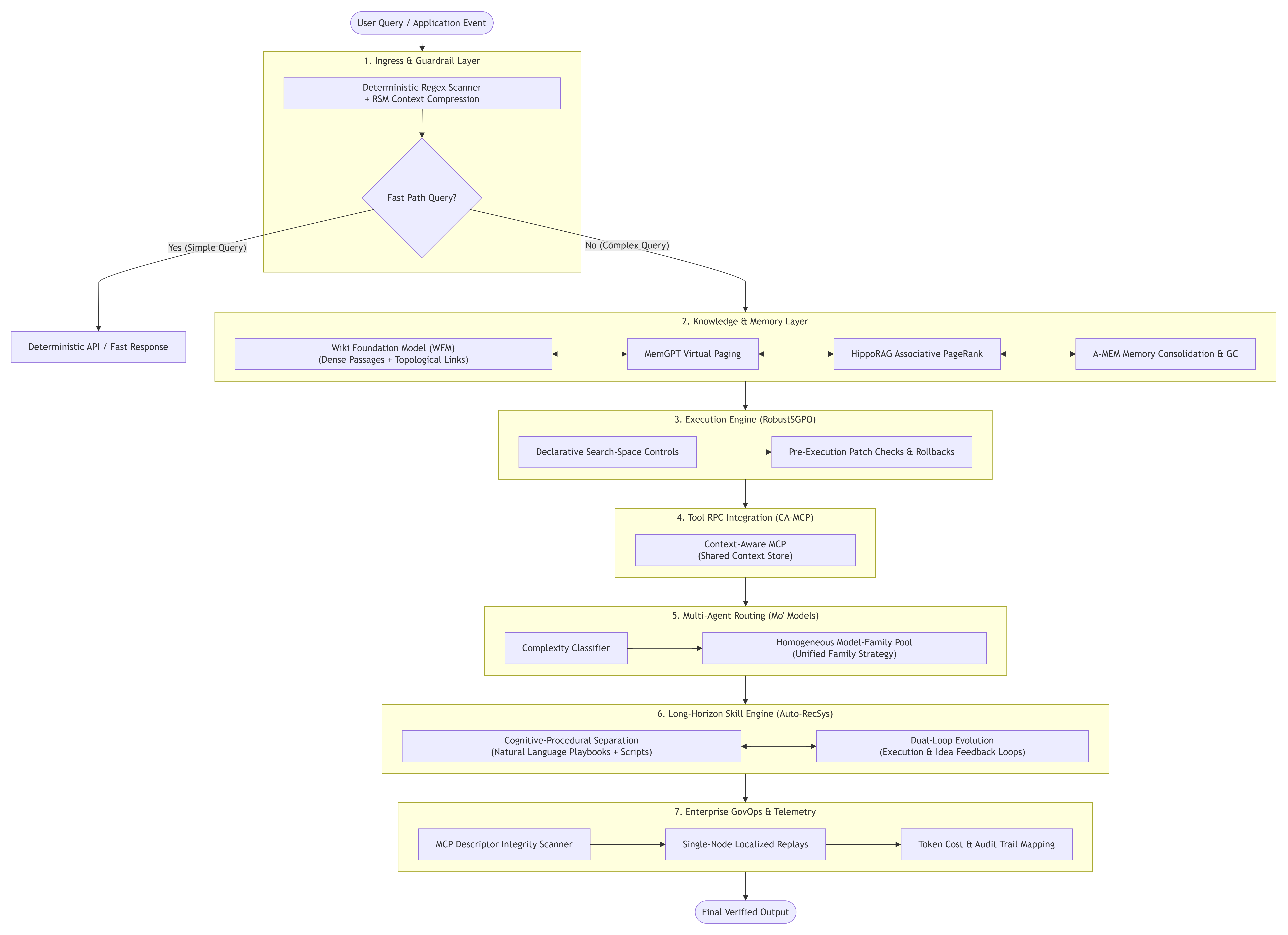
1. The Ingress & Guardrail Layer (Fast Perimeter Execution)
Before an incoming request ever reaches a multi-agent harness or deep-reasoning model, it must pass through a low-latency perimeter layer.
The Problem: Passing raw human prompts directly into agentic loops causes severe token bloat, exposes systems to prompt injection, and inflates API costs.
The Production Solution: Implement deterministic, fast-path perimeter checks < 100ms or under 100 ms combining sub-10ms regex/heuristic scanners with token-packing algorithms like Redundant Syntax Minimization (RSM).
Ecosystem Role: Decouples perimeter security and context compression from reasoning logic. Simple queries bypass heavy reasoning entirely, routing straight to deterministic APIs or fast-path models.
2. The Knowledge & Memory Layer: Stateful Consolidation & Associative Retrieval
Research Anchors: WFM / Wiki Foundation Model (Tencent & Monash), MemGPT (UC Berkeley), HippoRAG (Ohio State Univ), and A-MEM
The Problem: Traditional Vector RAG loses multi-hop relationships, while traditional GraphRAG strips out dense textual nuances into hyper-sparse triples. Furthermore, unmanaged agent memory suffers from "context rot"—where historical noise and conflicting past states accumulate over time, degrading reasoning accuracy.
The Production Solution: Migrate from isolated vector databases to an Agent-Native Wiki Topology coupled with a Three-Tier Stateful Memory Hierarchy.
How to Implement:
Agent-Native Wiki Topology (WFM): Maintain a persistent knowledge layer where dense document passages remain first-class nodes linked directly to topological graph entities via continuous dual-space embeddings.
Working Memory & Virtual Paging (MemGPT): Treat the immediate context window as active RAM, using explicit self-directed function calls to page context in and out of external persistent storage.
Associative Graph Retrieval (HippoRAG): Traverse multi-hop connections across historical sessions using dual-space embeddings and Personalized PageRank (PPR) algorithms modeled after hippocampal indexing.
Memory Garbage Collection (A-MEM): Run asynchronous background jobs to summarize execution histories, update outdated state keys, decay low-relevance memory nodes, and consolidate raw logs into higher-level abstractions.
Ecosystem Role: Serves as the agent’s persistent, self-cleaning long-term memory. Rather than re-retrieving context or suffering from context window bloat, agents navigate a structured, continuous wiki graph with bounded message-passing overhead and automatic state pruning.
3. The Execution Layer: Search-Space Bounded Harnesses
Research Anchor: RobustSGPO (Wuhan Univ & Kuaishou)
The Problem: Self-improving agents, meta-prompting loops, and automated tool-builders often fail in production because they make unconstrained, out-of-scope edits across system boundaries.
The Production Solution: Implement Declarative Search-Space Controls.
How to Implement: Treat agent prompts and tool definitions as version-controlled code artifacts. When allowing an agent loop to adapt or optimize its own execution harness, enforce strict, multi-step permission checks:
Edit Scope Pre-declaration: Restrict modifications strictly to local instructions or specific node parameters.
Patch Checking: Validate generated edits against invariant rule-sets before execution.
State Rollbacks: Maintain explicit snapshot checkpoints to fall back gracefully if candidate attempts degrade quality.
- Ecosystem Role: Acts as the safe sandbox for System 2 execution, preventing dynamic prompt drift and bounding token budgets during dynamic task execution.
4. The Integration & RPC Layer: Context-Aware Model Context Protocol (CA-MCP)
Research Anchor: CA-MCP / Context-Aware Model Context Protocol (Jayanti et al., 2026)
The Problem: Standard Model Context Protocol (MCP) implementations create major orchestration bottlenecks because a central LLM must repeatedly re-send full conversation histories and context to stateless tool servers on every single JSON-RPC call. This results in context loss, high token costs, and high latency.
The Production Solution: Implement CA-MCP with a Shared Context Store (SCS).
How to Implement:
Decoupled State Management: Deploy a shared context layer (e.g., Redis or shared memory) where external MCP tool servers can read and write execution context asynchronously.
Direct Server Context Sync: Allow specialized tool servers to pull needed state directly from the Shared Context Store without requiring the primary LLM planner to serialize context into payload parameters.
Ecosystem Role: Acts as the high-throughput RPC layer connecting agentic reasoning loops to enterprise tool ecosystems, eliminating redundant LLM context-passing overhead and driving down tool execution latency.
5. The Multi-Agent Routing & Pool Selection Layer
Research Anchor: Mo' Models, Mo' Problems (NVIDIA & Univ of Copenhagen)
The Problem: Teams often build multi-agent systems by throwing disparate, heterogeneous models into a mesh (e.g., mixing small local models with various closed-source APIs), assuming model diversity improves accuracy. In reality, arbitrary candidate expansion introduces system instability and frequently performs worse than a single top-performing base model.
The Production Solution: Standardize on Homogeneous Model-Family Pools.
How to Implement:
Before-Generation Routing: Use a lightweight classifier to route tasks based on query complexity rather than broadcasting queries to multiple disparate model families.
Ensemble Strategy: When multi-agent collaboration or majority voting is required, select instances within the same model family (e.g., scaling across parameter sizes within a single family architecture).
Ecosystem Role: Maximizes multi-agent system stability, controls latency variance, and ensures predictable API billing across heterogeneous enterprise workloads.
6. Long-Horizon Execution & Skill Evolution
Research Anchor: Auto-RecSys (Meta & UIUC)
The Problem: Enterprise tasks spanning long horizons (e.g., multi-day workflows, distributed GPU training, complex data pipelines) fail due to long feedback loops, fragile infrastructure dependencies, and context loss across sessions.
The Production Solution: Enforce Cognitive-Procedural Separation and Dual-Loop Skill Evolution.
How to Implement:
Cognitive vs. Procedural Division: Natural-language "skill playbooks" guide high-level LLM planning, while strict, deterministic scripts execute actual environment operations to guarantee operational correctness.
Dual-Loop Memory:
Execution Evolution Loop: Captures runtime execution traces, isolates failure points, and crystallizes successful pipelines into versioned operational playbooks.
Idea Evolution Loop: Evaluates task outcomes to inform high-level strategy and next-step ideation.
Ecosystem Role: Enables persistent, fault-tolerant execution across long-horizon tasks, allowing the system to accumulate organizational memory and become more reliable as playbooks mature.
7. The Operational Layer: GovOps, Telemetry, and Granular Repair
A platform ecosystem is incomplete without continuous observability and programmatic governance.
Targeted Node Repairs: When a multi-step agent DAG fails, avoid resetting the entire workflow. Combine execution traces from the harness with Wiki Graph nodes to isolate the exact step that failed, triggering localized, single-node retries.
FinOps & Token Attribution: Map token consumption directly to specific execution layers (Perimeter Scans, Graph Traversals, System 2 Reasoning, Routing Decisions, and Long-Horizon Playbook Loops) to maintain continuous visibility over platform costs.
Programmatic Compliance: Enforce enterprise governance guardrails at the state boundary—verifying data handling policies before execution traces are stored in long-term memory.
Summary Architecture Blueprint
Ecosystem Layer | Primary Function | Research & Engineering Paradigm | Operational Benefit |
1. Ingress Guardrails | Fast perimeter check, PII redact, token compression | Deterministic Regex + RSM Compression | Sub-100ms latency, reduced base token usage |
2. Memory & State | Wiki topology, virtual paging, associative retrieval, state GC | WFM + MemGPT + HippoRAG + A-MEM | Structured multi-hop state; multi-session persistence without memory rot |
3. Harness Execution | Safe, self-correcting agent execution loops | Search-Space Control (RobustSGPO) | Prevents agent drift, caps optimization costs, ensures valid patches |
4. Tool Integration (RPC) | Decoupled context passing across tools | Context-Aware MCP (CA-MCP) | Eliminates redundant context payloads, reduces tool execution latency |
5. Orchestration / Pool | Model selection, multi-agent collaboration | Homogeneous Model Pools | Avoids routing degradation, improves system stability |
6. Long-Horizon Loops | Skill crystallization & async task execution | Cognitive-Procedural Playbooks (Auto-RecSys) | Persistent execution across failures; dynamic playbook maturation |
7. Platform GovOps | Tool metadata security, failure recovery, cost attribution | MCP Metadata Vetting + Single-Node Replays | Prevents metadata attacks, lowers re-computation costs, ensures auditability |
Executive Takeaway
Rather than treating every new research breakthrough as a prompt for a total architecture redesign, engineering leaders must view new academic findings as modular upgrades to specific platform layers:
Memory & State Layer: Upgrade traditional vector stores using Wiki Graphs (WFM), virtual context paging (MemGPT), hippocampal associative networks (HippoRAG), and self-evolving Zettelkasten note-linking with background pruning (A-MEM).
Execution Engine Layer: Upgrade agent harness loops with explicit declarative search-space scope controls (RobustSGPO) to contain agent drift and bound optimization budgets.
RPC & Integration Layer: Upgrade tool communication using Context-Aware Model Context Protocols (CA-MCP) to eliminate redundant state serialization over JSON-RPC.
Orchestration & Routing Layer: Upgrade agent routing by consolidating multi-agent workflows around homogeneous model family pools (Mo' Models) to stabilize system latency and quality.
Long-Horizon Skill Layer: Upgrade asynchronous execution using cognitive-procedural playbooks (Auto-RecSys) that separate natural language strategies from deterministic code scripts.
This layer-decoupled approach allows enterprise teams to continuously integrate state-of-the-art AI research into a stable, cost-effective, and production-ready platform.